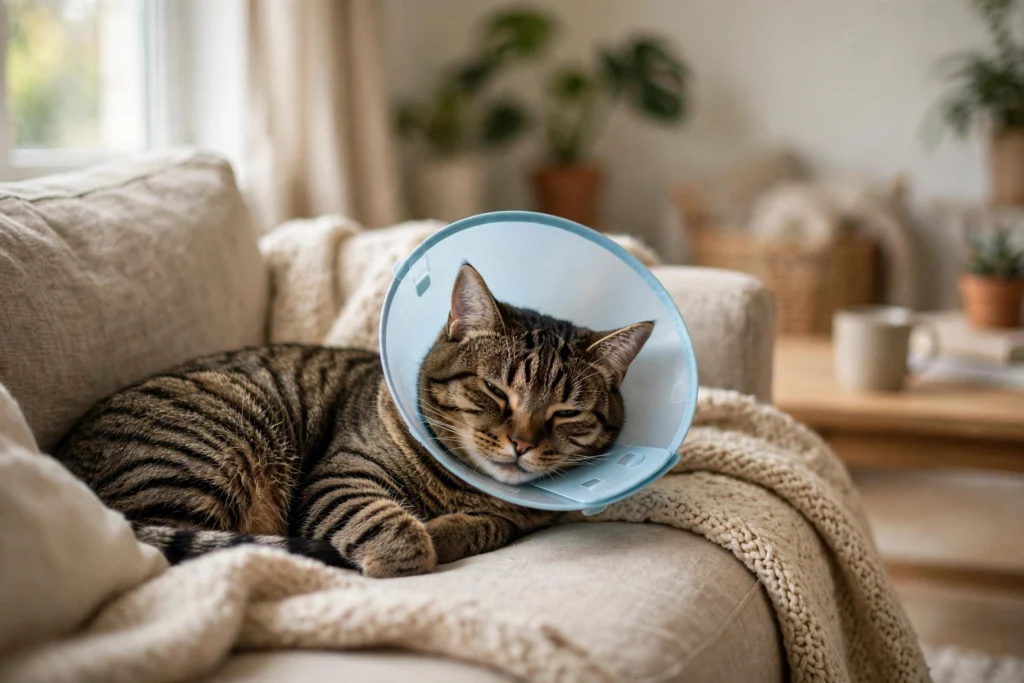

It is almost never too late to neuter a cat. There is no fixed upper age limit: a healthy cat can be neutered as a kitten, as an adult, or well into his senior years. What changes with age is not whether the surgery can be done, but how carefully your vet checks him first.
This guide explains the ideal age to neuter, what extra screening older cats need before anesthesia, the benefits you can still expect at any age, and the honest truth about behavior changes in a cat who has been spraying or fighting for years.
Is there an age limit for neutering a cat?
No. Vets do not work to a rule like “too old after five” or “too old after ten.” Neutering is a short, routine surgery, regularly performed on adult and senior cats, including cats adopted as adults whose history is unknown. The real question is never the birthday on its own. It is whether that individual cat is healthy enough for a brief anesthetic.
That is why the process for an eight-year-old cat looks a little different from the process for a five-month-old. Before booking an older cat in, your vet will usually want an exam and blood tests to check the organs that handle anesthesia, especially the kidneys and liver. If those results are good, age alone is not a reason to say no.
The same applies to females. Spaying an older female is a bigger operation than neutering a male, but it follows the same principle: screening first, then surgery if she is fit. In fact, older unspayed females carry a real risk of pyometra, a life-threatening womb infection, which is one reason vets often recommend spaying even later in life. VCA Animal Hospitals notes that spaying removes the risk of that infection entirely, along with ovarian and uterine cancers.
What is the ideal age to neuter a cat?
If you have a kitten, earlier is simpler. Most vets recommend neutering by about five months of age, before puberty: the surgery is quick, recovery is fast, and spraying, roaming, and unwanted litters are prevented before they start.
But “ideal” is not the same as “only.” Here is how the picture changes by life stage:
| Life stage | Age | What to expect |
|---|---|---|
| Kitten | Up to about 5 months | The standard recommendation. Fast surgery, fastest recovery, behavior problems prevented rather than managed. |
| Young adult | 6 months to 2 years | Still very routine. Puberty has arrived, so spraying and roaming may have started, but habits are usually not deeply set. |
| Adult | 2 to 7 years | No problem at all for a healthy cat. Your vet may suggest bloodwork as a baseline, and learned behaviors may soften rather than vanish. |
| Senior | 7 years and older | Still possible with proper screening. Pre-anesthetic blood tests and closer monitoring are standard, and recovery may take a little longer. |
If your cat is past the kitten stage, do not read that table as missed deadlines. Every benefit below still applies — they are a reason to book now rather than later.
What changes when you neuter an older cat?
The surgery itself is the same at every age. What changes is the preparation and monitoring around it.
A pre-surgery exam. Your vet will listen to your cat’s heart and lungs, check his weight and teeth, and ask about appetite, drinking, and any changes you have noticed. A heart murmur or unexplained weight loss does not automatically cancel surgery, but it does mean more checks first.
Bloodwork. For senior cats, pre-anesthetic blood tests are standard rather than optional. They show how the kidneys and liver are working, check for anemia, and can pick up hidden problems such as early kidney disease or an overactive thyroid, both common in older cats and both important for planning safe anesthesia.
Tailored anesthesia and monitoring. With blood results in hand, the vet can choose anesthetic drugs and fluid support that suit your cat’s organs, and monitor heart rate, breathing, blood pressure, and temperature throughout — how modern clinics keep a routine operation safe for a cat in his teens.
Weight management. Overweight cats heal more slowly and carry slightly more anesthetic risk. If your cat is heavy and there is no urgency, your vet may suggest slimming him down a little first.
What are the benefits of neutering at any age?
Some benefits of neutering shrink with age, but none of them disappear completely:
- No unwanted kittens. An unneutered male can father litters for his whole life. One escape is all it takes, at any age.
- Less roaming. Neutering removes most of the drive to wander in search of females, which means less exposure to traffic, predators, and getting lost.
- Less fighting. Intact males fight for territory and mates. Fight bites cause abscesses and spread incurable diseases such as FIV and FeLV. VCA Animal Hospitals points out that these bite-spread diseases are more common in unneutered males.
- Calmer home life. Neutering greatly reduces the strong smell of an intact male’s urine, and usually reduces spraying.
- No testicular cancer. Removing the testicles removes that risk completely, and lowers the chance of prostate problems.
- A longer, quieter life at home. A cat that is not driven to roam and fight is simply exposed to fewer dangers, whatever his age.
For females, spaying later in life still removes the risk of pyometra and womb and ovarian cancers. The one benefit that does fade with time is breast cancer protection: it is strongest when a female is spayed before her first heat, so it is a reason to act young, not a reason to give up on an older cat.
Will neutering an older cat stop spraying and fighting?
This is where honesty matters. Neutering removes the hormones behind spraying, roaming, and fighting, so most cats improve a lot. But behavior that has been practiced for years can become partly a habit, not just a hormone response.
VCA’s guidance on neutering makes the point plainly: the longer a male cat has sprayed and fought before neutering, the less certain it is that surgery alone will end those behaviors completely. A cat neutered at five months usually never starts spraying. A cat neutered at six years will very likely spray less, with weaker-smelling urine, and roam and fight less — but the habit may not vanish entirely.
What helps alongside surgery:
- Clean old spray spots with an enzymatic cleaner, so the scent does not invite remarking.
- Keep litter trays clean and plentiful, one per cat plus one extra.
- Give an anxious cat safe hiding spots and a predictable routine, since stress spraying is not purely hormonal.
- Ask your vet about behavior support if spraying continues after a few months.
Expect the hormonal changes to settle over a few weeks. Do not judge the result on day three.
How does recovery differ for young and older cats?
Kittens often act as if nothing happened by the next day. Adult cats usually need two or three quiet days. Senior cats can take a bit longer to shake off the anesthetic and may sleep more for the first 24 to 48 hours. In all cases, expect about 10 to 14 days before the incision is fully healed and normal activity resumes.
For an older cat, watch these points during recovery:
- Appetite. Many cats skip a meal after surgery. If your cat is still not eating after 24 hours, read our guide on why a cat won’t eat and call your vet, especially for a senior cat, who should not go long without food.
- The incision. Check it twice a day. Mild swelling is common. Redness, discharge, opening of the wound, or your cat licking at it despite a cone needs a vet call.
- Activity. Keep him indoors, limit jumping, and use the cone or recovery suit for the full period your vet advises, even if he hates it by day two.
- Warmth and rest. Older cats feel the cold more after anesthesia. A warm, quiet room with his bed, water, and litter tray nearby is ideal.
When might a vet delay neutering?
Occasionally a vet will postpone rather than refuse. Common reasons include:
- An active illness. A respiratory infection, fever, vomiting, or diarrhea should be sorted out first. Anesthesia on a sick cat is riskier, and routine surgery can wait a week or two.
- Uncontrolled health conditions. Heart disease, diabetes, or thyroid problems may need stabilizing before an elective operation.
- Severe obesity. Your vet may set a weight target first, because fat makes both anesthesia and healing harder.
- Problems found on bloodwork. If screening shows kidney or liver issues, the vet may adjust the plan, add fluid support, or, rarely, decide the risk outweighs the benefit.
A delay is not a dead end. It is your vet making a routine surgery as safe as it can be for your particular cat.
How much does it cost to neuter an older cat?
There is no single price. Neutering is one of the less expensive cat surgeries because it is quick and the incisions are small, but the total depends on your area, the type of clinic, and your cat’s health. Low-cost clinics charge less than full-service hospitals, and many run programs for adopted and senior cats.
For an older cat, the extra cost is usually not the surgery itself but the screening around it: the exam, blood tests, IV fluids, and closer monitoring. Ask for a written estimate before you book, including pain relief and the follow-up check. It is a modest one-off cost compared with treating a fight abscess or a litter of kittens.
When should you call the vet?
Book an appointment to discuss neutering if your cat is unneutered at any age, and call promptly after surgery if you notice:
- Not eating more than 24 hours after the operation
- Swelling, redness, discharge, or bleeding at the incision
- Repeated vomiting, or straining to urinate with nothing coming out — treat this as urgent
- Extreme sleepiness, weakness, or hiding that gets worse rather than better after the first day
- Your cat has pulled out stitches or will not leave the wound alone
If you are simply unsure whether your older cat is fit for surgery, that is exactly what the pre-op exam and bloodwork are for. Let the tests answer the question instead of guessing from his age.
Conclusion
It is almost never too late to neuter a cat. There is no upper age limit, only a health check: a vet exam and, for seniors, bloodwork to plan safe anesthesia. Neutering a young cat is simpler and prevents spraying and roaming before they start, but an older cat still gains freedom from litters, less roaming and fighting, and lower disease risk. Just expect learned habits to fade gradually rather than disappear overnight. If your cat is intact, whatever his age, the best time to book is now.
Frequently asked questions
Can a 10-year-old cat be neutered?
Yes, in most cases. Ten is senior territory, so your vet will want a full exam and pre-anesthetic bloodwork first. If his kidneys, liver, and heart check out, a healthy 10-year-old can safely have this short surgery.
Is anesthesia dangerous for a senior cat?
Age alone is not a disease, and modern anesthesia with proper screening and monitoring is considered low risk for most healthy senior cats. Blood tests and a tailored anesthetic plan are what keep it that way, which is why vets insist on them for older patients.
Will neutering calm down an older cat?
It usually reduces hormone-driven behavior: roaming, yowling for females, aggression toward other males, and the urge to spray. It will not change his basic personality, and habits learned over years may soften rather than stop completely.
How long does it take an older cat to recover from neutering?
Most cats are themselves within a few days, though seniors may be sleepy for the first 24 to 48 hours. The incision needs about 10 to 14 days to heal fully, with restricted activity and a cone or recovery suit during that time.
Can you spay an older female cat, or is it only neutering?
Yes, older females can be spayed too, with the same screening approach. It is a bigger surgery than neutering, so recovery is a little slower, but it removes the risk of pyometra, a potentially fatal womb infection that becomes more likely as an unspayed female ages.
My cat never goes outside. Is neutering still worth it?
Yes. Indoor intact males still spray, with much stronger-smelling urine, and indoor females still cycle and call. Neutering also protects against testicular cancer in males and pyometra in females — and covers the day he slips out of an open door.



Pingback: Do Indoor Cats Need Vaccines? Yes — These Ones