
No, cats cannot be diagnosed with ADHD. ADHD is a human medical diagnosis, and there is no feline version of it in veterinary medicine. When owners say their cat “has ADHD,” they almost always mean a cat that seems endlessly hyper: racing around the house, unable to settle, distracted mid-play, and wide awake at 3 a.m.
The good news is that most of this behavior is completely normal cat behavior. The important part is knowing where normal energy ends and a real problem begins. This guide explains what owners usually mean by “ADHD” in cats, the real causes behind hyperactive behavior, how to tell normal zoomies from warning signs, and how to help a wired cat burn off energy in healthy ways.
What do owners mean by “ADHD” in cats?
Nobody’s cat has had a formal evaluation. What owners are describing is a cluster of behaviors that look a lot like the human idea of hyperactivity and short attention span:
- The zoomies. Sudden bursts of sprinting from room to room, often after using the litter box or in the evening, sometimes called frenetic random activity periods.
- A very short attention span. The cat begs for play, chases a toy twice, then wanders off — only to demand attention again five minutes later.
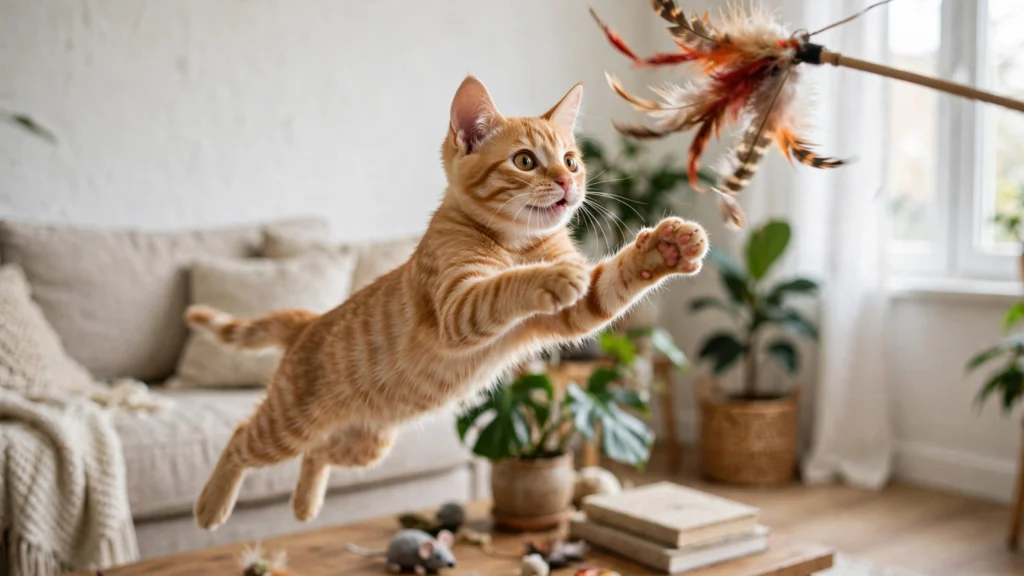
- Impulsive play. Pouncing on feet under the blanket, ambushing ankles from behind furniture, swatting objects off tables just to watch them fall.
- Night-time activity. Racing, meowing, and knocking things over while the household is trying to sleep.
- Restlessness. Pacing from room to room, unable to settle in one spot, startling at small sounds, then tearing off again.
None of these behaviors, on their own, point to a disorder. They are how a healthy, under-exercised predator behaves in a small indoor space. But context matters: the same restlessness in a calm senior cat that has suddenly changed is a different story, and we will get to that below.
Why do cats get the zoomies?
Cats are built for short, intense bursts of effort. In the wild, a cat’s day is a loop of stalking, chasing, catching, and then long naps to recover. Your indoor cat has the same wiring, but often none of the hunting. The stored-up energy has to go somewhere, and it comes out as the zoomies.
Zoomies are most common:
- At dawn and dusk. Cats are crepuscular, meaning they are naturally most active at twilight — prime hunting hours. What looks like midnight madness is often just a cat following its built-in schedule.
- After the litter box. Many cats sprint away after toileting. This is a well-known quirk and nothing to worry about.
- In kittens and young cats. A kitten under two years old is not hyperactive; it is simply young. Kittens play hard, sleep hard, and repeat. Most cats calm down noticeably as they mature, though some stay lively for years.
- In certain breeds. Abyssinians, Bengals, Siamese, and other active or vocal breeds are famously busy. A calm Bengal would be more surprising than a wild one.
In other words, a young cat tearing around at dusk is not a medical case. It is a cat being a cat, in a home that may not yet offer enough outlets for that energy.
What are the real causes of a hyperactive cat?
When a cat seems wired beyond the normal range, there is usually an ordinary explanation. Work through these before assuming anything more serious.
Not enough stimulation
This is the most common cause by far. A cat that sleeps alone in a quiet flat all day, with no play sessions, no window view, no scratching post, and no one to interact with, will invent its own entertainment — and you may not enjoy its choices. Boredom-driven hyperactivity usually fades fast once the cat gets regular play and things to do.
Age and breed
Kittens and young adults are supposed to be busy. Some breeds stay high-energy well into adulthood. If your cat has always been like this, and it is healthy and happy, that is just its personality.
Anxiety and stress
A stressed cat can look hyper rather than withdrawn. Changes like a new home, a new baby, a new pet, builders in the house, or conflict with another cat can produce pacing, night-time restlessness, over-grooming, and sudden sprints. If the hyperactivity started right after a change at home, anxiety belongs high on the list of suspects.
Hyperthyroidism in older cats
This is the one medical cause every owner of a senior cat should know. Hyperthyroidism — an overactive thyroid gland — is common in middle-aged and older cats, and the Cornell Feline Health Center lists hyperactivity and restlessness among its classic signs, alongside weight loss, a bigger appetite, and increased thirst and urination. An older cat that suddenly starts “acting like a kitten again” — losing weight while eating more and racing around at night — should have blood work done. It is treatable, and a blood test confirms it.
Cognitive changes in seniors
Very old cats can develop feline cognitive dysfunction, similar in some ways to dementia in people. The Cornell Feline Health Center notes signs such as altered sleep-wake cycles, staring into space, disorientation, and loud vocalizing, often in the middle of the night. A senior cat that howls at 3 a.m. and seems confused is not “hyper” — it needs a vet check to rule out treatable causes like hyperthyroidism and high blood pressure first.
Pain, itching, and other discomfort
A cat that cannot get comfortable may fidget, shift position constantly, and dash away from touch. Skin irritation, fleas, arthritis, and dental pain can all make a cat restless and irritable in ways that look like hyperactivity from a distance.
Is my cat’s behavior normal or a problem?
Use this table as a rough guide. It cannot replace a vet’s judgment, but it shows the patterns that separate ordinary cat energy from behavior worth investigating.
| Behavior | Usually normal | Worth a vet visit |
|---|---|---|
| Zoomies | Short bursts at dawn or dusk, then the cat settles and sleeps | Constant restlessness; the cat can almost never settle, day or night |
| Attention span | Loses interest in a toy after a few minutes, returns later | Seems unable to focus on anything, frantic and agitated rather than playful |
| Night activity | Active spells in the evening, quieter later at night | New night-time howling or pacing in a senior cat |
| Energy level | Matches the cat’s age; kittens are wild, seniors are calm | A calm older cat suddenly becomes hyperactive |
| Appetite and weight | Steady appetite and stable weight | Eating much more but losing weight, or drinking and urinating more |
| Overall pattern | The cat has always been this way | A clear change from the cat’s normal personality |
The single most useful question is this: is this new? A lifelong whirlwind of a cat is usually just a high-energy personality. A cat whose behavior has changed is telling you something, and that change is what your vet wants to hear about.
How can you calm a hyperactive cat?
If your vet has ruled out medical causes, the fix for most wired cats is a better energy routine, not medication. Cats calm down when their hunting cycle gets completed every day.
- Play on a schedule. Two or three interactive play sessions a day, around 10 to 15 minutes each, with a wand toy your cat can chase, stalk, and “kill.” An evening session an hour or so before bed is the best defense against 3 a.m. zoomies.
- End play the right way. Slow the toy down, let your cat catch it a final time, then offer a small meal or snack. Hunt, catch, eat, groom, sleep is the natural sequence — use it.
- Add feeding puzzles. Scatter meals into puzzle feeders or hide small portions around a room. A cat that works for its food burns mental energy as well as physical energy.
- Build vertical space. Cat trees, shelves, and a window perch give an active cat somewhere legal to climb, survey, and scratch.
- Rotate toys. Put most toys away and swap a few in every couple of days. Old toys become new again, and a bored cat gets interested.
- Keep a predictable routine. Meals, play, and quiet time at roughly the same times each day help anxious and high-energy cats alike, because predictability is calming.
- Do not reward the chaos. If your cat zooms and yowls at night and you get up to feed or play, you have just trained it to do it again tomorrow. Tire the cat out before bed instead, then keep nights boring.
Avoid sedating or “calming” products unless your vet recommends them for your specific cat. Most hyper cats are not anxious patients in need of medication; they are athletes in need of a workout.
When should you see the vet?
Book a visit if any of these fit your cat:
- A sudden change in energy or personality, especially in a middle-aged or older cat
- Restlessness combined with weight loss, a bigger appetite, or more drinking and urinating — the classic hyperthyroidism pattern
- Night-time howling, pacing, or apparent confusion in a senior cat
- A cat that cannot settle even after plenty of play, food, and a calm environment
- Hyper behavior alongside vomiting, diarrhea, or any other physical symptom
- Restlessness with loss of appetite — a cat that is both wired and off its food needs checking promptly; if your cat stops eating altogether, our guide on why a cat won’t eat explains why that should never wait more than 24 to 48 hours
- Repetitive behaviors like obsessive tail-chasing, over-grooming bald patches, or attacking its own tail
Bring notes. When did the behavior start, what time of day is it worst, and has anything at home changed? A short video of the behavior in action is genuinely useful — cats are famous for acting perfectly calm the moment they reach the clinic.
Conclusion
Cats do not have ADHD, and there is no test or diagnosis for it in veterinary medicine. What owners call ADHD is usually a young, healthy, under-stimulated predator doing exactly what cats are built to do: short explosive bursts of energy, followed by long sleeps. Give that cat scheduled play, puzzle feeding, and things to climb, and most “hyper” cats settle within weeks. The cases that deserve a vet are the changed ones — above all the older cat that suddenly becomes restless and loses weight, where hyperthyroidism is a common and treatable cause.
Frequently asked questions
Can cats really have ADHD?
No. ADHD is a human diagnosis, and there is no equivalent condition recognized in cats. Vets do not diagnose ADHD in cats, and there is no ADHD medication for them. What looks like ADHD is almost always normal feline energy, boredom, anxiety, or — in older cats — a medical issue such as hyperthyroidism.
Why is my cat so hyper at night?
Cats are crepuscular, so their natural active hours are dawn and dusk, and many extend that energy into the evening. A cat that has slept all day while you were out will be fully charged at night. A solid play session followed by a small meal an hour before bed usually shifts the wild hour earlier and lets the cat sleep when you do.
Do cats calm down with age?
Most do. Kittens and cats under two are at peak energy, and most cats mellow noticeably through adulthood. Some breeds and individuals stay lively for life. What should prompt a vet visit is the opposite pattern: an older cat suddenly becoming more active than it used to be.
Can boredom really make a cat hyperactive?
Yes, and it is the most common reason for “ADHD-like” behavior in indoor cats. Energy that has no hunting outlet comes out as zoomies, ankle ambushes, and night-time destruction. Regular interactive play and food puzzles fix the cause rather than the symptom.
Should I get a second cat to calm my hyper cat?
Sometimes a suitable companion gives a young, social cat a full-time playmate and helps a lot. But it can also double the chaos or add a stressed, unhappy cat to the home if the match is wrong. Solve play, enrichment, and medical checks first, and adopt a second cat because you want one — not as a guaranteed cure.
Is there medication for hyperactive cats?
There is no medication for feline “ADHD,” because the condition does not exist in cats. Where a vet finds anxiety or a compulsive disorder behind the behavior, they may discuss behavior medication as part of a wider plan. For the typical healthy, bored, hyper cat, play and enrichment are the treatment.