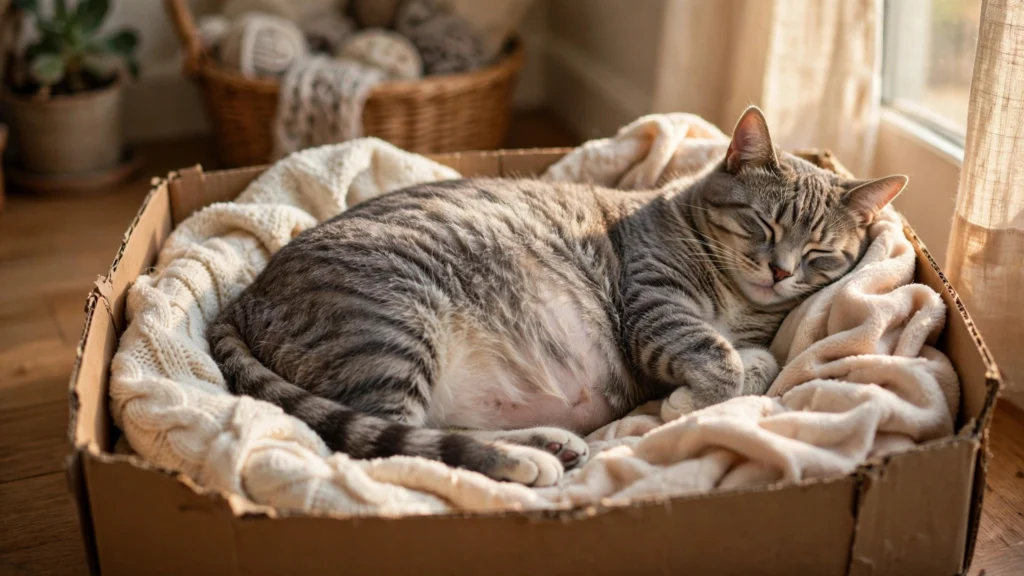

Cats are pregnant for about 63 to 65 days on average — roughly 9 weeks from mating to kittens. VCA Animal Hospitals puts the full normal range at about 64 to 71 days for many cats, and healthy litters occasionally arrive a little outside the average on either side. Count 63 to 65 days from the mating date and you will land very close to the real due date for most queens.
This guide walks through the whole timeline: how vets confirm a pregnancy and pin down a due date, what changes week by week, what can shift the timing, how to spot labor coming, and the warning signs that mean your cat needs a vet urgently rather than a quiet corner.
How do vets count and confirm a cat’s due date?
The clock starts at mating. If you know the day your cat was bred, add 63 to 65 days and mark that as her expected delivery window. Breeders record mating dates for exactly this reason.
The catch is that many owners never saw a mating. A cat that slipped out during a heat may come home already pregnant, with no start date to count from. In that case your vet works backwards from how far along the pregnancy appears to be:
- Palpation. From about two and a half to three weeks, a vet can gently feel the developing kittens through the abdomen, PetMD notes. A check three to four weeks after a suspected mating usually confirms whether a cat is pregnant.
- Ultrasound. Kitten heartbeats can be seen on ultrasound at around three to four weeks, confirming the kittens are alive, though ultrasound is not reliable for counting them.
- X-ray. Once the kittens’ skeletons have calcified, at about six weeks, an X-ray shows how many kittens to expect. Knowing the number matters: on delivery day, it tells you when she is finished — and when a missing kitten is an emergency.
One more wrinkle: because a female can mate more than once during a single heat, and ovulation in cats is triggered by mating itself, kittens in one litter are occasionally conceived a day or two apart. This is another reason due dates are windows, not appointments.
What happens week by week during cat pregnancy?
A cat pregnancy divides neatly into three trimesters of about 20 days each, and the whole thing moves fast. Use this table as your map — PetMD’s stage guide and VCA’s breeding guidance agree on the broad pattern below.
| Stage | What is developing | What you will see | Care at this stage |
|---|---|---|---|
| Weeks 1–2 (days 1–14) | Fertilized eggs travel to the womb and implant around day 12–13 | Nothing. She acts completely normal | Keep her routine, food, and parasite control normal; note the mating date |
| Week 3 (days 15–21) | Embryos are forming; hormones rise | Nipples enlarge and turn pinker (“pinking up”); heats stop | Book a vet check; palpation can confirm pregnancy around now |
| Week 4 (days 22–28) | Kittens’ organs are forming | Some queens feel queasy for a few days and eat a little less | Ultrasound can confirm heartbeats; handle her gently, no rough lifting |
| Week 5 (days 29–35) | Rapid growth; kittens are fully formed in miniature | Belly starts to round out visibly; appetite improves | Switch gradually to a high-quality kitten (growth) food for extra calories and protein |
| Week 6 (days 36–42) | Skeletons mineralize; growth continues | Clearly rounder belly; she rests more | X-ray from about now can count the kittens; keep her indoors |
| Week 7 (days 43–49) | Kittens keep growing and begin to move | You may see or feel kittens shifting in her belly | Keep things calm; free access to food, as her intake climbs well above normal |
| Week 8 (days 50–56) | Final growth; mammary glands develop | Nipples prominent; she grooms her belly more and starts scouting for a nest | Set up a nesting box in a quiet corner and let her get used to it |
| Week 9 (days 57–65) | Kittens are ready to be born | Restlessness, nesting, less appetite, possibly milk at the nipples | Be on standby; keep the vet’s number handy, including out-of-hours |
After birth, expect her food intake to climb even higher while she nurses — VCA notes a nursing mother may eat more than double her pre-pregnancy amount by the end of the nursing period.
What can shift the timing of a cat’s pregnancy?
Not every cat reads the calendar. These factors commonly nudge a due date earlier or later, or make it harder to predict:
- An unknown mating date. The biggest source of “early” and “late” kittens is simply not knowing when day one was.
- Multiple matings. Matings spread over two or three days of a heat can spread conception dates too, widening the delivery window.
- Litter size. Very large litters sometimes arrive a little early; a single kitten may take a little longer.
- The individual cat. Some queens consistently deliver on day 62, others on day 67. A previous litter’s timing is a useful clue for the next one.
- Age and health. Very young, older, or unwell mothers can vary more from the average and deserve closer vet monitoring.
As a rule of thumb, kittens born before about day 58 are premature and may struggle to survive without help, while a cat that passes day 70 with no sign of labor should be examined by a vet promptly.
Can a cat have a false pregnancy?
Yes. Cats are induced ovulators, so a mating that does not result in fertilization — or occasionally ovulation without pregnancy — can send the body into a false pregnancy, also called pseudopregnancy. Her hormones behave much as if she were pregnant for several weeks.
A cat with a false pregnancy may show nesting behavior, mammary development, and even milk production, as PetMD describes — yet there are no kittens. The signs typically fade on their own within a few weeks as hormone levels fall. The only way to be certain is a vet exam: palpation, ultrasound, or X-ray will show whether kittens are actually present. If false pregnancies keep happening and you are not breeding your cat, ask your vet about spaying.
What are the signs that labor is near?
In the last 24 to 48 hours, most queens give clear signals that kittens are coming:
- Nesting. She scratches and rearranges bedding, returns repeatedly to her chosen spot, or suddenly prefers a wardrobe or laundry basket over the box you prepared. Let her choose; move the bedding, not the cat.
- Restlessness. Pacing, following you from room to room, meowing more than usual, and an inability to settle. Some cats go the other way and hide.
- Appetite drop. Many cats stop eating in the last 24 hours before delivery.
- Temperature drop. Her normal temperature is around 100.5 to 102.5°F. A drop below 100°F — often to around 98–99°F — usually means labor will start within about 12 to 24 hours. Only take her temperature if she tolerates it calmly; do not stress a cat in early labor for a reading.
- Grooming and discharge. Frequent licking of her belly and vulva, and a small amount of discharge, are typical as labor approaches.
- Milk. In the final day or two, gentle pressure on the nipples may produce a little milk.
Labor itself starts with stage one: restlessness, nesting, panting, and sometimes vomiting, while the cervix dilates. This stage commonly lasts 6 to 12 hours, and first-time mothers can take longer. Strong, visible straining marks stage two — actual kitten delivery.
When does labor need a vet urgently?
Most cats deliver entirely on their own, and your job is quiet supervision. But call your vet — or an emergency clinic — straight away if you see any of the following:
- Strong straining for more than 30 minutes with no kitten produced
- More than 2 hours of on-and-off labor since the first kitten with nothing more delivered, or a rest of more than about 4 hours between kittens when you know more are coming
- Green, black, or foul-smelling discharge before any kitten is born, or any heavy bleeding at any point
- Stage one lasting more than 24 hours — restlessness and nesting with no progress to straining
- A kitten visibly stuck partway out that she cannot deliver
- She is exhausted, weak, trembling, or in obvious pain
- She passes day 70 of pregnancy with no signs of labor
- A placenta count that falls short of the kitten count once delivery seems finished — a retained placenta can make her seriously ill in the following days
Save your vet’s out-of-hours number in your phone before the due week arrives. If a problem is going to happen, it tends to happen at 2 a.m.
What should you know about the first days after birth?
You do not need to do much — a healthy queen handles feeding, cleaning, and warming her kittens herself. Your role is backup:
- Warmth and quiet. Keep the nest draft-free, warm, and away from household traffic and other pets.
- Check nursing. Kittens should nurse within the first hour or two and mostly sleep between feeds. A kitten that cries constantly or is pushed aside needs help and possibly a vet.
- Feed the mother well. She needs constant access to the same kitten/growth food plus fresh water; nursing is the most demanding stage of all.
- Watch the mother. A little discharge for a few days is normal. Refusal to eat, feverish behavior, ignoring the kittens, or a hot, swollen mammary gland is not — call your vet. A new mother that goes off her food entirely needs checking, just as any cat that stops eating does.
- Book a post-birth check. A vet visit in the first day or two confirms mother and kittens are all well.
And think ahead: an unspayed cat can come back into heat surprisingly soon after giving birth, so discuss spaying timing with your vet if this litter is her last.
Conclusion
A cat pregnancy lasts 63 to 65 days on average — about 9 weeks — with a healthy range that can run a few days either side. The timeline is predictable once it is confirmed: pinking up at week 3, a rounding belly at week 5, kittens countable on X-ray by week 6, and nesting behavior in week 9. Confirm the pregnancy early, feed her for the kittens she is growing, prepare a quiet nest, and learn the short list of labor emergencies by heart. Do those things, and the odds are strongly in favor of an uncomplicated birth and a healthy litter.
Frequently asked questions
How long are cats pregnant in months?
Just over 2 months. The average is 63 to 65 days, which works out to about 9 weeks.
How can I tell if my cat is pregnant without a vet?
The earliest home sign is “pinking up” — nipples that grow larger and pinker around week 3 — followed by a rounding belly from about week 5 and stopping heats. But weight gain and a round belly can also mean other things, and false pregnancy can copy the signs almost exactly. Only a vet exam can confirm it for certain.
Can a cat give birth at 58 days?
Sometimes, but kittens born before about day 58 are considered premature, and their survival chances drop. If your cat shows labor signs well before day 60, call your vet so help is ready if the kittens need it.
How long is a cat in labor?
Stage one — restlessness and nesting while the cervix opens — usually lasts 6 to 12 hours. Once strong straining starts, a kitten typically follows within 30 to 60 minutes, with rests between kittens. A whole litter often takes several hours, and pauses of a few hours between kittens can still be normal.
What if my cat goes past her due date?
A few days either side of day 65 is normal, especially when the mating date is uncertain. If she reaches day 70 with no labor, or she seems unwell at any point, have your vet examine her to check the kittens are still well and not simply too large to deliver.
How soon can a cat get pregnant again after giving birth?
Very soon. Cats can return to heat within a few weeks of delivering, even while nursing. Keep an unspayed new mother indoors and away from unneutered males, and arrange spaying with your vet once the kittens are weaned if you do not plan another litter.