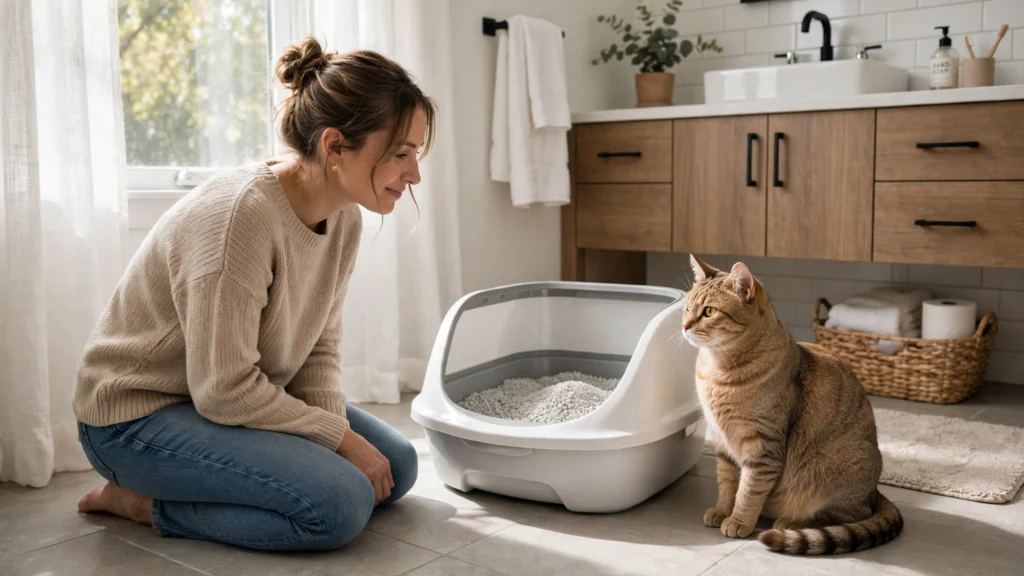

Here is the honest answer first: there is no safe way to make a cat poop instantly, and anyone who promises one is putting your cat at risk. What does exist is a set of gentle home steps that soften the stool and get the gut moving again, usually within a few hours to a day. For a mild, recent case, those steps are often all a cat needs.
Before you try any of them, though, there is one check you must do. A cat straining in the litter box is not always constipated. Sometimes the cat is trying to urinate and cannot, and that is a life-threatening emergency. This guide starts there, then covers the signs of constipation, the home steps that help, the dangerous remedies, and what your vet can do.
First, rule out a blocked bladder
Constipation and a urinary blockage look almost identical from outside the litter box: the cat crouches, strains, may cry, and produces little or nothing. The difference is what is stuck. A constipated cat cannot pass stool. A blocked cat cannot pass urine, so urine and toxins build up in the body.
PetMD explains that a urinary blockage is most common in male cats, because the male urethra is long and narrow, and can lead to kidney failure and death within 24 to 48 hours untreated. This is not a “wait until tomorrow” problem.
Stop and go to an emergency vet now if your cat strains repeatedly and produces little or no urine, cries while trying to use the box, makes constant trips with nothing to show for it, licks its genitals over and over, vomits or hides, or has a firm, painful, swollen belly.
The quickest way to tell them apart: check what is missing from the box. Dry, hard little stools point to constipation. A box with no urine in it, plus a hard, swollen belly, points to a blockage. If you are not sure, treat it as the urinary emergency. A vet can tell the difference in minutes, and with a blockage, minutes matter.
What are the signs of constipation in a cat?
A healthy cat usually passes stool once or twice a day. In constipation, stool becomes dry and hard inside the colon, so it is difficult or painful to push out. The longer it sits there, the harder it gets. Signs to look for:
- Straining in the litter box with little or nothing produced, sometimes crying out
- Small, hard, dry stools that look like pebbles, sometimes passed outside the box
- Going less often than normal, or skipping a day entirely
- Reduced appetite. A full, uncomfortable colon puts many cats off their food. If your cat has stopped eating altogether, read our guide on why a cat won’t eat and call your vet if it lasts more than 24 hours
- Vomiting, low energy, or hiding, which appear when constipation has been building for a couple of days
- A little liquid stool leaking around a hard mass. This looks like diarrhea but actually means solid stool is stuck
One missed stool in an otherwise bright, eating, urinating cat is usually a “start home care and watch” situation. Straining with nothing passed for 24 to 48 hours is a vet visit.
How can you help a constipated cat poop at home?
Work through these steps in order. They are gentle, safe for almost every cat, and together they tackle the main reason stool gets stuck: not enough water in it.
1. Push hydration first
Water is the single most useful treatment for mild constipation. Offer fresh water in several places, not just next to the food bowl. Many cats drink more from a running source, so a pet fountain can help. Stir an extra spoonful of water into your cat’s wet food, and offer the liquid from a tin of tuna in spring water (not brine) as a flavor boost.
2. Switch to wet food
Wet food carries far more moisture than dry kibble, and that moisture softens the stool. If your cat normally eats dry food, replace some or all of it with wet food for a few days, changing over gradually if your cat has a sensitive stomach.
3. Add a little pumpkin
Plain canned pumpkin (100% pumpkin, never pumpkin pie filling, which contains spices and sugar) is a gentle source of soluble fiber. Mix a teaspoon to a tablespoon into your cat’s food once or twice a day. Fiber holds water in the stool and adds bulk, encouraging the colon to push. Start small; too much too fast can cause gas.
4. Get your cat moving
Movement stimulates the gut. Ten to fifteen minutes of gentle play with a wand toy, two or three times a day, helps stool travel through the digestive tract, especially for indoor and older cats.
5. Try a warm compress
A cloth soaked in warm (not hot) water, held gently against your cat’s lower belly for a few minutes, can relax the area and make some cats more comfortable. Never press hard, and stop if your cat objects.
6. Make the litter box easy and inviting
A constipated cat may avoid the box because it now connects it with discomfort. Scoop it more often than usual, keep it in a quiet spot, and put a box where your cat spends most of its time. Older or arthritic cats do better with a low-sided box they can step into without climbing.
Give these steps 12 to 24 hours. If your cat passes stool, keep up the extra water and wet food for a few more days. If nothing has passed after 24 to 48 hours, or your cat seems worse, it is time for the vet.
What should you never give a constipated cat?
This is the most important section in this article. The fastest-acting human remedies are the riskiest of all for cats.
- Never give a Fleet or any sodium phosphate enema. These human enemas can cause life-threatening electrolyte imbalances in cats, including dangerously high phosphate and sodium and low calcium. As PetMD states, never give your cat an enema at home without first consulting a veterinarian, because some types are toxic to cats.
- Never give human laxatives unless your vet has prescribed that exact product and dose for your cat. Some human products are used in cats, but only at cat-specific doses. Guessing the dose can cause severe diarrhea, dehydration, and electrolyte problems.
- Never give mineral oil by mouth. It is easily inhaled into the lungs, where it can cause a serious form of pneumonia, and it does little for a hard, dry stool anyway.
- Never try to remove stool with your fingers or any tool, and never use suppositories meant for humans. You can tear the delicate lining of the rectum and colon. Manual removal is a vet procedure, done under sedation, for a reason.
If you have already given any of these, do not wait for symptoms. Call your vet or an animal poison line straight away.
What causes constipation in cats?
A cat that keeps getting constipated needs the cause treated, not just the stool softened. Common causes include:
- Dehydration. The most common cause of all. When a cat is short of fluids, the colon absorbs even more water from the stool, leaving it dry and hard.
- Hairballs. Swallowed fur can slow things down, especially in long-haired cats during shedding season.
- Obesity and inactivity. A sluggish gut moves slowly, and overweight cats are constipated more often.
- Kidney disease. Common in older cats, it causes ongoing fluid loss, meaning chronic mild dehydration and recurring constipation.
- Pain. Arthritis or an old pelvic fracture can make crouching or pushing painful, so the cat holds on and the stool hardens further.
- Something physically in the way. A growth or swallowed material can partly block the colon.
- Megacolon. With repeated constipation, the colon can stretch and lose its ability to contract. PetMD’s page on megacolon in cats describes how fecal material then accumulates instead of being pushed out, making constipation severe and recurring.
A first, mild episode in a young healthy cat is often just a fluid and fiber problem. Repeated episodes need a vet workup to find the cause.
How does a vet treat a constipated cat?
If home care has not worked, your vet has several options that are both faster and safer than anything available at home:
- Fluids. Rehydrating the cat softens the stool from the inside and is often the first step.
- Prescription laxatives. Your vet may prescribe lactulose, a syrup that draws water into the colon. VCA Animal Hospitals notes that lactulose is used in cats to soften the stool and treat constipation, and usually takes effect within 1 to 2 days. Your vet may instead suggest polyethylene glycol (MiraLAX) at a specific cat dose. These are dose-to-effect medicines, so only use the dose your vet sets.
- A clinic enema. A vet can give a warm-water or cat-safe enema and monitor your cat afterwards. This is the closest thing to fast relief that exists, and it belongs in the clinic, not your bathroom.
- Manual removal under sedation. For a large, hard, stuck mass (called obstipation), the vet will sedate your cat and gently remove the stool, protecting your cat from pain and the colon from damage.
- Treating the cause. Blood tests, X-rays, and an examination help find kidney disease, a narrowed pelvis, megacolon, or another underlying problem. Long-term, recurring cases are often managed with a vet-chosen diet, daily laxatives at a set dose, and sometimes a medicine that helps the colon contract. Do not start any of these on your own.
When should you call the vet?
Call your vet the same day if your cat has passed no stool for 24 to 48 hours despite home care, is vomiting, will not eat, or seems weak or withdrawn. The same applies if you see blood in the stool, your cat cries while straining, or your cat is a kitten, elderly, or has kidney disease.
And go to an emergency vet immediately if your cat is straining and cannot urinate, has a hard swollen belly, or collapses. As covered at the start, that picture points to a blocked bladder, not constipation, and it cannot wait.
How can you prevent constipation in your cat?
Most mild constipation is preventable:
- Feed wet food as at least part of the diet, with a splash of water added
- Keep several fresh water bowls around the home, or use a fountain
- Play actively every day to keep the gut moving and the weight down
- Brush long-haired cats regularly in shedding season
- Keep litter boxes clean and easy to reach: one per cat, plus one spare
- Keep up vet checkups for older cats, so kidney disease is caught early
Conclusion
No safe remedy makes a cat poop instantly, and the products that claim to work fastest, especially human phosphate enemas, are the ones that can seriously harm your cat. Mild constipation usually responds to simple things: more water, wet food, a little pumpkin, some play, and an inviting litter box, often within hours. First, always make sure your cat can urinate, because a blocked bladder looks like constipation and is a true emergency. If nothing has passed within 24 to 48 hours, or your cat is vomiting, not eating, or in pain, your vet can offer real relief safely.
Frequently asked questions
How long can a cat go without pooping?
Most cats pass stool once or twice a day. Missing a single day is usually not an emergency in a cat that is eating, drinking, and urinating normally. If nothing has passed for 48 hours, or your cat is straining or off its food sooner, book a vet visit.
How fast does pumpkin work for a constipated cat?
Pumpkin is gentle, not instant. Mixed into food, it usually helps within 12 to 24 hours. Use plain canned pumpkin, not pie filling, starting with a teaspoon for an average cat.
Can I give my cat MiraLAX or another human laxative?
Only if your vet tells you to, at the exact dose they set. Vets do sometimes use polyethylene glycol (MiraLAX) for cats, but the dose is small and cat-specific. Other human laxatives, and human enemas especially, can be dangerous. Never guess.
Why does my cat keep getting constipated?
Recurring constipation usually has an underlying cause, such as chronic dehydration, kidney disease, obesity, arthritis pain when posturing, hairballs, or megacolon, where the stretched colon can no longer contract properly. Repeated episodes deserve a vet workup.


Pingback: How to Treat a Cat With a Cold: Home Care That Helps