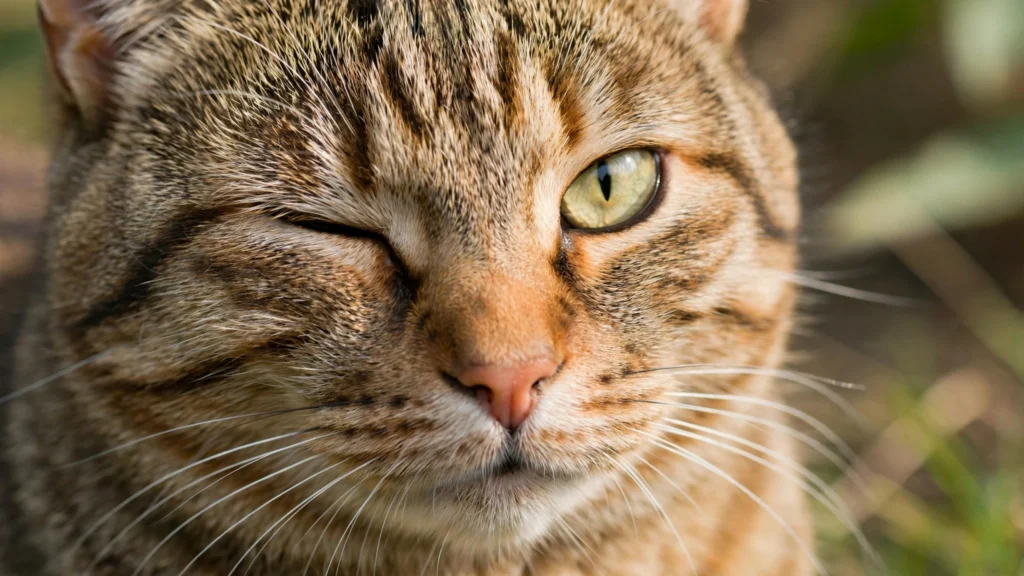

A cat squinting one eye is almost always telling you that the eye hurts. Squinting, called blepharospasm, is a pain and irritation reflex, not a sign of tiredness, and when only one eye is involved the cause is usually something local to that eye: a scratch, something stuck in it, or an infection starting on that side. Because eye problems can worsen quickly, a squint still present after 24 hours needs a vet, and some warning signs mean going the same day.
This guide walks through the common causes of a one-eye squint, how one-eye and both-eye problems differ, what you can check at home, what you should never put in a cat’s eye, and the red flags that make it an emergency.
What does squinting in one eye mean?
Squinting is the eyelid’s protective response. When the eye’s surface or the tissues around it are sore, inflamed, or injured, the eyelid muscles clamp down and the cat holds the eye partly or fully closed. Many cats also show a raised third eyelid (the pale membrane in the inner corner), extra tearing, or pawing at the face.
A squint is a symptom, not a diagnosis: your cat is saying “something is wrong with this eye.” Slow blinks with both eyes are different; that is normal contentment, and the eyes look clear.
What are the common causes of a cat squinting one eye?
Most one-eye squints come from a short list of causes, ranging from minor irritation to conditions that can threaten vision.
Conjunctivitis
Conjunctivitis is inflammation of the conjunctiva, the thin membrane lining the eyelids and covering the white of the eye. The Cornell Feline Health Center describes it as the most common of all feline eye disorders, and lists squinting, frequent blinking, and discharge among its signs. The membrane looks red and swollen, and discharge can be clear and watery or thick and colored. It often starts in one eye and spreads to the other. In cats it is usually driven by infection, most often feline herpesvirus or bacteria such as Chlamydia.
A scratch or ulcer on the cornea
The cornea is the clear front surface of the eye, packed with nerve endings, which is why even a tiny scratch hurts a lot. A claw from another cat, a thorn, or the cat’s own paw can scrape it. If the damage does not heal cleanly, it becomes a corneal ulcer: an open sore on the eye. Signs include strong squinting, tearing, pawing, and sometimes a cloudy patch on the surface. Ulcers are a very common reason for a one-eye squint, and they can deepen fast if infected.
Something stuck in the eye
A grass seed, grit, a loose hair, or dust can lodge on the eye or under the eyelid, and every blink drags it across the surface. The squint usually starts suddenly, with lots of tearing and pawing. Material under the third eyelid is a classic hidden spot, one reason a vet exam matters: the irritant may not be visible from the front.
Upper respiratory infections and herpesvirus
Feline herpesvirus is a very common cause of eye trouble in cats. It is the same virus behind many upper respiratory infections, and it can inflame the conjunctiva and cornea, sometimes causing ulcers shaped like tiny branching lines. Eye signs may come with sneezing and a runny nose; if your cat is also sneezing, our guide on why a cat is sneezing a lot covers that side of the picture. Herpesvirus stays in the body for life and can flare up during stress or illness, so some cats get repeat episodes. It often starts in one eye but commonly involves both in time.
Uveitis (inflammation inside the eye)
Uveitis is inflammation of the uvea, the middle layer inside the eye that includes the colored iris. It is painful and can permanently damage vision if not treated promptly. According to PetMD, squinting and holding the eye closed are common symptoms of uveitis in cats, along with a cloudy look, redness, a pupil smaller than the one in the other eye, a change in iris color, and sensitivity to light. Uveitis often signals a wider problem in the body, so a vet will usually look beyond the eye itself.
Entropion and eyelid problems
In entropion, the edge of an eyelid rolls inward, so fur and lashes rub against the cornea with every blink. The result is constant irritation, tearing, and squinting, sometimes with an ulcer where the rubbing happens. An eyelid injury or a growth on the lid can cause a similar one-sided squint.
A raised third eyelid
Sometimes the first thing you notice is the third eyelid creeping across the eye while the cat squints. That membrane rises when the eye is painful or the cat is unwell. It is a clue, not a cause in itself.
Is squinting in one eye different from squinting in both eyes?
Yes, and the pattern gives useful clues about the cause:
| Pattern | More likely causes | What it suggests |
|---|---|---|
| One eye only | Scratch or ulcer, foreign body, claw injury, early conjunctivitis, entropion, uveitis | A local problem in that eye, with injury and irritation topping the list. Needs a vet promptly. |
| Both eyes | Upper respiratory infection or herpesvirus flare, conjunctivitis in both eyes, allergies or irritants, whole-body illness | An infectious or whole-body cause is more likely. Still needs a vet, especially in kittens. |
| One eye, then the other a few days later | Infectious conjunctivitis, herpesvirus | The infection is spreading between eyes. Watch the second eye closely. |
A one-eye squint after a cat fight or a run through bushes should be treated as a probable injury until a vet proves otherwise.
What can you check at home safely?
You can learn a lot by looking, as long as you do not touch or probe the eye. In good light, compare the two eyes and note:
- How open is it? A slight narrowing is different from an eye clamped shut. Note whether it is improving or worsening.
- Is there discharge, and what color? Clear and watery usually means irritation or a virus; thick yellow or green points more toward infection. Gently wipe away what collects on the fur with a soft cloth dampened with warm water.
- Does the surface look clear or cloudy? A healthy cornea is crystal clear. Cloudiness or a blue-grey haze means going in the same day.
- Are the pupils the same size? A smaller pupil in the squinting eye, or any mismatch, is a warning sign.
- Is the third eyelid showing? Note how much of the eye it covers.
- How is your cat acting? Pawing at the eye, hiding, or loss of appetite all help your vet.
Take a photo in good light to track change. Do not force the eyelids open, pick at the eye, or press on the eyeball.
What should you never put in a squinting eye?
This is where well-meaning owners most often make things worse:
- Never use human eye drops unless your vet has prescribed that exact product for this cat and this problem. Human drops can contain ingredients unsuitable for cats.
- Never use leftover antibiotic or steroid drops from a previous problem. Steroid drops are the big trap: on a cornea with an ulcer, steroids can stop it healing and can even lead to the eye rupturing. The bottle that helped last time can harm this time.
- Never use contact lens solution, homemade salt water, or herbal remedies in the eye. They are not properly sterile and can add infection or irritation.
To clean the area, use a soft cloth dampened with warm water, on the fur around the eye only.
What first aid can you give at home?
No home treatment fixes the causes of a squint, but you can protect the eye until the vet sees it:
- Stop the rubbing. Pawing can turn a small scratch into a deep ulcer. If your cat is going at the eye, put on a recovery collar (cone) and keep it on.
- Keep the cat calm and indoors. Bright light bothers a sore eye, so a quiet, dimmer room helps.
- Do not delay. A squint no better within 24 hours needs an appointment; the emergency signs below mean not waiting at all.
When is a squinting eye an emergency?
Eye problems can move fast, and some cost the cat its vision if hours are lost. Go to a vet the same day, or an emergency clinic, if you see any of these:
- The eye looks bulging or pushed forward, or the cat cannot close the eyelids over it
- The surface turns cloudy, blue, grey, or white
- Blood in or on the eye, or the eye looks torn or collapsed
- The pupil is a different size or shape from the other eye
- Your cat suddenly seems unable to see, bumping into things or missing jumps
- The squint follows a cat fight, claw injury, or any blow to the head or eye
- Thick yellow or green discharge, marked swelling, or the eye is held completely shut in pain
- The squint has lasted more than 24 hours, even if nothing else looks wrong
- The cat is a young kitten with a swollen or sealed eye
What will the vet do?
The vet starts with a close examination of both eyes, often in a dimmed room with magnification. Tests are quick:
- Fluorescein stain. A harmless orange dye that pools in any break in the cornea and glows under a blue light. This is how scratches and ulcers are confirmed.
- Tear production test. A small paper strip measures tears, used if the eye looks dry.
- Eye pressure check (tonometry). High pressure suggests glaucoma; unusually low pressure can fit with uveitis.
- Checking under the lids and third eyelid for trapped foreign material.
Treatment then targets the cause: antibiotic drops or ointment for bacterial infection or to protect an ulcer, antiviral treatment for herpesvirus, pain relief, and sometimes a collar to stop rubbing while the surface heals. Uveitis needs anti-inflammatory treatment and a search for the underlying cause, which may include blood tests. Entropion and deep or non-healing ulcers can need surgery. Most cases improve within a few days, and your vet will usually want a recheck to confirm an ulcer has healed before you stop the drops.
When should you call the vet?
The simple rule: if the eye is still squinting after 24 hours, book a visit. If you see cloudiness, discharge, a pupil difference, or a kitten with a sore eye, do not wait; call the same day. Vets would much rather check an eye that turns out fine than meet one a week late. If unsure, call and describe what you see.
Conclusion
A cat squinting one eye is a cat with a sore eye. The usual culprits are a corneal scratch or ulcer, something stuck in the eye, conjunctivitis, a herpesvirus flare, or inflammation inside the eye, and looks alone cannot separate them. Your job at home is to observe, note the discharge and any cloudiness, stop the rubbing with a collar if needed, and keep human and leftover drops away from the eye. Your vet’s job is to name the cause and treat it. Get a one-eye squint checked within 24 hours, and treat cloudiness, blood, a bulging eye, or a squint after a fight as a same-day emergency.
Frequently asked questions
How long can I wait before taking a squinting cat to the vet?
At most 24 hours, and only if the eye looks clear, there is no discharge or pawing, and the squint is clearly improving. Cloudiness, thick discharge, a known injury, or a kitten means going the same day.
Can a cat’s squinting eye heal on its own?
A trivial irritation, like a single hair that blinks away, can settle within hours. But ulcers, infections, foreign bodies, and uveitis do not reliably heal alone, and some worsen quickly. A persistent squint needs an exam, not watchful waiting.
Can I use human eye drops on my cat?
No. Do not use human eye drops, leftover pet drops, or anything containing steroids unless your vet has prescribed it for this specific problem. Steroid drops on an undiagnosed ulcer can seriously damage the eye.
Why is my cat squinting one eye with no discharge?
A clear, squinting eye with no discharge often points to pain on the surface or inside the eye: a fresh scratch, a small foreign body, early uveitis, or something under the third eyelid. No discharge does not mean it is minor; if it lasts more than a few hours, have it checked.
Is a squinting eye contagious to my other cats?
It can be, if the cause is infectious conjunctivitis or herpesvirus, which spread through close contact and shared bowls and bedding. A squint from an injury is not contagious. Until you know the cause, keep an infectious cat separate and wash hands between handling cats.

Pingback: Can Cats Have ADHD? Hyperactive Cat Behavior Explained
Pingback: How Long Are Cats Pregnant? The 63 to 65 Day Timeline