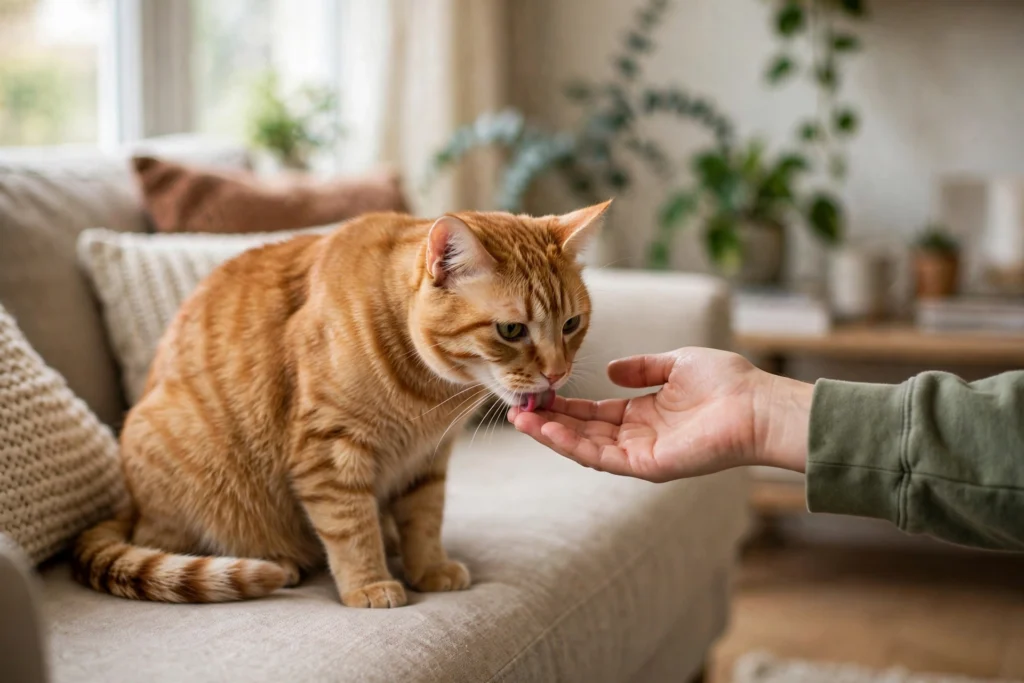

When your cat licks you, it is almost always good news. In most cases, it means your cat treats you as family: cats groom the cats they are bonded with, and your cat is simply including you in that circle. Licking can also be about scent, taste, or attention, and only sometimes is it a sign of stress or a health problem.
That rough, sandpapery tongue can leave owners wondering what message is behind it. This guide explains the 7 most common reasons cats lick people, why a lick sometimes turns into a bite, and how to tell normal, friendly licking from licking that needs a vet visit.
Why is licking such a big deal for cats?
Licking is one of the first things a kitten ever experiences. A mother cat licks her newborns to clean them, warm them, and help them breathe and feed. Kittens grow up associating the feel of a tongue with safety, care, and belonging.
Adult cats keep using licking all their lives. Cats spend a large share of their waking hours grooming — the Cornell Feline Health Center puts it at roughly 30 to 50 percent — and bonded cats spend part of that time grooming each other, not just themselves. When your cat turns that behavior on you, they are using one of their main social tools.
| Type of licking | What you will notice | What it usually means |
|---|---|---|
| Slow, gentle licking | Purring, relaxed body, half-closed eyes, maybe kneading | Affection and social bonding — you are family |
| Licking your hands after cooking or exercise | Focused on fingers, palms, or sweaty skin | Your skin tastes interesting — salt, oils, or food traces |
| Licking, then a soft bite | Skin twitch, tail flicking, ears turning, pupils widening | Overstimulation — your cat has had enough petting |
| Repetitive, hard to interrupt | Tense body, pacing, cat cannot settle, licks you or themselves over and over | Stress, nausea, or discomfort — time to watch closely |
| Licking objects instead of you | Licking plastic, fabric, walls, or the floor | Possible pica — worth a vet check if it keeps happening |
What are the 7 reasons your cat licks you?
Most licking fits one of these seven explanations. Often two or three are true at the same time.
1. Affection and social bonding
This is the most common reason. Cats that live together and get along groom each other on the head, neck, and shoulders — places a cat cannot easily reach alone. Behavior experts call this allogrooming. It strengthens the bond between the cats and calms both of them. When your cat settles on your lap and washes your hand or arm, they are doing exactly the same thing. To your cat, you are not a different species in that moment. You are one of their group, and you are being looked after.
2. Marking you with their scent
Cats live in a world of smell, and group members share a group scent. Licking leaves your cat’s scent on your skin, and your scent on them. Combined with cheek rubbing and head bunting, it is how a cat labels the important things in their life: this one is mine, this one is safe, this one belongs here. If your cat licks you most after you come home smelling of the outside world, scent is very likely the reason.
3. You taste good
Human skin is mildly salty from sweat, and it often carries traces of hand cream, soap, or the food you were just handling. Many cats find that combination genuinely tasty. Licking that starts right after you cook, eat, or exercise, and focuses on your fingers, is usually about flavor rather than feelings.
4. Asking for attention
Cats learn fast. If licking your hand has ever earned strokes, conversation, food, or play, your cat will file it away as a reliable way to start an interaction. This kind of licking often comes with eye contact, a chirp or meow, and it stops happily once you respond. It is the feline version of tapping you on the shoulder.
5. Kitten-like comfort behavior
Some adult cats keep a kittenish habit of licking, sucking, or kneading when they feel completely safe and content. It echoes nursing behavior and tends to appear when the cat is sleepy, warm, and close to a favorite person. Cats weaned very early sometimes show it more. On its own, in a relaxed cat, it is harmless and rather sweet.
6. Stress and self-soothing
Licking releases a small amount of feel-good chemicals in the brain, so cats use it to calm themselves. A cat that licks you much more than usual during a house move, after a new pet arrives, or while guests are visiting may be managing anxiety — their own, using you as the comfort object. The licking itself is not the problem. The stress behind it is what needs attention.
7. A possible medical flag
Occasionally, licking you is a way of saying something feels wrong. Nausea makes some cats lick their lips, drool, and lick people, floors, or fabrics. Pain, itchy skin, and dental problems can also change grooming habits. If the licking is new, intense, or paired with other changes — appetite loss, hiding, vomiting, or weight change — treat it as a symptom, not a quirk, and read the problem section below.
Why does my cat lick me and then bite me?
Few things confuse owners more than a cat that seems to be enjoying a grooming session and then suddenly grabs the hand with its teeth. In most cases, the bite is communication, not aggression.
Petting and grooming build excitement slowly. Cats have a lower tolerance threshold than most dogs, and when the stimulation passes it, the cat ends the session the only clear way they know. The bite is usually gentle, more of a hold than an attack, and the cat often walks away right after.
The warning signs come first, if you know where to look:
- The tail starts to flick or thump
- The skin along the back ripples or twitches
- Ears rotate sideways or flatten
- Pupils widen and the head turns toward your hand
- The purring stops and the body goes still and tense
When you spot two or three of these, stop petting and let your cat decide what happens next. Many lick-then-bite moments disappear completely once owners learn this early cutoff.
A different pattern is play. Young cats especially may lick during a cuddle and then bunny-kick or nip as the mood tips into hunting mode, often triggered by a moving hand under a blanket. That is excitement spilling over, not anger, and it is best answered by calmly redirecting to a toy rather than pulling your hand away fast, which feeds the game.
When is licking a problem?
Friendly licking is brief, relaxed, and easy to interrupt. Problem licking looks different. Book a vet visit if you notice any of the following:
- Compulsive licking. Your cat licks you, themselves, or surfaces over and over, seems unable to stop, and gets agitated when interrupted.
- Hair loss or skin damage. Cornell points out that licking which causes hair loss, bald patches, or extra hairballs is not normal grooming. A rough tongue can abrade the skin, and broken skin can become infected.
- Licking in one focused spot. Focused licking at one area of the body often means that area itches or hurts. VCA Animal Hospitals notes that frequent or sustained licking of the rear or genital area, for example, can signal irritation, infection, or trouble passing urine, and needs checking.
- Licking objects (pica). Repeatedly licking or chewing plastic, fabric, wool, cardboard, or walls is called pica when the cat targets non-food items. It can be linked to boredom, stress, early weaning, or medical problems such as stomach disease, so it should not be ignored.
- Licking plus appetite change. A cat that suddenly licks a lot and also goes off its food may be nauseous or unwell. Our guide on why a cat won’t eat covers the common causes, and a cat that refuses food for more than 24 hours needs a vet.
The pattern to remember: normal licking fits the moment, and the cat can take it or leave it. Problem licking is repetitive, intense, and leaves evidence behind — on the coat, on the skin, or on your furniture.
How should you respond when your cat licks you?
You do not need to stop friendly licking. For most cats it is a bonding moment, and simply letting it happen, or answering with slow strokes and a calm voice, strengthens your relationship.
If the licking gets too much — sandpaper tongues do wear skin down — redirect rather than scold:
- Offer a swap. Slide a toy, a lick mat, or a grooming brush into the moment. Many cats happily transfer the session to being brushed.
- Withdraw calmly. Gently move your hand away and stand up or turn your attention elsewhere. Cats read a quiet exit clearly.
- Never punish. Shouting, pushing the cat away sharply, or spraying water teaches your cat that you are unpredictable. It does not teach them anything about licking.
If stress seems to be driving the licking, look at the home, not just the cat: predictable routines, a quiet resting place, scratchers, and daily play sessions lower the background anxiety that fuels most over-grooming.
When should you call the vet?
Call your vet if the licking is part of a bigger change, in particular:
- A sudden increase in licking you, themselves, or objects, with no clear trigger
- Bald patches, red or broken skin, or frequent hairballs
- Licking paired with drooling, lip-smacking, vomiting, or diarrhea, which can point to nausea
- Licking one body area persistently, or scooting and rubbing the rear on the floor
- Any licking change alongside appetite loss, weight change, hiding, or unusual tiredness
- A cat on medication that starts licking excessively, since nausea is a side effect of several common drugs
Medical causes and stress causes can look identical from the outside, so your vet will usually start with a skin and general exam and ask about diet and recent changes at home before suggesting treatment.
Conclusion
Most of the time, a cat that licks you is paying you a compliment. You are being groomed like family, marked with a trusted scent, and possibly tasted because your skin is interesting. Watch the context: a relaxed cat with soft body language is showing affection, while tense, repetitive, hard-to-stop licking — especially with hair loss or object licking — deserves a vet visit. Learn your cat’s early “that is enough” signals, and even the lick-then-bite habit usually fades away.
Frequently asked questions
Is it safe to let my cat lick me?
On unbroken skin, yes, for most people. A cat’s mouth carries bacteria, so keep licking away from cuts, wounds, and your eyes, and wash your hands and face afterward. Be stricter if anyone in the home has a weak immune system, and do not let your cat lick you after you have applied medication creams.
Why does my cat lick my face or hair?
Faces and hair carry strong scents — sweat, skin oils, shampoo — and cats find them fascinating. Licking your face or hair is usually the same bonding and scent behavior as licking your hand, just aimed at the smelliest, most “you” part of you. Gently redirect to your hand if you would rather keep your face out of it.
Why does my cat lick me in the morning?
Morning licking usually combines several reasons: your cat has missed you overnight, your skin is salty after sleep, and licking you is a very effective alarm clock. If the licking is followed by a trip to the food bowl area, breakfast is part of the message.
Why does my cat lick me but not other people?
Because the behavior is about relationship and routine. You are the person who feeds, plays with, and relaxes with your cat, so you are the one who gets groomed. It is a sign of familiarity, not something other family members should take personally.
How do I stop my cat from licking me so much?
First rule out stress and medical causes, especially if the licking is new. Then redirect: offer a brush session, a toy, or a lick mat, and calmly end interactions when the licking starts. Keep responses boring and consistent. Punishment does not work on cats and usually makes anxiety-driven licking worse.



Pingback: Can Cats Have Seaweed? Safety, Benefits and Risks