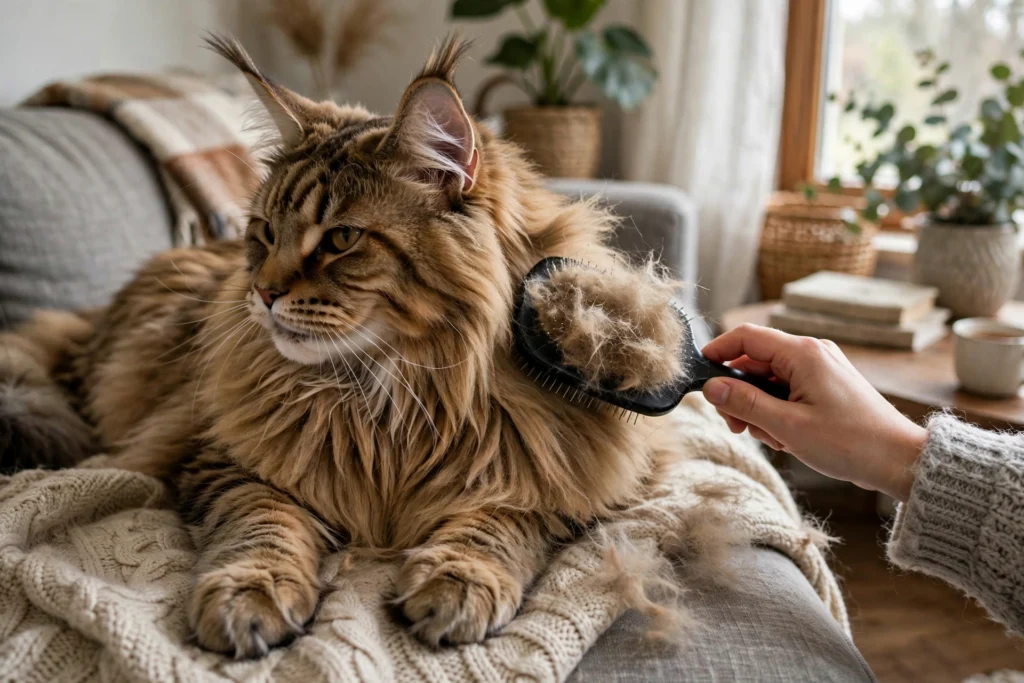

Yes, Maine Coon cats shed — moderately to heavily. They lose a light, steady amount of fur all year round, and then shed much more heavily twice a year, in spring and autumn, when their thick coat changes with the season. The good news is that shedding you can plan for is shedding you can manage: a simple brushing routine of two to three sessions a week keeps most of the fur on the brush instead of on your sofa.
This guide explains how much shedding is normal for a Maine Coon, why their coat drops so much hair, how shedding changes with age and season, and the grooming routine and tools that keep it under control. You will also learn the warning signs that shedding has crossed the line from normal into a health problem.
How much do Maine Coon cats shed?
Compared with the average cat, a Maine Coon sheds a lot — and the fur is unusually visible, because each long hair shows up on clothing and furniture far more than a short-haired breed’s would. Expect a daily dusting of loose hairs on bedding, clothes, and floors, and small tumbleweeds of fur in the corners of hard floors.
Expect this pattern:
- Day to day: light, constant shedding all year. It never fully stops.
- Spring: the heaviest shed of the year, sometimes called a coat blowout, as the dense winter undercoat comes out.
- Autumn: a second heavy shed, as the summer coat makes way for the thicker winter one.
- Indoor cats: the seasons can blur. Constant indoor temperatures and artificial light mean many indoor Maine Coons shed moderately all year with less dramatic peaks.
PetMD’s Maine Coon breed guide notes that these cats have thick coats that need routine grooming to prevent matting and reduce their heavy shedding — in other words, the breed is officially a heavy shedder, and grooming is part of the deal.
Why do Maine Coons shed so much?
It comes down to their coat, which was built for cold Maine winters. A Maine Coon wears a double coat:
- The undercoat is soft, fine, and dense. This is the insulation layer, and it is the layer that sheds in bulk when the seasons turn.
- The topcoat is longer, coarser, and somewhat water-resistant. It protects the undercoat from rain and snow, and gives the breed its shaggy look — uneven in length, with a mane-like ruff around the neck, a very fluffy tail, and tufted ears and paws.
Two layers of hair means roughly two layers of shedding. The undercoat in particular grows in thick for winter and has to come out for summer. Add the breed’s size — this is one of the largest domestic cat breeds, so there is simply more cat, more coat, and more fur per shed — and the total volume is easy to explain.
Shedding itself is healthy and necessary. Hair grows in cycles, old hairs fall out, and new ones replace them. You cannot and should not try to stop shedding. The goal is to collect the loose fur on your brush, before your cat spreads it around the house or swallows it while grooming.
Does shedding change with a Maine Coon’s age?
Yes. Shedding follows the coat through life:
Kittens
Maine Coon kittens are born with a shorter, softer kitten coat that sheds very little. There is not much to manage in the first months — but this is the perfect time to get a kitten used to being brushed, so grooming is normal life later.
Young adults
Maine Coons mature slowly and keep growing for several years, far longer than most breeds. As the adult double coat comes in — typically through the first two to three years — shedding increases, and the dramatic mane, ruff, and britches (the long fur on the back legs) develop. Owners are often surprised that their “low-shedding kitten” becomes a properly fluffy, properly shedding adult.
Adults
A mature Maine Coon settles into the full pattern: steady year-round shedding with heavy spring and autumn peaks.
Seniors
Older cats groom themselves less thoroughly, so loose fur stays in the coat longer and mats form more easily; the management burden shifts more to you. Thinning or dull fur in an old cat can also reflect health changes, not just age, so mention it to your vet.
What is the best grooming routine for a Maine Coon?
The standard advice for this breed — PetMD recommends brushing at home two to three times a week — is the routine that works. Think short and regular rather than rare and heroic:
- Brush 2 to 3 times a week in normal times, for about 10 to 15 minutes.
- Brush daily in spring and autumn while the undercoat is blowing out. Five daily minutes beats one long weekly battle.
- Work in the direction of growth, in sections. Start with a wide-toothed comb to find tangles, then a slicker brush or undercoat rake to pull out loose undercoat.
- Check the friction zones every session: behind the ears, the armpits, the belly, the ruff, and the britches. These mat first.
- End on a good note with a treat or play, especially while your cat is learning the routine.
Never yank a mat out, and never cut one out with scissors close to the skin — cat skin is thin and tears easily, and mats often sit tighter than they look. Tease small tangles apart with your fingers and a comb. For a solid mat, or a coat that has got away from you, a professional groomer is the kind option, not a failure.
Grooming does three jobs at once: it removes loose fur before it lands on your furniture, it prevents the mats that cause far more trouble than shedding, and it reduces hairballs, because fur caught on the brush is fur your cat will not swallow.
Which grooming tools do you need for a Maine Coon?
You do not need a drawer full of gadgets. Four or five well-chosen tools cover everything:
| Tool | What it does | How to use it |
|---|---|---|
| Stainless steel comb (wide and fine teeth) | Finds tangles and mats, works through the ruff and britches | First tool in every session; also your mat detector |
| Slicker brush | Lifts out loose topcoat and light undercoat | Gentle strokes after combing; good for regular sessions |
| Undercoat rake | Reaches through the topcoat to pull out shedding undercoat | The key tool in spring and autumn; use on the body, not the face |
| De-shedding tool | Strips out large amounts of loose undercoat quickly | Short sessions only, in peak season; overuse can damage the topcoat |
| Grooming glove | Picks up loose hair while you stroke your cat | Ideal for cats that dislike brushes, and for quick daily passes in shedding season |
Skip anything with blades marketed for cutting through coats, and be cautious with de-shedding tools: used too often or with too much pressure, they can thin and break the protective topcoat. The rake and comb, used regularly, do most of the real work.
Does diet affect how much a Maine Coon sheds?
Yes. The coat is built from what the cat eats, so skin and coat health — and therefore shedding — track diet quality closely. A Maine Coon shedding excessively on a poor diet often improves noticeably on a better one.
What supports a healthy coat:
- Plenty of quality protein. Hair is protein. A complete, balanced cat food with animal protein as the main ingredient is the foundation.
- Omega-3 and omega-6 fatty acids. These fats support skin health and a glossy coat, and are included in many good cat foods. Fish oil supplements exist, but add them only if your vet agrees — more is not automatically better.
- Fresh water, always available. Hydrated skin sheds more normally. Cats that drink little may do better with wet food or a water fountain.
- No sudden food changes. Switch foods gradually over a week or so. Digestive upsets and stress can both show up as extra shedding.
One caution: no food will stop a Maine Coon from shedding. Diet can fix shedding that is worse than it should be; it cannot cancel the spring blowout.
How can you keep the house manageable?
Alongside brushing, a few habits keep a heavy-shedding breed livable:
- Vacuum with the season. Weekly is fine most of the year; expect to go more often during the spring and autumn peaks, especially on rugs and upholstery.
- Use washable throws on your cat’s favorite sofa spot and bed corner. Shaking out and washing a throw is easier than de-furring a couch.
- Keep a lint roller by the door and one in the car during peak season.
- Brush in one place, where your cat already likes to sit, so stray hairs concentrate there instead of everywhere.
- Wash bedding regularly, yours and the cat’s.
When is Maine Coon shedding not normal?
Shedding, even heavy seasonal shedding, should be even across the body and the skin underneath should look calm and healthy. Book a vet visit if you see any of the following:
- Bald patches or fur coming out in clumps, leaving thin or bare areas
- Itching, scratching, or biting at the skin, redness, scabs, bumps, or flaky skin
- A dull, greasy, or brittle coat that changed noticeably over a few weeks
- Sudden heavy shedding outside the normal seasons, especially with stress, a house move, or a new pet — stress shedding is real, but it is a diagnosis to confirm, not assume
- Shedding paired with other signs such as weight loss, appetite change, lethargy, or drinking much more than usual
The causes behind abnormal shedding include skin allergies and parasites such as fleas, ringworm and other skin infections, hormonal conditions, and poor nutrition. Shedding plus sneezing, watery eyes, or itchy skin often points toward allergies — our guide on why a cat is sneezing a lot covers the allergy side of that picture. The good news is that most causes are very treatable once identified, and a vet can usually narrow it down quickly with an exam and a close look at the skin.
Conclusion
Maine Coons shed moderately to heavily — a little every day, and a lot in spring and autumn when their double coat turns over. That is the honest price of one of the most magnificent coats in the cat world. Fortunately, it is a manageable price: brush two to three times a week (daily at peak season), keep a comb, a slicker brush, and an undercoat rake on hand, feed a good diet, and the fur ends up in your brush rather than everywhere else. Watch for bald patches, itching, or a coat that suddenly changes — those are vet questions, not grooming ones.
Frequently asked questions
Are Maine Coon cats hypoallergenic?
No. Maine Coons are not hypoallergenic. Allergies are triggered mainly by a protein in cat saliva and skin, which spreads onto fur as the cat grooms — and a big, heavy-shedding cat spreads a lot of it around the home. People with cat allergies usually find this breed a poor match.
Do Maine Coons shed more than other cats?
More than short-haired breeds, yes — both in volume and in visibility, because the hairs are long. Among long-haired breeds they are in the normal-to-heavy range. A Persian has a comparably demanding coat, while a Siamese sheds far less.
How often should you brush a Maine Coon?
Two to three times a week is the standard advice, and daily during the heavy spring and autumn shedding periods. Short, frequent sessions are easier on both of you than one long weekly session.
Do Maine Coons shed in winter?
They shed lightly all year, winter included. Winter is actually when the coat is at its thickest, because the dense undercoat grows in for the cold. The big release of fur happens when that winter coat comes out in spring.
Can you shave a Maine Coon to stop shedding?
It is not recommended. The double coat insulates against both cold and heat and protects the skin, and shaved double coats can grow back unevenly. Shaving also does not stop shedding — the shorter hairs still fall. Manage the coat with brushing instead. The one exception is a vet or groomer removing mats that cannot be combed out.
Do neutered Maine Coons shed less?
Spaying or neutering does not change the basic shedding pattern set by the double coat and the seasons. Hormones can influence coat condition slightly, but expect the same grooming routine either way.

Pingback: Are Ragdoll Cats Hypoallergenic? The Honest Answer
Pingback: How Long Does an iPad Last? 5 to 7 Years, Often More