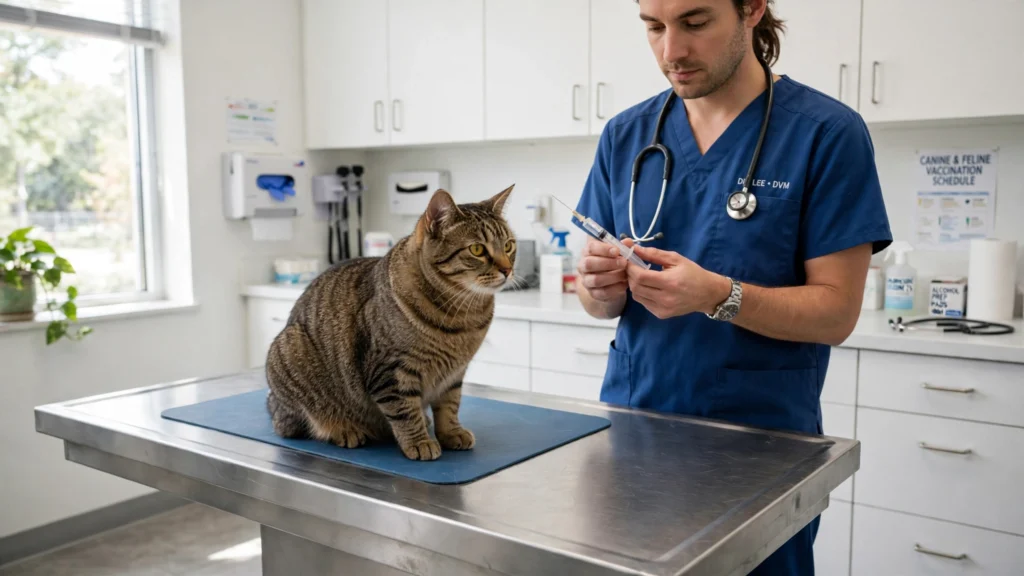

Most cats need a rabies shot every 1 to 3 years as adults. The routine starts with a single first dose as a kitten, usually at 12 to 16 weeks of age, followed by a booster one year later. After that booster, how often the shot repeats depends on the vaccine your vet uses and the law where you live: some vaccines are labeled for one year, others for three.
This guide walks through the full schedule, explains why even indoor cats need this vaccine, and covers what happens if your cat falls overdue or meets a wild animal. Rabies is almost always fatal once signs appear, and there is no cure — so this is the one shot you never want to let lapse.
What is the rabies vaccine schedule for cats?
Unlike some other kitten vaccines, rabies starts with just one dose. According to PetMD’s guide to rabies vaccines for cats, kittens typically receive their first rabies vaccine at about 12 weeks of age. Many vets give it at the 12 to 16 week visit, and the exact minimum age is sometimes set by local law.
The booster a year later is not optional, even with a three-year vaccine. That booster is what locks in long-term protection; only after it does the longer interval begin.
| Stage of life | When the shot is given | What to know |
|---|---|---|
| Kitten, first dose | 12 to 16 weeks old | A single dose. Often given at the last kitten visit, alongside the final kitten boosters. |
| Young cat, booster | 1 year after the first dose | Essential. Skipping it can mean starting over and may leave your cat legally unprotected. |
| Adult cat, maintenance | Every 1 or 3 years | Depends on the vaccine your vet uses and your local law. Your rabies certificate shows the exact due date. |
| Adult cat, never vaccinated | One dose now, booster in 1 year | After the one-year booster, the cat moves onto the normal 1 or 3 year cycle. |
Your vet’s reminder is based on the due date printed on your rabies certificate, so keep that document safe (more on paperwork below).
Why does the interval differ — 1 year vs 3 years?
Both types of vaccine are used in cats. The difference is in how the vaccine is made and licensed, not in how well it works during its labeled period. A one-year vaccine must be repeated every year. A three-year vaccine protects for three years — but only after the kitten dose and the one-year booster have been done properly.
Three things decide which one your cat gets:
- Your vet’s clinic policy. Some clinics stock one type, some offer a choice.
- Local law. Some states, counties, and countries only recognize certain vaccines or require annual vaccination regardless of the label.
- Your cat’s situation. For cats with certain health histories, vets sometimes prefer a specific product.
Never assume a shot “lasts three years” because a friend’s cat got a three-year vaccine. Check your own certificate: if the due date has passed, your cat is legally overdue even if some immunity remains.
Do indoor cats need rabies shots?
Yes. This surprises many owners, but indoor cats need rabies vaccination too, for four good reasons:
- The law usually requires it anyway. In most US states, rabies vaccination is required for all cats over a certain age, indoor or not. Many areas in other countries have similar rules.
- Bats get indoors. A bat in the house is one of the most common rabies exposure routes for indoor cats, and a curious cat can catch or corner one before you notice.
- Indoor cats escape. A door left open or a broken screen — it takes one short adventure outside to meet a raccoon, skunk, or stray animal.
- Life happens. Boarding facilities, groomers, landlords, and airlines commonly require proof of current rabies vaccination.
The vaccine also protects your family and removes legal risk. An unvaccinated indoor cat that bites or scratches someone — even a guest who startles it — can face quarantine or worse under local rules, purely because its status is unproven.
What does the law say about rabies shots for cats?
There is no single worldwide schedule, because rabies law is local. In the United States, requirements are set state by state, sometimes by county or city. Most require cats to be vaccinated by 12 to 16 weeks of age and kept current after that. Other countries vary: some require it for all cats, some mainly for animals crossing borders.
Practical steps that work almost everywhere:
- Ask your vet what your local rule is. Vets work under these laws daily and will schedule your cat to match them.
- Keep the signed rabies certificate. The certificate from the vet — not just a receipt or a tag — is the legal proof. You will need it for boarding, travel, licensing, and after any bite incident.
- Note the expiry date, not just the date given. A shot with a one-year vaccine expires two years earlier than the same visit with a three-year vaccine.
- Moving or traveling? Check the destination’s rules in advance; international travel often needs paperwork arranged weeks ahead.
What happens if your cat is overdue for a rabies shot?
Life gets busy, and boosters get missed. The fix is usually simple: book the booster as soon as you realize. A lapsed cat generally just gets a single booster, and with documented proof of at least one previous rabies vaccine, it is considered current again right away in many jurisdictions.
Do not wait for the next annual checkup if the certificate expired months ago — every week overdue is a week your cat is legally unvaccinated. Call the clinic, tell them the last date on the certificate, and let them set the date. They see overdue cats every week.
If your cat is an adult that has never had a rabies vaccine at all, say so. The schedule is still simple (one dose now, one in a year), but the paperwork and legal status differ from a cat with a vaccine history.
What if your cat is exposed to a wild animal?
This is the situation where vaccination status matters most. A fight with a raccoon or stray, a bat found in the room with your cat, or any bite from an animal you cannot test counts as a possible exposure. Act the same day:
- Keep your cat away from other pets and people, and avoid handling any wound with bare hands.
- Call your vet immediately and describe what happened. Call animal control or your local health authority too if your vet advises it — reporting is often required.
- Follow the official instructions exactly. They depend on your cat’s vaccine status.
The AVMA’s model rabies guidance, which many local rules are based on, sets out the general pattern:
- Currently vaccinated cats get a booster right away and are observed at home for at least 45 days. Any illness in that window must be reported.
- Overdue cats with proof of a past vaccine usually get the same handling: immediate booster, then at least 45 days of observation, though authorities can extend this.
- Never-vaccinated cats face the harshest outcome. Authorities may require a long, strict quarantine — often months — and in some places euthanasia is recommended, because vaccine alone cannot reliably protect an already-exposed unvaccinated animal. The decision rests with the local rabies authority.
This is the strongest reason to keep the vaccine current: an up-to-date cat gets a booster and stays home with you.
What are the side effects of the rabies vaccine in cats?
Most cats show nothing at all, or a quiet day. Mild, short-lived reactions are the common ones, and they typically pass within 24 to 48 hours:
- Sleepiness or less energy than usual
- Eating a little less for a day. If your cat refuses food completely or it lasts beyond a day or two, our guide on why a cat won’t eat explains when to call the vet
- Mild soreness or a small, soft swelling where the injection went in
- A slight fever, usually noticed only as extra napping
Serious reactions are rare, but know the signs. Repeated vomiting, facial swelling, hives, trouble breathing, or collapse in the hours after vaccination is an emergency — go straight back to the vet. A hard lump at the injection site that keeps growing after several weeks should also be checked; a rare type of tumor can form at injection sites in cats, and early checks matter. Mention any past reaction to your vet before every vaccine.
How much does a rabies shot for a cat cost?
Prices vary by clinic and region. PetMD notes that cat vaccinations commonly fall in the $15 to $40 range per vaccine, and the rabies shot often sits at the affordable end — though the total bill can be higher if an examination fee applies. Low-cost clinics, shelters, and community events in many areas offer rabies shots for less, sometimes free. If cost is why your cat is overdue, call around: it is far cheaper than quarantine boarding or fines.
How can you keep track of your cat’s rabies shots?
- Keep the certificate in one known place, and save a photo of it on your phone.
- Put the due date in your calendar with a reminder a month early. Clinic reminders are a backup, not the system itself.
- Share records when you change vets. Without proof of the earlier vaccine, a new clinic may have to treat your cat as never vaccinated.
- Keep the tag on the collar if your cat wears one. It is not legal proof, but anyone who finds your cat can see at a glance that it is vaccinated.
When should you talk to your vet about rabies vaccination?
Most of the time, the annual or three-year wellness visit is all you need. Book a specific conversation if:
- You have adopted a cat with no vaccine records, or records you cannot verify
- Your cat’s certificate has expired — by days or by years
- Your cat fought with wildlife, was bitten, or was in a room with a bat
- Your cat had a reaction to a vaccine in the past
- Your cat is ill or on medication, and you want to agree on timing
Conclusion
The rabies schedule is one of the simplest in cat care: one dose at 12 to 16 weeks, a booster one year later, then a booster every one or three years depending on the vaccine and your local law. Indoor cats need it just as much as outdoor cats — legally, and because bats and escapes do not check whether a cat “never goes out.” Keep the certificate, watch the due date, and you will be glad the paperwork says “current” if your cat ever meets a wild animal.
Frequently asked questions
How long does a rabies shot last in a cat?
Either one year or three years, depending on the vaccine used. Both start with a kitten dose and a booster one year later. Your certificate shows which one your cat had and when it expires.
Can a cat get a rabies shot early, before the due date?
Yes. A slightly early booster is safe and common, for example before travel or boarding. Your vet will set the new due date from the day the shot is given. A few weeks early beats a few weeks late.
Is the rabies vaccine required for cats everywhere?
No. Rules vary by state, county, and country. Most US states require it, some countries require it for all cats, and others mainly require it for imported or traveling animals. Your local vet can tell you the rule that applies to you.
What if my cat has never had a rabies shot?
An adult cat with no vaccine history gets one dose now and a booster one year later, then joins the standard cycle. Until that first shot, your cat counts as fully unvaccinated in the eyes of the law.
Do senior cats still need rabies shots?
Usually yes. The legal requirement does not normally disappear with age, and older cats meet bats and wildlife too. If your senior cat has health problems, discuss timing with your vet rather than skipping quietly.
Can the rabies vaccine make my cat sick?
A day of sleepiness, mild soreness, or a smaller appetite is fairly common and passes quickly. Serious reactions are rare — but repeated vomiting, facial swelling, or difficulty breathing after a vaccine is an emergency.



Pingback: Do Maine Coon Cats Shed? How Much and How to Manage
Pingback: Why Does My Cat Wee on My Bed? Causes & Fixes