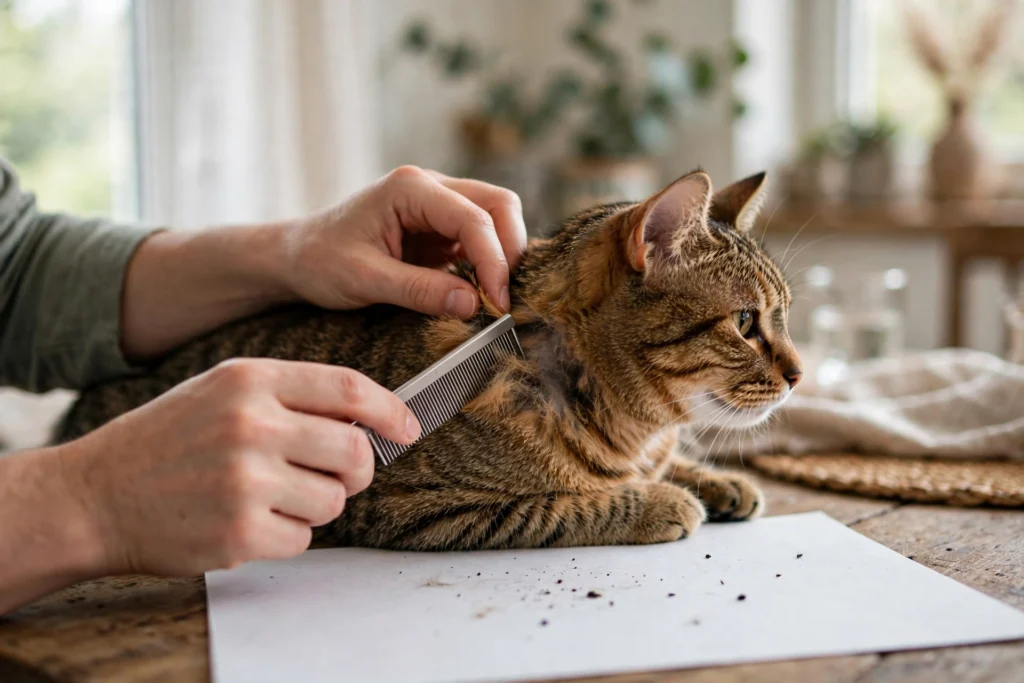

The fastest way to tell if your cat has fleas is the flea comb and wet paper test. Comb your cat over a sheet of white paper, then wet any black specks that fall out. If the specks dissolve into reddish-brown smears, that is flea dirt — digested blood passed by feeding fleas — and it means fleas are (or very recently were) living on your cat, even if you never see a single live flea.
This guide walks through the signs to look for, the home check step by step, why fleas are more than an itch, and what to do if the test comes back positive.
What are the signs your cat has fleas?
Some cats carry fleas with barely a scratch, while others react to a single bite. Watch for a pattern of signs, not one clue alone:
Scratching, biting, and over-grooming
This is the sign most owners notice first. A cat with fleas scratches more than usual, chews at its coat, and may stop mid-nap to bite at its back or sides. Cats that groom excessively can lick patches of fur right off, especially along the back and belly.
Black specks in the fur (flea dirt)
Flea dirt looks like tiny grains of black pepper sprinkled through the coat. It is actually flea droppings made of digested blood, and you will usually find the most of it around the neck and at the base of the tail. Ordinary dirt looks similar — which is exactly why the wet paper test below matters, because ordinary dirt does not turn red.
Hair loss, scabs, and sore skin
Repeated scratching and licking damages the coat. Look for thinning fur, small crusty bumps, and scabs, most often at the base of the tail, along the back, and around the neck. According to VCA Animal Hospitals, this pattern is typical of cats allergic to flea bites, and the broken skin can become infected.
Restlessness and behavior changes
A bitten cat is an uncomfortable cat. Yours may seem on edge, twitch its skin, dart across the room, or have trouble settling to sleep. Skin rippling along the back followed by frantic grooming is a classic flea-time picture.
Seeing live fleas
Adult fleas are small, dark brown, and fast. Part the fur against the grain in good light and you may spot one scurrying toward the skin, especially on the neck, belly, and tail base. A tiny insect that leaps when you try to touch it is almost certainly a flea.
Pale gums and tiredness (heavy infestations)
Fleas feed on blood, and a heavy burden can drain a small cat — most dangerously kittens, elderly cats, and cats already unwell. Pale gums, weakness, and unusual tiredness are warning signs of anemia and need a vet, not a wait-and-see approach.
How do you check your cat for fleas at home?
You need no special equipment — just a fine-toothed flea comb (a few dollars at any pet store), a sheet of white paper, and a small bowl of warm soapy water. Do the check when your cat is calm, in good light.
- Stand or sit your cat over the white paper. The white background makes dark specks easy to see.
- Comb slowly against and with the fur. Work the comb deep enough to reach the skin, spending the most time where fleas gather: the back of the neck, along the back, and especially around the base of the tail. Add the belly, armpits, and behind the ears if your cat allows it.
- Tap the comb on the paper after each pass. Any live fleas caught in the teeth go straight into the soapy water, which drowns them so they cannot jump back into the coat.
- Collect the black specks that have fallen onto the paper.
- Now wet the specks. Dampen the paper and smear one speck gently with your fingertip.
- Read the result. If it dissolves into a reddish-brown or rusty streak, it is flea dirt — digested blood — and it confirms fleas are feeding. If the specks stay black or gray and crumble, they are probably just debris.
No live fleas and no flea dirt after a thorough combing is reassuring, but not a 100 percent guarantee. A cat that grooms a lot can lick away most of the evidence, which is why vets sometimes recommend flea treatment for an itchy cat even when the comb comes up clean.
Where on the body should you check most carefully?
Fleas prefer warm, sheltered spots where the coat is thick and the cat cannot easily reach:
- Base of the tail and lower back — the number one hotspot for fleas and flea dirt
- Back of the neck and between the shoulder blades — safely out of grooming reach
- Belly and groin — thinner fur here makes fleas and dirt easier to spot
- Armpits and behind the ears — warm folds fleas favor
Also check your cat’s bed — flea dirt and tiny white eggs shake loose where your cat sleeps.
Why do fleas keep coming back? The life cycle explained
Finding a few fleas on your cat is only the visible tip of the problem. The adults live on the cat, but their eggs fall off into carpets, bedding, and furniture, where the rest of the cycle plays out hidden from view.
| Stage | Where it lives | What to know |
|---|---|---|
| Egg | Falls off the cat into bedding, carpets, and floors | Tiny white specks, hard to see. A female starts laying within about two days of her first blood meal. |
| Larva | Deep in carpet pile, floor cracks, and under furniture | Avoids light and burrows down, which is why surface cleaning misses it. |
| Pupa | Inside a sticky cocoon in the same hidden spots | The toughest stage. It can wait weeks to months, and insecticides barely touch it. Vibration and body heat trigger hatching. |
| Adult | Jumps onto your cat (or you) | The only stage that bites. The whole cycle can take as little as two weeks in ideal conditions, or up to a year in poor ones. |
This is why a single bath never solves fleas. You killed today’s adults, but eggs, larvae, and pupae in the home keep producing new adults for weeks. Beating fleas means treating the cat and the home at the same time, and keeping it up long enough for every hidden stage to run its course.
Why are fleas more than just an itch?
Fleas are a genuine health risk, not just a nuisance:
- Flea allergy dermatitis. Many cats are allergic to flea saliva. Even a few bites can trigger intense itching, hair loss, and scabby skin, often starting at the tail base — suffering far out of proportion to the number of fleas.
- Anemia. A single flea drinks many times its weight in blood over its lifetime, so hundreds of fleas can seriously drain a kitten or small, weak cat. A severely anemic cat may become weak and breathe fast as its body struggles to move oxygen around — treat that combination as urgent.
- Tapeworm. Fleas carry the larval stage of a common tapeworm. When your cat grooms and swallows an infected flea, the tapeworm can mature in the intestine. VCA Animal Hospitals notes that any cat with fleas is likely to have tapeworms too. Rice-like segments near your cat’s rear or on bedding are the telltale sign.
- Skin infections. Constant scratching breaks the skin and bacteria move in. Hot, weepy, or smelly patches need veterinary care.
What should you do if the check is positive?
Act on the cat, the other pets, and the home together — treating only one of the three is the most common reason flea control “doesn’t work.”
Treat your cat with a vet-approved product. Ask your vet what they recommend for your cat’s age and weight. Modern spot-on and oral products given monthly (some last three months) are far more effective than flea shampoos and powders, which kill only the fleas present that day. Treat every pet in the home, each with a product made for its own species.
Never use a dog flea product on a cat. This one rule can save your cat’s life. Many dog products contain permethrin, which is highly toxic to cats because a cat’s liver cannot break it down. As PetMD warns, permethrin poisoning can cause tremors, drooling, vomiting, and seizures, and can be fatal. If a cat is ever exposed — including by grooming a recently treated dog — contact a vet immediately. Always confirm the label says the product is made for cats.
Clean the home like you mean it.
- Vacuum carpets, rugs, sofas, and floor cracks thoroughly and often. Vacuuming removes eggs, larvae, and pupae, and the vibration encourages pupae to hatch into adults that your cat’s treatment can then kill. Empty the vacuum or discard the bag outside afterward.
- Wash your cat’s bedding (and yours, if the cat sleeps on it) in hot water weekly.
- Keep this routine going for several weeks. Vets often advise continuing flea control on all pets for 3 to 6 months after an infestation, so every hidden life stage has time to emerge and be killed.
Comb regularly in the meantime. Daily flea combing steadily reduces the adults on your cat and lets you monitor whether numbers are falling.
When should you call the vet?
Book a visit promptly if:
- A kitten, elderly, pregnant, or unwell cat — they cannot afford blood loss or the wrong product
- You see pale gums, weakness, or your cat seems unusually tired or wobbly
- The skin is scabby, weepy, hot, or smells bad, suggesting infection or severe allergy
- Your cat is losing patches of fur or scratching itself raw
- Fleas are still obvious after a month of correct treatment and cleaning
- Your cat trembles, drools heavily, twitches, or has a seizure after any flea product was applied — this is an emergency, especially if a dog product was involved. Go to a vet now.
Also call if the comb test is negative but the scratching continues. Fleas are the most common cause of itching in cats, but food allergies, mites, and skin infections can look similar, and your vet can sort out which you are dealing with.
Conclusion
You do not need to catch a flea in the act to know it is there. Scratching, restlessness, hair loss at the tail base, and above all black specks that turn rusty red on wet white paper are proof enough. Confirm it with the comb test, then treat the cat, every other pet, and the home together — with a cat-safe product, never a dog one — and keep going for several weeks so the hidden eggs and pupae run out. If your cat is very young, weak, pale-gummed, or still has fleas after a month of effort, your vet is the next stop.
Frequently asked questions
Can indoor cats get fleas?
Yes. Fleas and their eggs hitchhike indoors on shoes, clothing, and other pets, and pupae can already be waiting in carpets when you move in. Indoor cats are not protected by walls, which is why vets often recommend year-round prevention for them too.
I can’t find any fleas. Does that mean my cat doesn’t have them?
Not necessarily. Adult fleas are fast, and most of an infestation is eggs, larvae, and pupae in the home anyway. A comb check that finds no flea dirt is a good sign, but a cat that grooms a lot can remove the evidence. If the itching continues, ask your vet.
How long does it take to get rid of fleas completely?
Usually several weeks, sometimes a few months. The pupa stage resists insecticides and can wait weeks to months before hatching, so new adults keep appearing for a while. Consistent treatment of all pets plus regular vacuuming is what ends it.
Can cat fleas live on humans?
They may bite people — itchy red bites around the ankles are common during an infestation — but cat fleas do not live and breed on humans. We are a snack, not a home. Their real hosts are your pets, so treating the animals and the house solves the bites on you too.
Should I treat my cat even if I only found one flea?
Yes. Where there is one adult, there are very likely eggs already in your home, and a female begins laying eggs within about two days of feeding. One flea today can be an infestation in a few weeks, so start treatment and cleaning right away.



Pingback: Can You Trim a Cat's Nails? Yes — Here's How Safely