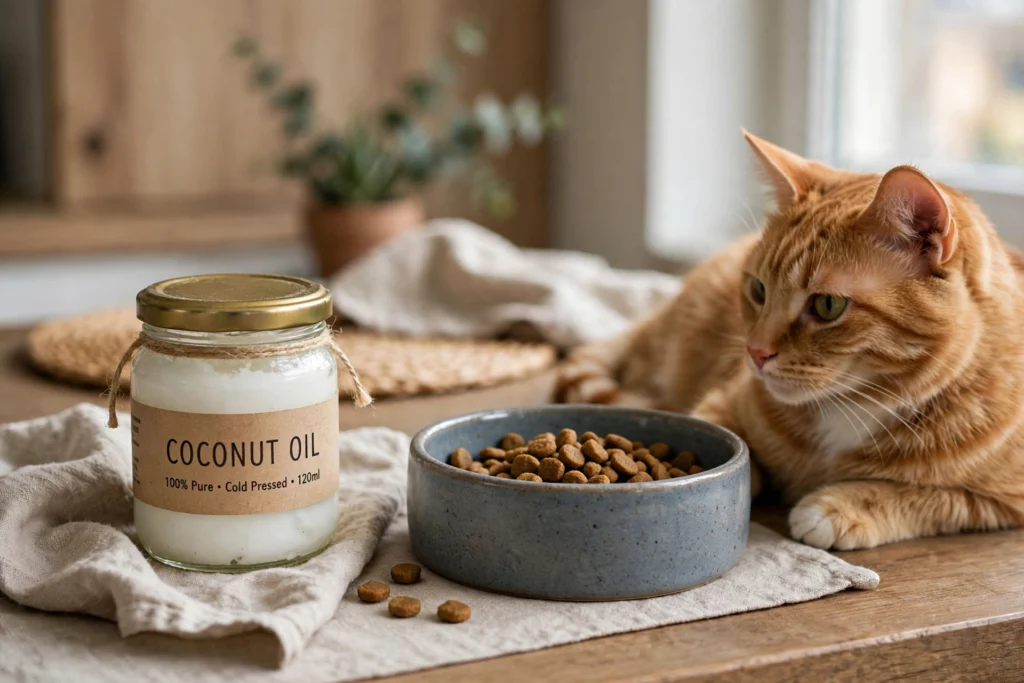

Yes, cats can have coconut oil, in small amounts. It is not toxic to them, and a little can be a reasonable extra for some cats. But “can have” is not the same as “needs.” Coconut oil is pure fat, the benefits are modest, and too much will make a cat gain weight or give her diarrhea.
This guide gives you the honest picture: what coconut oil may actually help with, what it will not do, the risks of overdoing it, and exactly how much to give if you decide to try it. One thing first, though. If your cat has stopped eating or is unwell, coconut oil is not the answer. A cat that refuses food needs the cause found, and our guide on why a cat won’t eat covers that properly.
Is coconut oil toxic to cats?
No. Coconut oil does not appear on the ASPCA’s toxic lists for cats, and it is a normal food oil, not a concentrated essential oil. That distinction matters. The oils that poison cats, like peppermint and tea tree, are highly concentrated plant extracts. Coconut oil is the fat pressed from coconut flesh, the same oil people cook with.
It is mostly saturated fat, and a large share of that fat is medium-chain triglycerides, or MCTs. MCTs are digested a little differently from other fats and are generally easy for cats to handle in small quantities. Coconut oil also contains lauric acid, a fatty acid often credited with antibacterial and antifungal properties in lab studies.
None of that makes it a health food for cats. It makes it a safe-in-small-doses food, with some plausible pluses and some real limits. The rest of this article is about where that line sits.
What are the benefits of coconut oil for cats?
You will see coconut oil credited with everything from curing allergies to boosting the immune system. Here is what is claimed, and how strong the support really is.
Skin and coat
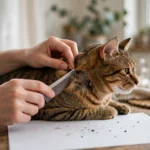
This is the most believable use. Rubbed onto dry, flaky skin, coconut oil works as a moisturizer, and many owners report a softer, shinier coat. Taken by mouth, the extra fat can also improve a dull coat. Be honest about the evidence, though: this is owner experience and basic skin science, not clinical trials in cats. Veterinarians usually point out that omega-3 fatty acids from fish oil have far better evidence behind them for skin and coat problems. The Pooler Veterinary Hospital guide makes the same point: coconut oil may help mildly, but it is rarely the best tool for the job.
Hairballs
The logic is simple: a little oil lubricates the digestive tract, so swallowed hair slides through instead of coming back up as a hairball. Plenty of owners say it helps. There is little formal research, and it is not a guaranteed fix, but as folk remedies go, this one is low risk at sensible doses. Persistent hairballs deserve a vet conversation anyway, because frequent vomiting is not always about hair.
Digestion
Small amounts are said to soothe the gut and help mild constipation by softening the stool. Again, the evidence is anecdotal. And the dose makes the remedy: a little too much oil flips the effect completely and causes loose stools or diarrhea instead.
What it does not do
Coconut oil will not cure skin infections, allergies, arthritis, or dental disease, and it is not a meaningful source of omega-3 or omega-6 fatty acids, whatever the jar’s marketing says. It should never replace a treatment your vet has prescribed. Think of it as a minor optional extra, not a medicine.
What are the risks of coconut oil for cats?
The risks are mostly about quantity, and they are easy to underestimate because the oil looks so harmless.
- Weight gain. Coconut oil is calorie-dense: roughly 40 calories in a single teaspoon. For an indoor cat whose whole day’s food might be around 200 to 250 calories, a daily teaspoon is a large extra meal she did not need. Unchecked, that is how cats quietly become overweight.
- Diarrhea and vomiting. Too much fat, too fast, is the most common problem. A cat new to coconut oil who gets a spoonful may have loose stools within the day.
- Pancreatitis risk. Diets high in fat can trigger inflammation of the pancreas in susceptible cats, and cats with a history of pancreatitis are usually put on careful, lower-fat diets. Flooding that system with extra oil is asking for trouble.
- Allergy or sensitivity. True coconut allergy in cats is uncommon, but it happens. Itching, skin redness, or stomach upset after starting the oil means stop.
- Greasy coat and mess. Applied topically, expect some of it on your furniture until it absorbs, and expect your cat to lick off a good share of whatever you apply.
How much coconut oil can a cat have?
Less than you think. Veterinary guidance is consistent on this: start tiny, go slowly, and stay small. The PetsCare safety guide gives the same range as most vet sources: begin with 1/8 to 1/4 teaspoon, and never exceed about 1/2 teaspoon a day.
| Stage | Amount | How often | What to watch |
|---|---|---|---|
| First taste | A dab on your fingertip, or about 1/8 teaspoon | Once | Interest, and any stomach upset over the next day |
| Introduction | 1/8 to 1/4 teaspoon mixed into food | Once a day, or a few times a week | Stool quality; stop if it turns soft |
| Regular use, if all is well | 1/4 teaspoon for most cats | A few times a week is plenty | Weight creeping up; reduce food slightly to balance |
| Maximum | 1/2 teaspoon per day | Only for larger cats, and only if your vet agrees | Any diarrhea means you have passed her limit |
Two habits keep this safe. First, if you add oil regularly, trim her normal food by a small amount to make room for the calories. Second, treat the ranges above as ceilings, not targets. Many cats get whatever benefit is available at 1/4 teaspoon a few times a week, and some cats do best with none at all.
How do you give coconut oil to a cat?
Most cats actually like the taste, which makes this easy:
- Mixed into food. The simplest method. Stir the measured amount through wet food so she cannot just lick the oil and leave the meal, and so the dose spreads out.
- Off a spoon or your finger. Fine for the first taste test. Many cats will lick it up willingly.
- A dab on the paw. For a cat who turns her nose up at the food bowl, smear a tiny amount on top of a front paw. Her grooming instinct will do the rest. Use a very small dab, since this method is impossible to measure precisely.
- Melted or solid both work. Coconut oil softens at warm room temperature. Either form is fine; never serve it hot.
Introduce it over at least a week. Sudden new fats are the classic recipe for an upset stomach, and a slow start lets you spot the cat who simply does not tolerate it.
Can you put coconut oil on a cat’s skin and fur?
Yes, and for dry skin this is often the better route. Warm a pea-sized amount between your fingers until it melts, then massage it gently into the dry or flaky area. A few notes make this work better:
- Patch test first. Try a small spot and wait a day before treating a larger area, in case of sensitivity.
- Use very little. A thin film is enough. Thick layers just end up licked off or spread onto your sofa.
- Expect licking. Whatever goes on the coat partly ends up in the stomach, so topical use still counts toward her daily amount. Keep quantities tiny.
- Do not use it on broken skin, hot spots, or infections. Greasy oil over an infected patch can trap moisture and delay proper treatment. Skin disease needs a diagnosis, not a moisturizer.
- Watch for greasiness spreading. Some owners apply it before a play session, so the cat is distracted while it absorbs.
Which cats should not have coconut oil?
Skip it, or get your vet’s clear go-ahead first, if your cat:
- Is overweight or gains weight easily. She does not need 40 extra calories a teaspoon.
- Has had pancreatitis, or is on a prescribed low-fat diet for any reason.
- Has high triglycerides or problems metabolizing fat.
- Has a sensitive stomach that flares up with dietary changes.
- Is a kitten. Kittens have specific nutritional needs and delicate digestion; ask your vet before adding any supplement.
- Is already unwell or off her food. New extras muddy the picture when your vet is trying to find a cause.
When should you call the vet?
Coconut oil disagreements usually announce themselves in the litter box and pass quickly once you stop. Call your vet if you see:
- Diarrhea or vomiting that lasts more than a day, or keeps coming back
- Signs of abdominal pain: crouching, hunching, crying when picked up, hiding away
- Refusal to eat, especially combined with lethargy — pancreatitis can look exactly like this
- Itching, hives, or skin redness that worsens after use
- Rapid weight gain over a few weeks of regular use
Bring the jar, or at least know how much you have been giving and for how long. Dose history helps your vet judge whether the oil is the culprit or a coincidence.
Conclusion
Cats can have coconut oil, and it is not toxic to them. Used in genuinely small amounts — start at 1/8 to 1/4 teaspoon, stay at or under 1/2 teaspoon a day — it may soften dry skin, add shine to a coat, and possibly ease hairballs, though the evidence for all of that is more anecdote than science. The risks are real but manageable: extra calories, loose stools, and a pancreatitis concern for cats who are already vulnerable. Overweight cats and cats with pancreatic or fat-related problems should skip it. If your cat enjoys a little and thrives on it, fine. If not, she is missing nothing essential — a complete cat food already gives her every fat she actually needs.
Frequently asked questions
Can kittens have coconut oil?
Not without asking your vet first. Kittens are growing fast on carefully balanced food, their stomachs are easily upset, and added fat can throw both digestion and nutrition off balance. If there is a specific reason you want to try it, your vet can judge whether it suits your kitten’s age and weight.
Is coconut oil good for hairballs?
It may help a little by lubricating the gut so hair passes through, and many owners use it for exactly that. The evidence is anecdotal, dedicated hairball remedies and diets are more predictable, and regular grooming removes the hair before it is swallowed. Frequent hairballs, or vomiting that looks like hairballs but produces nothing, deserve a vet visit.
Can cats have coconut milk, coconut water, or coconut flesh?
Small tastes are not toxic, but none of them are good cat foods. Coconut milk is fatty and can upset the stomach, coconut water contains sugars and potassium a cat does not need, and shredded coconut flesh is hard for cats to digest in quantity. If she steals a lick, do not panic. Just do not serve them on purpose.
Does coconut oil repel fleas on cats?
You will see this claim online, usually based on lauric acid. There is no solid evidence that rubbing coconut oil on a cat prevents or kills fleas, and a greasy coat is not a flea control plan. Use a vet-approved flea preventative instead; it is safer and it actually works.
Can I give my cat coconut oil every day?
You can, at the small end of the range, provided she tolerates it and you balance the calories. Many vets suggest a few times a week rather than daily, since the benefits do not grow with frequency but the weight gain does. If daily use is your plan, 1/4 teaspoon with a small trim to her regular food is the sensible pattern.