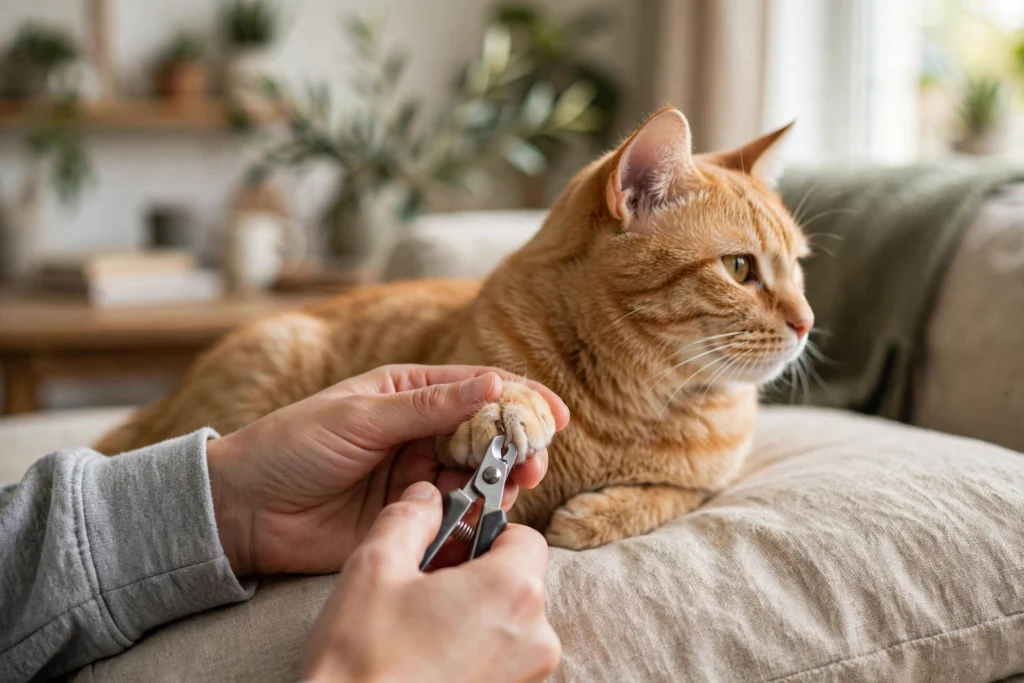

Yes, you can — and most indoor cats need it. Trimming at home is safe as long as you cut only the sharp, clear tip of the claw and stay well away from the pink “quick” inside it, which carries blood vessels and nerves. With the right clippers, a calm cat, and a few nails at a time, most owners pick it up quickly.
This guide covers why trimming matters, how often, the tools worth owning, and the step-by-step method — including what to do if you cut too deep.
Why should you trim your cat’s nails?
A cat’s claws grow continuously, in layers. Scratching sheds the old outer layer and keeps the claw sharp, but it does not really shorten it. Left untrimmed, nails cause real problems:
- Snagging and tearing. Overgrown hooks catch on carpets and blankets, and a claw that rips free is painful and can bleed or become infected.
- Curling into the paw pad. A neglected nail keeps curving until the point grows into the pad — a painful ingrown nail. Dewclaws and the claws of older cats are the usual victims.
- Damage and accidental scratches. Blunt nails do far less harm to furniture, curtains, and your skin.
Trimming is not about stopping scratching — that is normal, healthy behavior. You are simply taking off the sharp tip.
How often should you trim a cat’s nails?
For most cats, every two to three weeks is a good rhythm. The ASPCA recommends a trim every ten days to two weeks for the sharp, fast-growing front claws. Back claws grow more slowly and often need attention only once a month.
Rather than watching the calendar, watch (and listen) for the signs it is time: nails clicking on hard floors, tips that hook and catch on fabric, or a claw in a strong curve. Indoor cats and seniors need trimming most often, because they wear their nails down least.
What does a cat’s claw look like inside?
Understanding the anatomy removes most of the fear. Each claw is hard keratin — the same material as your fingernails — wrapped around a living core called the quick, which contains blood vessels and nerves. On most cats you can see it as the pink section running from the base partway toward the tip.
The rules that follow are simple:
- Cut only the clear, sharp tip beyond the quick — PetMD advises stopping about 2 millimeters before the quick ends.
- Cutting into the quick hurts and bleeds.
- On dark claws, where the quick is hidden, trim tiny amounts at a time and stop when the cut surface turns gray or pink.
- The more regularly you trim, the more the quick recedes, so staying on schedule makes future trims safer.
Front and back claws are not identical, and it is worth knowing the differences:
| Feature | Front claws | Back claws |
|---|---|---|
| Number | 5 per paw, including the dewclaw on the inner leg | 4 per paw |
| Shape and sharpness | Thinner, sharper, strongly curved — built for gripping and climbing | Thicker, blunter, less curved |
| Trimming need | The priority — usually every 2 to 3 weeks; they stay sharp because they barely touch the ground | Check monthly; they wear down somewhat by walking |
| Watch out for | The dewclaw never touches the ground, so it overgrows first | Thick nails in seniors can split if squeezed too hard |
Which tools do you need?
You do not need much, but the right clipper makes the job far easier. Keep styptic powder in the kit — it stops bleeding if you nick the quick.
| Tool | How it works | Best for | Watch out for |
|---|---|---|---|
| Scissor-style cat clippers | Small scissors with curved, notched blades that cup the claw | Most cats and owners — good control, clear view of the quick | Dull blades crush instead of cutting; replace when they stop slicing cleanly |
| Guillotine clippers | The claw goes through a ring and a blade slides across | Kittens and small, thin claws | The blade hides the tip as you cut — check the quick before every squeeze |
| Nail grinder (rotary file) | A spinning stone files the tip down gradually | Cats that hate clipping; nervous owners | Noise and vibration scare some cats; slower |
| Human nail clippers | Standard clippers, used sideways on the claw | A stand-in for kittens and small claws in a pinch | Made for flat nails — can split a round claw |
| Styptic powder | Dabbed onto a bleeding tip, helps blood clot fast | Every trimming kit, no exceptions | Cornstarch works as a backup (see below) |
How do you trim a cat’s nails, step by step?
Before the first trim: practice handling. For a few days, when your cat is sleepy, gently press each toe pad so the claw slides out, then let go and give a treat. No clippers yet. The ASPCA suggests this build-up — touch, press, treat — so paw handling becomes boring before cutting starts.
Then, for each session:
- Pick a calm moment. A drowsy cat after a meal or nap is ideal. Never start when your cat is wound up, or when you are rushed.
- Set up first. Clippers, styptic powder, and treats within reach, in good light. Seat your cat in your lap facing away from you, or on a table.
- Extend one claw. Hold the paw and press the pad with your thumb until the claw comes fully out.
- Find the quick. Look for where the pink section ends, and pick your cut point: the sharp tip only, about 2 mm short of the quick.
- Cut once, cleanly. Hold the clippers top-to-bottom on the claw (cutting side-to-side can split it) and make one confident snip. Hesitant squeezing crushes the claw.
- Release, praise, treat. Let the paw go, reward, then decide: another nail, or done for today?
- Don’t forget the dewclaws. The small claw higher up on the inner front leg never wears down on its own — check it every session.
Stop the moment your cat has had enough: pulling away, growling, tail lashing, or trying to bite all mean “finished.” Letting the cat win that argument makes the next session possible.
What if your cat hates nail trims? The one-paw-a-day approach
Most cats do not need all 18 claws done in one sitting, and forcing a full set creates a cat that hides when the clippers appear. Instead:
- One paw a day — or even one or two nails a day — gets the job done across a week with almost zero stress. The ASPCA’s advice is blunt: do not try to trim all of your cat’s claws at once, and early on, do no more than a claw or two per sitting.
- Pair every nail with a treat, so the clipper predicts good things. Many owners also trim a nail or two while the cat is deep in a nap.
- Use a helper or a towel. A second person can feed treats or hold the cat. A loose towel wrap with one paw out helps some cats feel secure — but if wrapping makes your cat panic, skip it. Either way, quit while ahead: ending after two calm nails teaches your cat sessions are short.
What should you do if you cut the quick?
It happens to almost everyone, and it looks worse than it is. Stay calm — your cat takes its cue from you.
- Apply styptic powder. Press a pinch directly onto the nail tip and hold gentle pressure for a few seconds. This is the fastest way to stop the bleeding.
- No styptic powder? PetMD suggests packing the tip with cornstarch, or pressing the claw across a clean bar of soap, while keeping up gentle pressure with a cloth.
- End the session. That is enough trimming for today. Give a treat and let your cat go.
- Watch the claw. Bleeding from a nicked quick normally stops within a few minutes. If it is still bleeding after about 10 minutes of pressure, if the claw looks torn, or if your cat is limping hours later, call your vet.
Next time, trim less. Taking half as much off, twice as often, is always the safer trade.
Kittens, seniors, and polydactyl cats
Kittens. Start paw handling in the first weeks of life and kitten claws — thin, soft, and very sharp — will never be a drama. Use small scissor clippers, take only the tiny hook off, and keep sessions to a few nails.
Senior cats. Older cats are the highest-risk group for overgrowth: they scratch less, shed their claw sheaths poorly, and their nails grow thick and brittle. Check their claws every couple of weeks, cut in small bites (brittle nails split easily), and watch for claws curling toward the pad. An arthritic senior may go off her food or move less when a sore, ingrown claw is hurting — pain hides quietly in old cats, so if you notice your cat not eating as usual, check the feet and book a vet visit.
Polydactyl cats. Cats with extra toes have extra claws to match, sometimes in odd positions between the toes where they are easy to miss. Those in-between claws never touch the ground, so they overgrow quickly and can dig into the skin. Count every toe at each session.
When should a vet or groomer do it instead?
There is no prize for struggling. Hand the job to a professional if:
- Your cat panics, bites, or cannot be held safely — a clinic can trim with trained handlers, and discuss sedation for truly terrified cats
- A claw has grown into the pad, is broken or bleeding, or the toe looks swollen or infected
- Your own eyesight, grip, or steadiness makes small, precise cuts difficult
Professional trims are inexpensive, and many owners alternate: the groomer does a full set every couple of months, and they maintain the front tips at home in between. If it is your first time, most vets will happily demonstrate during a routine visit.
A note on declawing: please don’t
If scratching damage brought you to this article, declawing can sound like a permanent fix. It is not nail removal — it is amputation of the last bone of each toe, and the ASPCA strongly discourages it because of the pain and the behavior and litter-box problems that can follow. Regular trimming, well-placed scratching posts, and soft nail caps solve the same problem without surgery.
Conclusion
Yes — trimming your cat’s nails yourself is safe, normal, and worth learning. Cut only the clear tip, stop about 2 mm before the pink quick, keep styptic powder in reach, and build up slowly, one paw a day. Front claws need attention every two to three weeks, back claws less often, and dewclaws must never be skipped. If your cat truly cannot tolerate it, or a claw is already injured or ingrown, a professional trim is a perfectly good answer — the goal is short, comfortable nails, not a test of wills.
Frequently asked questions
Does trimming a cat’s nails hurt them?
No, not when it is done correctly. The tip of the claw is dead keratin with no nerves. It only hurts if you cut into the quick, where the nerves and blood vessels are — which is why you stop short of it.
How many claws does a cat have?
Most cats have 18: five on each front paw (including the dewclaw) and four on each back paw. Polydactyl cats have extra toes and extra claws, so count carefully.
Can I use human nail clippers on my cat?
In a pinch, yes — especially on kittens and small, thin claws. Turn them sideways so they cut top-to-bottom rather than squeezing the round claw flat, which can split it. For regular use, cat clippers give a cleaner cut and a better view.
Do outdoor cats need their nails trimmed?
Often less, because rough ground and bark wear the tips down — but “less” is not “never.” Outdoor cats still have dewclaws, which touch nothing. Check all four paws every few weeks.
How can I see the quick on black nails?
You cannot see it directly, so shave off paper-thin slices and check the cut face after each one. It starts white and chalky; when the center turns gray, then soft pink or black, you are at the quick — stop there. When in doubt, take less off and trim again sooner.


Pingback: How Can You Tell If a Cat Is Pregnant? Week-by-Week Signs