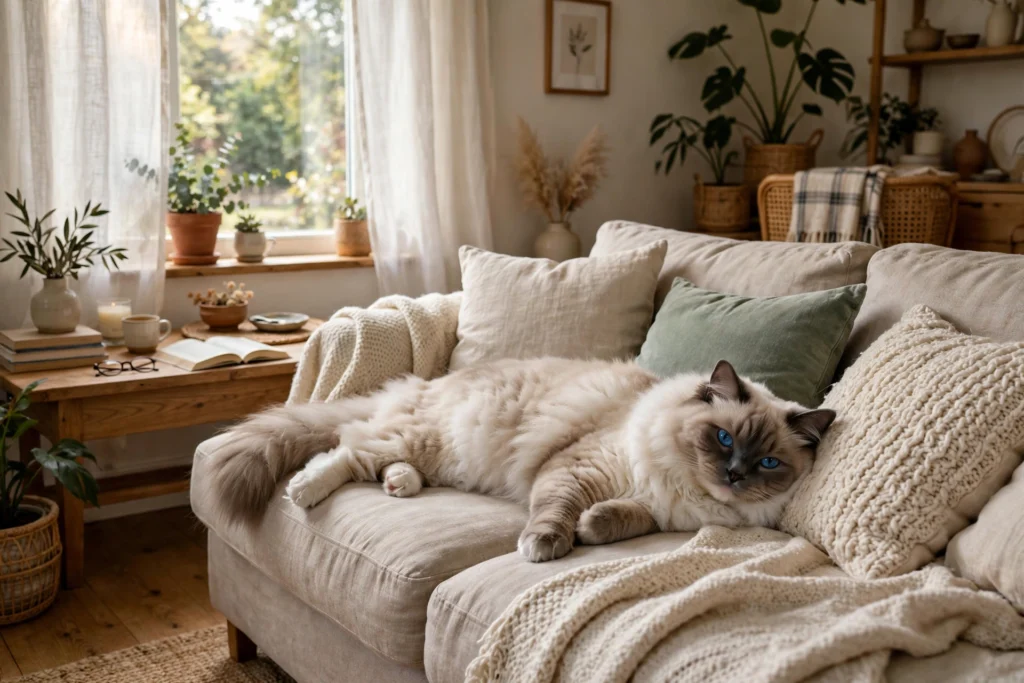

No, Ragdoll cats are not hypoallergenic. Like every other domestic cat, a Ragdoll produces Fel d 1, the protein that causes most cat allergies, and no breed is completely allergen-free. Some allergy sufferers do report milder reactions around Ragdolls, and there are honest reasons that can happen — but “hypoallergenic” is a promise no breeder can truthfully make about this breed.
This guide explains what actually causes cat allergies, why Ragdolls have their low-allergen reputation, and where that reputation goes further than the science. You will also find practical tips that help allergy sufferers live with a cat, and a short look at the breeds that have actually been studied for lower allergen levels.
What actually causes a cat allergy?
Most people who react to cats are not allergic to fur itself. They are allergic to proteins the cat produces, and the main one is called Fel d 1. It is made in the cat’s salivary glands and in the sebaceous (oil) glands of the skin. Every time a cat grooms, saliva full of Fel d 1 is spread across the coat. As it dries, tiny particles flake off into the air, settle on furniture, bedding, and clothing, and get breathed in.
Those particles are very small and unusually sticky. They can stay airborne for a long time, cling to walls and soft furnishings, and remain in a home long after a cat has left it — which is why sufferers can react in a house where the cat is not even in the room.
Typical cat allergy symptoms include:
- Sneezing, a runny or blocked nose
- Red, itchy, or watery eyes
- Coughing, wheezing, or a tight chest
- Itchy skin, hives, or a rash where the cat has licked or rubbed
If your symptoms include coughing or a tight chest, do not just assume it is the cat — read our guide on why a cat is sneezing a lot for the feline side of those signs, and talk to your own doctor about testing, because only proper allergy testing can confirm what you are reacting to.
One more fact matters for the Ragdoll question: the amount of Fel d 1 a cat makes varies a lot between individuals, and is not decided by breed alone. Unneutered males tend to produce more than females and neutered males. But a “low” cat can be found in any breed — and a “high” one can too.
Why do people say Ragdolls are better for allergies?
If Ragdolls make the same allergen as every other cat, why the reputation? It comes from the coat, plus a claim that has never really been proven.
The missing undercoat
Most long-haired cats have two layers: long guard hairs on top and a dense, soft undercoat beneath. Ragdolls are unusual because they have little to no true undercoat, so they tend to shed less loose hair than a double-coated breed such as a Persian or a Maine Coon. Less loose hair can mean dander and dried saliva are spread a little less widely. That is a real effect — but it reduces the delivery system for the allergen, not the allergen itself.
The Fel d 1 claim
Some breeders say Ragdolls produce less Fel d 1 than other cats. Treat this claim with care. There is no solid published evidence for it, and the general scientific position is that Ragdolls produce standard levels of the protein, like other cats. What is true is that Fel d 1 levels vary widely between individual cats — so one Ragdoll may genuinely be a low producer, but so may a shelter moggy, and another Ragdoll from the same litter may not be.
Anecdotes are not proof
Many owners honestly say their Ragdoll bothers them less than other cats did. That can be real, for several reasons: the lighter shedding, a cat that happens to be a low Fel d 1 producer, or simply a milder allergy kept under control by good housekeeping. What those stories cannot tell you is whether you will react to a specific kitten.
Do Ragdoll cats shed a lot?
Less than most long-haired breeds, but they do shed. Expect loose hair all year in small amounts, with heavier shedding as the seasons change. The silky coat is less prone to matting than a double coat, but still needs brushing a few times a week. For an allergy sufferer, that brushing matters twice: it keeps the coat in good condition and removes allergen-carrying hair and dander before it spreads through the home.
| Claim about Ragdolls | What is actually true |
|---|---|
| “Ragdolls are hypoallergenic” | No. They produce Fel d 1 like all cats, and no breed is allergen-free. |
| “Ragdolls don’t shed” | They shed lightly to moderately. They have no dense undercoat, so they shed less than double-coated breeds. |
| “Ragdolls make less Fel d 1” | Unproven. Levels vary by individual cat; no solid evidence the breed as a whole produces less. |
| “Long hair means worse allergies” | No. Coat length does not decide allergen levels. Hair is only the carrier, not the cause. |
| “Kittens are safe for allergies” | Kittens produce less Fel d 1 than adults, but levels rise as the cat matures. A kitten is not a guarantee. |
How can allergy sufferers live with a Ragdoll?
If your allergy is mild to moderate, a Ragdoll — or any cat — may still be possible with a proper management plan. These steps reduce the total allergen load in your home, which is what decides how you feel day to day:
- Do a trial before you commit. Spend real time with the exact cat first: visit several times, handle the cat, and ideally arrange a foster or trial period. Reacting well to one Ragdoll does not guarantee the next one, so test the individual cat, not the breed name.
- Make the bedroom a cat-free zone. This is the single most useful rule. You spend roughly a third of your life in bed, breathing whatever is in the pillow. Keeping the cat out of the bedroom and off the bed gives your system a nightly break.
- Use a HEPA air purifier. Run one in the rooms where the cat spends the most time, especially the bedroom doorway area or living room. HEPA filtration traps the tiny airborne particles that carry Fel d 1.
- Groom regularly — ideally not by you. Brush the cat a few times a week to remove loose hair and dander, and have a non-allergic household member do it if possible, ideally away from your main living space. Wiping the coat with a damp cloth between brushes also lifts off dried saliva.
- Clean like it matters. Vacuum soft furnishings and floors often with a HEPA-filter vacuum, wash bedding and throws regularly, and favour hard floors and blinds over heavy carpets and curtains where you can. Allergens build up in fabric.
- Wash your hands and avoid touching your face. After handling the cat, wash your hands, and try not to rub your eyes. It sounds basic, but direct transfer accounts for a lot of eye symptoms.
- Talk to your doctor about treatment. Antihistamines and nasal sprays control symptoms for many people. For a longer-term fix, allergen immunotherapy (allergy shots or tablets) gradually trains the immune system to tolerate cat allergen and is the option most likely to change the picture over years, not days. The ASPCA’s pet insurance guide to pet allergies makes the same starting point: see a doctor for proper testing, because it is the only way to know whether the pet — or something carried in the pet’s fur — is really what you are reacting to.
Do these things consistently and many mild sufferers find life with a cat quite manageable. What they do not do is make a Ragdoll hypoallergenic — they make the home lower-allergen, which is the honest version of the claim.
Are there better-tested low-allergen options?
If you are choosing a breed mainly for allergies, a few breeds have at least some research or long-standing observation behind them:
- Siberian. The breed most often cited by allergists. Some Siberians carry gene variations that appear to reduce Fel d 1, and many test lower. Levels still vary cat by cat, so the same trial-visit advice applies.
- Balinese. Sometimes called the long-haired Siamese, and often reported to produce less of the protein, though formal evidence is limited.
- Devon Rex and Cornish Rex. Very short, fine coats that shed little and hold less loose hair and dander.
- Sphynx. Hairless, but not allergen-free: the protein is still produced in skin and saliva. Hairless does not mean hypoallergenic.
Notice the pattern: every option is “lower” or “less shedding,” never “none.” Guidance from Cats Protection says the same plainly — hypoallergenic cats do not exist, because all cats produce allergens whatever their breed, age, or sex. Choose with that in mind and these breeds are reasonable places to start your search, not guarantees.
There is also a newer feeding approach: diets coated with anti–Fel d 1 antibodies (from egg product) neutralise some of the Fel d 1 in the cat’s saliva as it eats, lowering the active allergen spread during grooming. Early studies are promising, and it combines well with the cleaning steps above — but it lowers exposure rather than removing it.
When should you talk to a doctor or vet?
This article is about people as much as cats, so this section has two sides.
See your doctor or an allergist if:
- You are thinking of getting any cat and already suspect an allergy. Get tested first, before a kitten is involved.
- Your symptoms include wheezing, chest tightness, or asthma that gets worse around cats. Asthma plus cat allergy needs proper medical management, not just a purifier.
- Over-the-counter remedies stop working, or symptoms are affecting your sleep and daily life. Immunotherapy may be worth discussing.
See your vet if:
- Your Ragdoll’s shedding suddenly increases, or you see bald patches, redness, or crusting. That is not normal shedding — it can point to skin disease or parasites.
- Your cat grooms excessively or seems itchy. Irritated skin produces more dander, which makes your allergies worse too.
- You want to try an allergen-reducing diet, and want advice on whether it suits your cat.
Conclusion
Ragdolls are not hypoallergenic, and neither is any other cat. They produce Fel d 1 at normal levels; claims that the breed produces less are breeder claims, not established science. What Ragdolls genuinely offer is a coat with no dense undercoat and lighter shedding, which can spread allergen a little less around the home. For someone with a mild allergy, a trial period with the individual cat, a cat-free bedroom, HEPA filtration, regular grooming, and proper medical treatment can make living with a Ragdoll realistic. For severe allergy or asthma, get tested and spend time with the actual cat before deciding.
Frequently asked questions
Can a Ragdoll still trigger allergies even if it sheds less?
Yes. Shedding is only the transport system. Fel d 1 sits in the cat’s saliva and skin oils, and it spreads by grooming, rubbing, and direct contact as well as on loose hair. A low-shedding cat can still produce plenty of allergen.
Are female or neutered Ragdolls better for allergies?
Possibly, a little. Unneutered males tend to produce more Fel d 1 than females and neutered males, so a female or a neutered male is the safer bet on average. It is a tendency, not a rule, and individual variation matters more than sex.
Are Ragdoll kittens hypoallergenic?
No. Kittens produce less Fel d 1 than adult cats, which is one reason people sometimes think they “became” allergic as their cat grew up. Allergen production rises as the cat matures, so a kitten you tolerate now is not proof of how you will react to the adult cat.
Will keeping a Ragdoll out of my bedroom really help?
Yes, it is one of the most effective single steps. It cuts out many hours of close exposure to allergen built up in bedding every night, and gives you one low-allergen space to retreat to when symptoms flare.
Do allergen-reducing cat foods work?
They are designed to neutralise Fel d 1 in the cat’s mouth, and early research shows they can reduce the active allergen a cat spreads. Use them as one layer of a full plan — cleaning, filtration, grooming, and medical treatment — not as the whole solution.
What if I react to a Ragdoll at the breeder’s home?
Take it seriously, and do not let anyone talk you into “you’ll get used to it.” Sometimes people improve around a specific cat, but sometimes they get worse. Visit again on another day, and if symptoms are strong both times, that cat is not the right one for you.


Pingback: How Long Does an iPad Last? 5 to 7 Years, Often More