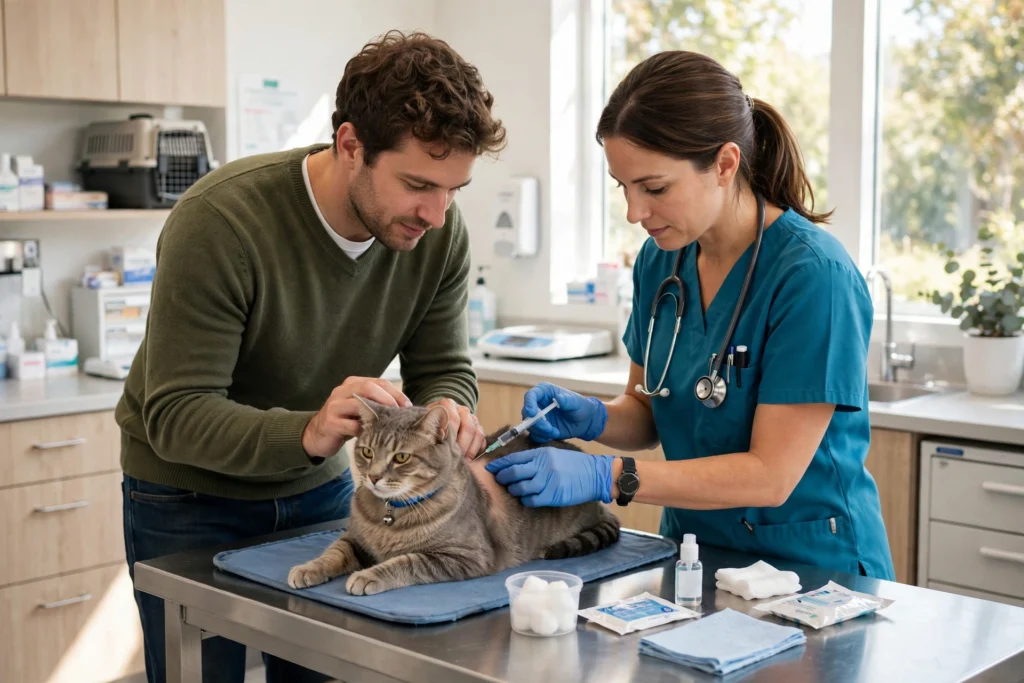

Yes, indoor cats do need vaccines — but not every vaccine, and not as many as an outdoor cat. The core shots, FVRCP and rabies, are recommended for all cats, including cats that never set a paw outside. The rest depends on your cat’s lifestyle, and that is a conversation worth having with your vet.
This guide explains which vaccines an indoor cat needs, why a cat that never leaves home is still at risk, the usual schedule for kittens and adults, and the side effects to watch for, including the rare ones you may have heard about.
Which vaccines does an indoor cat need?
Vets divide cat vaccines into two groups. Core vaccines are recommended for every cat because the diseases are serious, common, or a risk to people. Non-core vaccines are added only when a cat’s lifestyle makes exposure likely. The Cornell Feline Health Center confirms that even cats kept indoors at all times should receive the core set.
| Vaccine | Type | What it protects against | Indoor cat? |
|---|---|---|---|
| FVRCP | Core | Feline herpesvirus and calicivirus (major causes of cat flu and eye infections) and panleukopenia, a severe and often fatal gut disease | Yes, for every cat |
| Rabies | Core | Rabies, a fatal virus that also infects people | Yes — and legally required in many areas |
| FeLV (feline leukemia) | Core for kittens, non-core for adults | A virus spread by close contact with infected cats, which weakens the immune system | Recommended for all kittens; for adults, only if they meet other cats or may escape |
| Bordetella and Chlamydia | Non-core | Respiratory bacteria seen mainly in boarding catteries, shelters, and multi-cat outbreaks | Only if your vet advises it for your situation |
Notice what is not on the list for a strictly indoor adult cat: yearly FeLV boosters with no exposure risk, and vaccines against diseases your cat has no realistic way to meet. A good vaccine plan is not “everything, every year.” It is the core protection, plus extras matched to real risk.
Two of the diseases in the single FVRCP injection, herpesvirus and calicivirus, cause the sneezing fits, runny eyes, and mouth sores that owners often meet as “cat flu.” If your cat is sneezing now, our guide on why a cat is sneezing a lot explains the causes — but note that vaccination prevents or softens these infections best when it happens before exposure, which is why the kitten series matters so much.
Why is an indoor cat still at risk?
“Indoor” lowers risk a lot. It does not remove it. These are the gaps vets actually see:
- Escapes happen. A door left open, a window screen pushed out, a frightened dash during fireworks or a move. An unvaccinated cat that spends even one night outside has zero protection for that night.
- Bats get inside. Bats are a leading rabies carrier, and they slip into houses and apartments through small gaps. A cat that catches or plays with a bat indoors has had a genuine rabies exposure.
- Viruses travel on you. Panleukopenia virus is tough and long-lived in the environment. It can arrive on shoes, clothes, and hands after you have stroked another cat or visited a shelter or vet waiting room.
- Your cat still leaves home. Vet visits, boarding, grooming, and cat shows all put your cat in spaces shared with other cats. Most boarding facilities also require proof of vaccination before they will accept a cat at all.
- New arrivals change the equation. A new kitten, a foster cat, or a partner’s cat moving in can bring viruses into a home that was previously low-risk.
None of this means an indoor cat needs the same plan as a farm cat. It means the core vaccines are cheap insurance against the handful of realistic surprises.
Does an indoor cat really need a rabies vaccine?
For most readers, yes — for two separate reasons.
The first is the law. Many states, provinces, and municipalities require rabies vaccination for all cats above a certain age, whether they go outside or not. The Cornell Feline Health Center makes this point directly to indoor-cat owners: in New York, for example, the vaccine is legally required for every cat over six months old, and many other regions have similar rules.
The second reason is the bat scenario above, plus one legal consequence owners rarely hear about. If an unvaccinated indoor cat bites someone, or is exposed to a bat that cannot be tested, authorities may require a long quarantine or worse, because there is no proof of protection. A vaccinated cat in the same situation usually just gets a booster. Rabies is essentially always fatal once symptoms appear, in cats and in people, so this is the one vaccine where “he never goes out” is not a strong argument.
What is the vaccine schedule for an indoor cat?
The exact timing depends on the products your clinic uses and on local law, but the standard pattern looks like this, following the Cornell Feline Health Center’s guidance:
Kittens
- FVRCP starts at 6 to 8 weeks old, repeated every 3 to 4 weeks until about 16 to 20 weeks. The repeats are needed because antibodies from the mother block the vaccine early on, and they fade at different times in different kittens.
- One rabies dose, usually at around 12 weeks of age or a little later, depending on the product and local rules.
- FeLV in two doses a few weeks apart is recommended for all kittens, because kitten lifestyles change — today’s indoor kitten can become next year’s escape artist.
Adults
- A booster one year after the kitten series finishes.
- After that, FVRCP boosters are typically every three years for a low-risk indoor cat.
- Rabies boosters every one to three years, set by the vaccine used and by local law.
- FeLV boosters only continue if the cat’s risk continues.
Missed a booster by months or years? You usually do not start over. Cornell notes that an adult cat who is overdue should simply receive a booster, whatever the gap. Tell your vet what your cat has had, and when, and they will rebuild the schedule from there.
What side effects can cat vaccines cause?
Most cats show nothing at all, or a quiet day. Common, mild reactions include sleepiness, a slight fever, less appetite for 24 to 48 hours, and a small, painless swelling where the injection went in. These pass on their own.
Rare reactions need prompt attention:
- Allergic reactions are uncommon and usually happen within minutes to a few hours: repeated vomiting, facial swelling, hives, drooling, or difficulty breathing. Difficulty breathing is an emergency — go straight back to the clinic.
- Injection-site sarcoma is the serious one you may have read about. Very rarely, a tumor develops where a vaccine was given. It is uncommon, and it is one reason vets now give vaccines low on a leg, where a problem is easier to deal with. The practical takeaway is monitoring: a small lump after a vaccination is normal and should shrink over a few weeks. A lump that grows, appears long after the visit, or is still present after a few months should always be shown to your vet.
Put in context, the diseases these vaccines prevent — rabies, panleukopenia, severe respiratory disease — are far more dangerous than the vaccines themselves. The goal is not zero vaccines or every vaccine. It is the right ones, which is the next section.
Can a blood test replace booster vaccines?
Partly, in some cases. A titer test is a blood sample that measures whether your cat still has protective antibodies, and it works reasonably well for panleukopenia and the respiratory viruses. Some owners of senior or chronically ill indoor cats use titers to check whether a booster is needed yet.
There are real limits, though. A titer cannot replace the rabies vaccine where the law requires the vaccine itself, no matter what the blood result shows. Titers also cost more than a booster, and they measure antibodies only, not the cat’s full immune readiness. Think of them as a tool for special cases, discussed with your vet, rather than a standard swap.
How do you build a risk-based vaccine plan?
At your cat’s next visit, walk through these questions with your vet:
- Is my cat truly indoors-only, or does he sit on a balcony, visit a cottage, or slip out?
- Do other cats live here, visit, or get fostered here?
- Will my cat be boarded, groomed, or shown in the next few years?
- Are we planning a new kitten or a move to a home with outdoor cats?
- How old is my cat, and does he have any chronic illness that changes the balance?
An honest answer set usually produces a lean plan: FVRCP and rabies on a three-year rhythm, FeLV dropped after the kitten year if there is genuinely no cat contact, and a note to revisit the plan if life changes. That is modern feline medicine working as intended — protection matched to the cat, reviewed as the cat’s life changes.
When should you call the vet?
After a vaccination, call the same day if you notice repeated vomiting, facial swelling, hives, collapse, or any trouble breathing — breathing trouble means go now, not after a phone call. Also book a visit if:
- The injection-site lump grows, or has not gone after a few months
- Your cat has never been vaccinated, or you have adopted a cat with no records
- Your cat is due for boarding, travel, or a new pet joining the home and you are unsure of his status
- Your cat was exposed to a bat or had a fight with an unknown animal, vaccinated or not
Conclusion
Yes, indoor cats need vaccines. The core set — FVRCP and rabies — protects against diseases that can still reach a cat indoors through escapes, bats, contaminated shoes, and trips out of the house, and rabies vaccination is often the law besides. Beyond the core, let lifestyle decide: FeLV for kittens and for cats with real exposure, extras only where your vet sees genuine risk. Keep boosters on the simple one-to-three-year rhythm your vet sets, watch for the rare reactions, and review the plan whenever your cat’s life changes.
Frequently asked questions
Do indoor cats need the FeLV vaccine?
All kittens should get it, because their future lifestyle is unpredictable and kittens are the most vulnerable to the virus. A strictly indoor adult cat with no contact with other cats usually does not need ongoing FeLV boosters. If your cat escapes often, lives with an outdoor cat, or you foster, your vet will likely keep it going.
How often do indoor cats need the FVRCP vaccine?
After the kitten series and a booster at one year, most low-risk indoor cats get FVRCP every three years. Cats in higher-risk homes may be boosted more often. Your vet sets the interval based on the product used and your cat’s risk.
What happens if my indoor cat has never been vaccinated?
Book a visit. An unvaccinated adult usually receives FVRCP doses a few weeks apart, a rabies dose, and an FeLV test and series if appropriate, then joins the normal booster rhythm. It is never too late to start.
Are vaccines safe for senior indoor cats?
For most healthy seniors, yes, and rabies may still be legally required. For a very old or chronically ill cat, your vet may space vaccines out, use titer tests, or stop non-essential boosters. That is a judgment call you make together, based on the individual cat.
Can vaccines make my cat sick for a day?
A mild, short reaction is fairly common: sleepiness, slight fever, and eating less for a day or two. It is the immune system doing its job, and it passes. Repeated vomiting, facial swelling, or breathing problems are not normal — those need a vet immediately.
Do indoor cats need shots every year?
Not necessarily the shots themselves, but they do need a yearly vet exam. Many indoor cats are on three-year booster intervals for FVRCP, with rabies given every one to three years depending on the product and local law. The annual visit is still worthwhile for weight, teeth, and early disease checks.


Pingback: How Much Does It Cost to Cremate a Cat? Prices Explained
Pingback: How to Treat Ear Mites in Cats at Home, Safely
Pingback: How High Can Cats Jump? (Up to 6 Times Their Own Height)