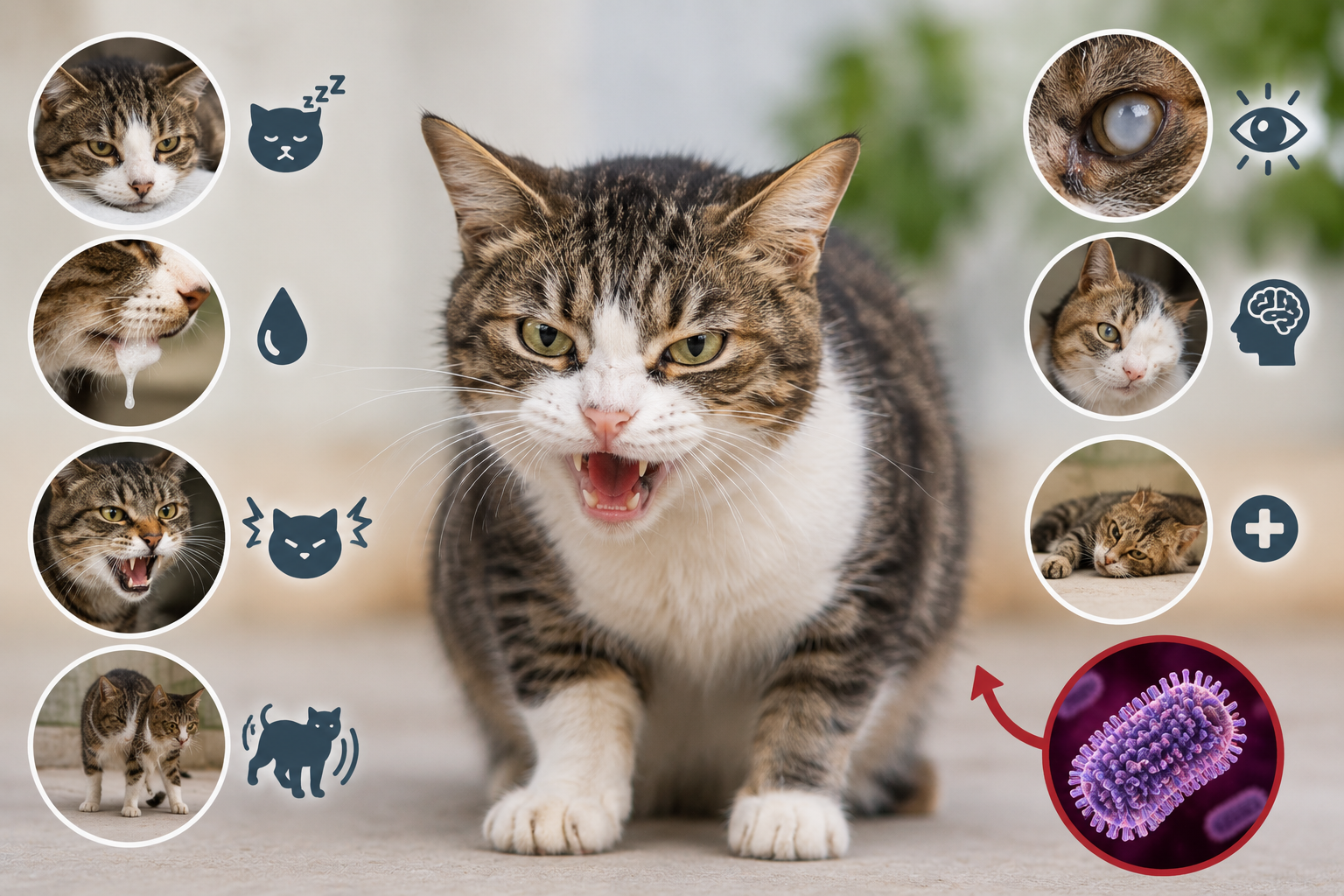
A cat with rabies shows a sudden, serious change in behavior, then loses control of its body. It may attack for no reason, or it may turn strangely clingy. Later come heavy drooling, trouble swallowing, a dropped jaw, wobbly walking, seizures, and paralysis.
You cannot confirm rabies by looking at a cat, and no test works on a living cat. Only a lab test after death gives a sure answer. So treat any cat with these signs as dangerous, keep your distance, and call a vet or local animal control right away.
Below you will find the signs in the order they appear, how fast the disease moves, what else can look like it, and what to do if a person or a pet may have been exposed.
What are the first signs of rabies in a cat?
The first signs are changes in mood and habits. They are easy to miss because they look like an ordinary sick day. Vets call this the prodromal stage, which just means the warning stage. It usually lasts two to three days. Look for:
- A sudden loss of appetite
- Nervous, jumpy, or anxious behavior
- Irritability, or snapping when touched
- Hiding away, or seeking out a quiet corner
- A normally unfriendly cat that suddenly wants cuddles
- Avoiding bright light
- Licking or scratching at an old bite wound
The key word is sudden. A calm cat turns fierce, or a shy cat turns friendly, and nothing else explains it. Any unexplained change in an unvaccinated cat is a reason to be careful. The concern grows if the cat goes outdoors, lives near wildlife, or may have met a bat.
What does furious rabies look like?
Furious rabies is the form most rabid cats show. Vets estimate that about nine in ten rabid cats have it. The cat becomes restless, jumpy, and angry, and it can look as if it has gone mad.
- Sudden attacks, with hard biting and scratching and very little warning
- Wide pupils and a tense, alert posture
- Strong reactions to noise, light, and movement
- Snapping at the air, as if watching something that is not there
- Biting or chewing objects, or attacking the bars of a cage or the walls of a room
- Loud, strange yowling, or a change in the voice
- Stumbling, twitching, tremors, and seizures
Many people expect a rabid cat to foam at the mouth. Some do, and some don’t. A rabid cat may drool heavily or hardly at all, so never wait for foam before you take the signs seriously.
What does paralytic rabies look like?
In the paralytic form, often called dumb rabies, the cat grows weak and quiet instead of angry. In cats it often shows up a few days after the furious stage. Some cats show only this form.
- A dropped jaw, or a mouth that will not close
- Heavy drooling, because the cat cannot swallow
- Pawing at the mouth, as if something is stuck in the throat
- A hoarse voice, or no sound at all
- Trouble blinking
- Weak back legs and stumbling, then paralysis that spreads through the body
- Coma, then death
These cats rarely try to bite, so they can look harmless. They are not. Their saliva carries the virus.
Never open a sick cat’s mouth or give it medicine by hand if it is drooling or cannot swallow. People can catch rabies by checking a cat’s mouth or giving medicine with bare hands. Leave it to a vet.
How fast does rabies move in a cat?
After a bite, a cat usually looks fine for a while. Most cats show their first signs two to three weeks to three months later, but the wait can be as short as a few days or longer than six months. It depends on how much virus got in and where the bite was.
A cat can spread the virus before it looks sick. The virus can be in its saliva for several days, and possibly up to 10 days, before the first signs. That is why a cat that bites someone is watched for 10 days, even when it seems healthy.
| Stage | Usual length | What you see |
| Incubation | Weeks to months | Nothing |
| Early (prodromal) | 2 to 3 days | Mood change, poor appetite, dislike of light |
| Furious | 1 to 7 days | Aggression, restlessness, seizures |
| Paralytic | 2 to 4 days | Drooling, trouble swallowing, paralysis |
The stages blend together, and some cats skip one. Once signs begin, most cats die within about 10 days, and some within three or four.
Can a vet test a living cat for rabies?
No. The only sure test uses brain tissue, so it can only be done after death. A vet judges the case from the cat’s signs, its vaccine record, and any chance it met a rabid animal. A lab test then confirms it.
When rabies is likely, the cat is put down so its brain can be tested. That is a hard choice, but rabies cannot be treated once signs appear, and a rabid cat is a danger to everyone near it. The test result also tells any exposed person whether they need treatment.
What else can look like rabies?
Several problems cause sudden changes in behavior. A bone or other object stuck in the throat can cause drooling and pawing at the mouth. Mouth pain, poisoning, a head injury, and other brain diseases can cause stumbling, seizures, and odd behavior. A cat in pain may also lash out.
Early rabies is hard to tell apart from these, so a vet should examine any cat with these signs. But in a cat with no rabies vaccine, treat sudden aggression, or paralysis that keeps getting worse, as possible rabies until a vet or health official rules it out.
How do cats catch rabies?
Cats catch rabies from the bite of a rabid animal. The virus lives in saliva and enters through the wound. In North America, the usual sources are bats, raccoons, skunks, and foxes. In much of Asia and Africa, rabid dogs are the main source. Worldwide, rabies kills an estimated 59,000 people a year, and about 99 percent of those cases come from a dog bite.
In the United States, cats are the domestic animal most often found with rabies. Roughly 200 to 300 rabid cats are reported each year, and the count was 222 in 2023. Cats roam, hunt at night, and chase bats and other wildlife. Cats that live outdoors or in unmanaged colonies face the most risk, because they are less likely to be vaccinated.
Indoor cats are safer, but not safe. A bat that gets into the house can bite a curious cat, and bat bites are small and easy to miss.
One more fact helps in a home with several cats. No cat-to-cat spread has been recorded, and there is no cat strain of the virus. Each rabid cat got the virus from another kind of animal.
How can you tell if your cat was exposed?
Many exposures happen out of sight. Cats fight and hunt where you cannot see them. These clues point to a possible exposure:
- A fresh bite, scratch, or swollen spot on a cat that just came in from outdoors
- A fight with a stray cat, a dog, or a wild animal
- A dead or sick bat, skunk, raccoon, or fox found near your cat
- A bat inside the house, even if you did not see it touch the cat
A cat can be exposed without any wound you can find. If any of these happened, call your vet the same day, even if the cat seems fine. A cat that is already vaccinated should get a booster within about four days of the exposure. Do not wait for signs, because by then it is too late to help the cat.
What should you do if you think a cat has rabies?
Safety comes first. Follow these steps.
- Stay back. Do not touch the cat, comfort it, or try to check its mouth. Keep children and other pets away.
- Contain it without contact. If it is your cat, shut it in a room and close the door. If it is a stray, do not try to catch it.
- Call for help. Phone your vet (ring ahead so the staff can prepare) or your local animal control or health department.
- Share the details. Give the cat’s vaccine history, any bites or wildlife contact, when the changes began, and who may have been bitten or scratched.
- Check for exposure. Anyone bitten, scratched, or splashed with saliva in the eyes, mouth, or broken skin should get medical advice at once.
- Keep the body if the cat dies. Do not bury it or throw it away. Health officials may want to test it.
What happens next depends on the case. A vet or health officer may ask to see the cat, confine it, or send it for testing. Other pets that may have been bitten are checked against their vaccine records. Exposed people are told whether they need treatment. Follow their instructions, and do not move the cat yourself unless they tell you to.
What if a cat bites or scratches you?
Act at once. Rabies in people is almost always deadly once symptoms start, but treatment given soon after a bite works.
Wash the wound with soap and running water for about 15 minutes. Afterward you can apply an iodine-based antiseptic. Leave the wound uncovered, and never rub in chili powder, plant juices, or other irritants. Then go to a clinic or hospital the same day.
Treatment is wound care, rabies antibodies placed in the wound, and several doses of vaccine over about two weeks. Saliva that gets into the eyes, mouth, or an open cut counts as exposure too.
If the cat looks healthy and can be found, keep it confined for 10 days. If it is still healthy after 10 days, it did not have the virus in its saliva when it bit. If it shows signs or dies, it is tested. If it is a stray that cannot be found, a doctor will likely advise treatment. Let a doctor or health officer decide whether treatment can wait. Do not decide alone.
How can you protect your cat from rabies?
Vaccination is the dependable protection. A kitten can get its first rabies shot from about 8 to 12 weeks old, depending on the vaccine label and local law. A booster follows one year later, then every one or three years, depending on the vaccine and local rules. A cat is generally counted as protected about four weeks after the first dose. If a booster is overdue, get one as soon as possible.
A few habits add protection. Keep your cat indoors, especially at night, and keep window screens in good repair. If a bat gets inside, call animal control or a health office before you release it, and tell your vet.
Vaccination also decides what happens after an exposure. A vaccinated cat that meets a rabid animal gets a booster right away and 45 days of close watching. An unvaccinated cat may face euthanasia or months in strict isolation. Keep your cat’s vaccine certificate where you can find it fast.
Conclusion
A cat with rabies shows sudden, serious changes: strange aggression or strange clinginess, then drooling, trouble swallowing, a dropped jaw, wobbling, and paralysis. No test can confirm it in a living cat, so keep your distance and call a vet or animal control at once. If anyone is bitten or scratched, wash the wound for 15 minutes and get medical care the same day. Vaccination prevents rabies in cats, so keep your cat’s shots up to date.
Frequently asked questions
Can a cat have rabies and not act aggressive?
Yes. In the paralytic form, a cat turns weak and quiet, drools, and cannot swallow. These cats rarely bite. Some cats also die with few clear signs, so any sudden change in an unvaccinated cat deserves a call to the vet.
How long can a cat live with rabies?
Once signs start, most cats die within about 10 days, and some within three or four. Before signs appear, a cat may look healthy for weeks or months while the virus spreads toward the brain.
Can an indoor cat get rabies?
Yes, though the risk is low. The main danger is a bat that gets into the home and bites the cat. Rabies vaccination protects indoor cats too, and many places require it by law.
Can you get rabies from a cat scratch?
It is possible, but less common than a bite. Saliva on the claws or skin can carry the virus into broken skin. Wash any scratch from a suspect cat for 15 minutes and see a doctor.
Is there a cure for rabies in cats?
No. Once signs appear, rabies in a cat is fatal. The protection is the vaccine, given before any exposure. Exposed cats are handled by vaccine status, with a booster and observation or, for unvaccinated cats, euthanasia or long isolation.
Related Articles
Why Is My Cat Coughing? Causes and When to Worry



2 thoughts on “How to Tell If a Cat Has Rabies: Signs and Next Steps”