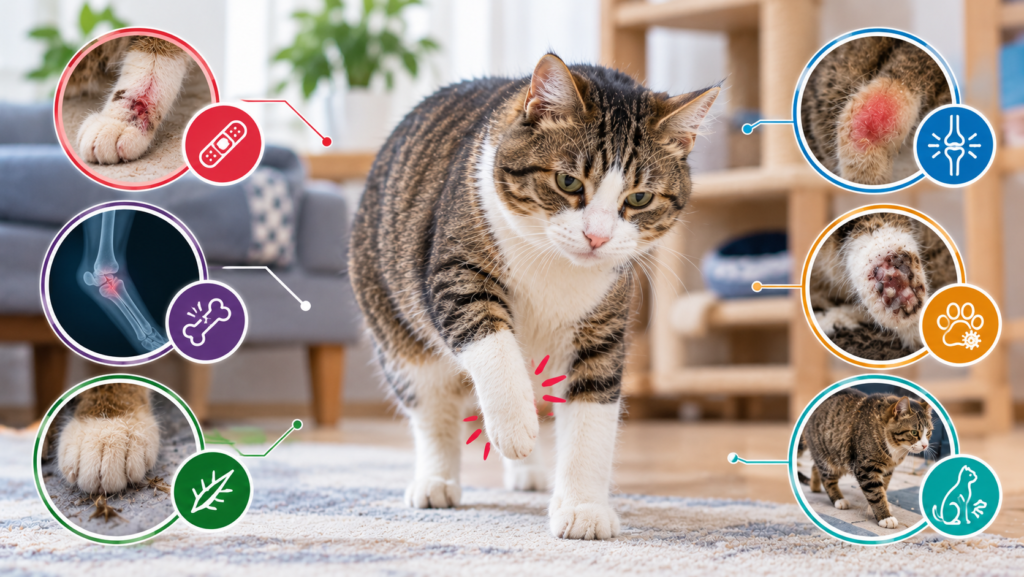

A limping cat is a cat in pain. The cause is often small, like a torn nail, a thorn between the toes, or a pulled muscle. It can also be a bite abscess, a broken bone, or arthritis, and rarely a blood clot that needs help within hours.
Here is the quick plan. Look at the paw and leg gently, keep your cat resting indoors, and watch the limp for a day or two. Call your vet if it does not get better in that time. Go to a vet right away if your cat cannot put weight on the leg, cries out, or has a wound or swelling. The rest of this guide helps you match what you see to the most likely cause.
What does a limp look like in a cat?
A limp means your cat is not using one or more legs the normal way. In cats it is easy to miss. Cats hide pain well, and they don’t walk far enough in a day for a limp to stand out. Here is what to look for:
- Holding one paw off the ground
- Putting less weight on a back leg
- Taking shorter, slower steps
- Stopping before a jump, or skipping jumps your cat used to make
- Licking or chewing one paw or leg more than usual
A cat that hides more, grooms less, or growls when touched may be telling you the same thing. Pain changes behavior as much as it changes the way a cat walks.
Tip: If the limp comes and goes, film your cat walking on your phone. Cats often behave differently in a vet’s office, so a short video shows your vet what you saw at home.
What are the most common causes of a cat limping?
Start at the top of this list, since the first few causes are the easiest to check at home.
Paw and nail problems
The easiest causes to find are in the paw itself. A torn or broken nail, a nail that has grown into the pad, a thorn or splinter between the toes, a cut, or a burn can all make a cat hold up a foot. Cats with a sore paw often lick it again and again. Check between the toes and under the pads first. These problems are usually simple to fix, but a deep splinter or an infected nail still needs a vet.
Bite wounds and abscesses
If your cat goes outside, a fight is one of the top suspects. A cat bite leaves a small hole that closes over fast and traps bacteria under the skin. Over the next two to four days, a pocket of pus (an abscess) builds up. The first sign may be a sudden limp, because the bite is often on a leg or paw. You may also see swelling, a warm spot, a fever, or a cat that is quiet and off its food.
An abscess needs a vet. Treatment usually means draining it, cleaning it, and giving antibiotics and pain relief. Most cats feel much better within a few days. Your vet may also suggest an FIV blood test a few months after a fight, because bite wounds are the main way that virus spreads.
Sprains, strains, and bruises
A bad landing, a rough game, or a slip off a shelf can pull a muscle or sprain a joint. These limps often start suddenly and may be mild. Your cat may still walk on the leg but favor it. Rest is the main treatment. A sprain can look just like a small fracture, though, so a limp that lasts more than a day or two needs an exam, and often an X-ray, to tell the two apart.
Falls, fractures, and dislocations
Most cats will not walk on a broken leg, a torn ligament, or a dislocated joint. Signs include a leg that hangs at a strange angle, a swollen joint, or a bone showing through the skin. If your cat has fallen from a height, been hit by a car, or been attacked by a dog or another animal, treat the limp as an emergency. Major trauma can cause hidden injuries, so a vet should check a cat after a car strike or an attack, even one that can still walk.
Arthritis and joint disease
Arthritis is very common in older cats, yet it rarely looks like a clear limp. In one study of cats over 12 years old, 90 percent had joint disease on X-rays, but only 4 percent were lame. Another review found that 82 percent of cats over 14 had arthritis in at least one joint.
Instead of limping, an arthritic cat may stop jumping onto the sofa, take stairs slowly, feel stiff after rest, or hide more. Slow changes like these are easy to put down to old age, but they are pain, and pain can be treated. Your vet can offer prescribed pain medicine, a weight plan, and tips such as low steps and soft beds.
Less common causes
Some causes are rare but serious. A joint infection, a nerve problem, nerve damage from diabetes, and bone cancer can all cause limping. They usually need blood tests and imaging to find. Any limp that keeps coming back, or has no clear cause after a few days, deserves a full check.
Is it the front leg or the back leg, and does it matter?
It helps your vet, so make a note. A limp in one leg usually points to an injury, such as a pulled muscle, a broken bone, or a bite. A limp in more than one leg is harder to spot and more often comes from a slow problem like arthritis. This table pairs common clues with likely causes.
| What you notice | Likely cause | What to do |
| Sudden limp, and your cat goes outside | Bite abscess, sprain, or a fall | Check for wounds and swelling. See a vet within a day. |
| Holds up one paw and licks it | Torn nail, thorn, or sore pad | Look between the toes. See a vet if you can’t find or fix it. |
| Stiff after rest, stops jumping | Arthritis | Book a vet visit and ask about pain relief. |
| Won’t put any weight on the leg | Fracture, dislocation, or torn ligament | See a vet right away. |
| Back legs suddenly give way, loud crying | Blood clot | Go to an emergency clinic now. |
What should you do at home when your cat is limping?
Stay calm and be careful. A cat in pain can bite or scratch, even someone it loves. If your cat pulls away or growls, stop and call your vet. If you can handle your cat safely, follow these steps.
- Wait until your cat is calm and resting.
- Look over the leg and paw gently. Check for cuts, swelling, a broken nail, or something stuck between the toes or pads.
- Run a finger lightly along the leg. Most cats pull the leg back at a sore spot. Stop there and note where it was.
- Keep your cat indoors in a small, quiet room for a day or two, away from high places. A large dog crate works if your cat won’t settle.
- Watch for 24 to 48 hours. Note whether the limp is better or worse, and whether your cat eats and acts as usual.
- Call your vet if the limp has not improved in that time, or sooner if it gets worse.
If a cut pad or a broken nail is bleeding, press on it gently with a clean cloth first. These first-aid steps for a limping cat cover what to do before you head to the clinic.
Never give human painkillers. Ibuprofen and paracetamol are toxic to cats. Only give pain medicine that your vet has prescribed for your cat.
When is a limping cat an emergency?
Go to a vet or an emergency clinic right away if your cat:
- Cannot stand, or drags a leg
- Has a leg that looks bent, swollen, or out of shape, or a bone showing through the skin
- Was hit by a car or attacked
- Cries, hides, or snaps when you go near the leg
- Has a deep wound, heavy bleeding, or a hot, swollen lump
- Is breathing hard, very sleepy, or confused
- Flinches when you touch its neck or back
The blood clot every cat owner should know about
A saddle thrombus (also called aortic thromboembolism) is a blood clot that blocks blood flow to the back legs. It is usually linked to heart disease, often one that nobody knew about. A cat that was fine a minute ago may cry out, drag one or both back legs, and have cold, pale, or bluish paw pads. Some cats also breathe fast.
You can’t treat this at home. Wrap your cat in a soft blanket, keep your hands away from its mouth, and go straight to an emergency clinic. The outlook is guarded, and fast treatment gives the best chance.
What will the vet do to find the cause?
Your vet will start with questions. When did the limp start? Which leg is it? Is it getting better or worse? Does your cat go outside? Next comes a hands-on exam. Your vet watches your cat walk, then feels the bones, joints, and muscles for pain, swelling, or looseness. The work-up can include X-rays, ultrasound, and other imaging, and often blood tests. If the cause is still unclear, a CT scan, an MRI, or a test of joint fluid may follow.
Treatment depends on the cause. Pain relief usually comes first, as an injection, a patch, or tablets. Abscesses are drained and treated with antibiotics. Some fractures need surgery. Arthritis needs long-term pain control. Anti-inflammatory medicines such as meloxicam and robenacoxib can ease pain from both injuries and arthritis, but they must come from your vet.
How can you help prevent limping?
You can’t stop every accident, but a few habits lower the risk:
- Keep your cat indoors or give outdoor time in a catio or on a leash. This cuts the risk of car strikes, fights, and falls.
- Neuter your cat. Neutered cats roam and fight less, so they get fewer bite abscesses.
- Keep your cat lean. Extra weight strains the joints and makes pain worse.
- Trim the nails so they don’t snag or grow into the pad.
- Book regular check-ups: once a year, and every six months for senior cats.
For older cats, low steps, a ramp to the sofa, and a soft bed on the floor take the strain off sore joints. If your cat is skipping jumps it used to make, mention it at the next visit.
Conclusion
A limping cat is in pain, and the cause can be anything from a torn nail to a broken bone or a blood clot. Check the paw gently, rest your cat indoors, and watch for a day or two. See a vet if the limp lasts, returns, or gets worse, and go straight away if your cat cannot stand, cries out, or has a wound or swelling. A good result is a cat that walks and jumps comfortably again.
Frequently asked questions
Why is my cat limping but not injured?
Limping with no visible wound can come from arthritis, a sprain, an infection, or a problem inside a joint or nerve. None of these show on the skin. If the limp lasts more than a day or two, your vet should examine the leg.
Will my cat’s limp go away on its own?
A mild limp from a small strain can fade with rest in a day or two. Don’t wait longer than that. A limp that stays, returns, or gets worse points to an injury or illness that needs treatment.
Why is my cat suddenly limping on a back leg?
A sudden back leg limp can come from a pulled muscle, a bite abscess, or a fall. If the back legs go weak, the paws feel cold, and your cat cries out, a blood clot is possible. That is an emergency, so go to a vet now.
Can I give my cat ibuprofen or paracetamol for the limp?
No. Both are toxic to cats. Only your vet can pick a safe pain medicine and dose for your cat, so call the clinic if your cat seems to be hurting and you can’t get there right away.
Should I still see a vet if the limp stops?
Yes, if it lasted more than a day or keeps coming back. A limp that comes and goes still means pain. A brief limp that clears in minutes, like a leg that fell asleep, is usually no worry.
Related Articles
Why Won’t My Cat Eat? Causes and What to Do
Is It Normal for Cats to Throw Up? When to Worry


Pingback: Why Is My Cat Salivating So Much? Causes & When to Worry