
Most cats stay in heat for about 7 days at a time. That is only the average, though. A heat can be as short as 1 day or stretch to 21 days, and if your cat is not mated or spayed, she will usually come back into heat after a break of about a week. During the breeding season, that means a new heat roughly every 2 to 3 weeks.
This guide explains how long each stage of the cycle lasts, how often heats return, and the signs that tell you a heat has started. You will also learn how to keep your cat comfortable at home, and why spaying is the only permanent way to stop the cycle.
How long does a cat stay in heat?
The part of the cycle most owners mean by “in heat” is called estrus. It is the stage when the female (a queen) is fertile and receptive to males. Estrus lasts several days for most cats, with 7 days as the average given by VCA Animal Hospitals. Some cats finish in 3 or 4 days. Young cats having their first heats often have shorter ones.
A heat does not start and stop in one step. The full cycle has stages, and knowing them explains why the yowling seems to fade, then return so soon.
| Stage | How long it usually lasts | What happens |
|---|---|---|
| Proestrus | 1 to 2 days | She attracts males but will not accept them. Early restlessness and rubbing begin. |
| Estrus (heat) | About 7 days (range 1 to 21) | She is fertile and receptive. The calling, rolling, and mating posture are strongest now. |
| Interestrus | About 7 days (range 2 to 19) | The quiet break between heats, if she did not ovulate. Then the cycle starts again. |
| Diestrus | About 35 to 40 days | Happens only if she ovulated. If she is not pregnant, this is a false pregnancy, and her body acts pregnant for a while. |
| Anestrus | Weeks to months | The resting stage outside the breeding season, when daylight hours are short. No heats at all. |
Add the stages together and one complete cycle runs about 3 weeks on average, though anything from 1 to 6 weeks can be normal. So if your cat seems to be “in heat all the time,” she is most likely cycling normally: a week of heat, a quiet week, then heat again.
One thing surprises many owners: cats are induced ovulators. That means the egg is released only after mating happens. A cat that never meets a male usually does not ovulate, which is why her heats keep coming back so quickly through the season.
How often do cats go into heat?
Cats are seasonally polyestrous. In plain terms, they have many heats inside one long breeding season. The season is switched on by daylight. In the Northern Hemisphere, most cats cycle from around January to late autumn, then rest during the short days of early winter.
Indoor cats often break this rule. Artificial light and a warm home can keep a cat cycling all year round. Cats in tropical regions may also cycle in every month.
Within the season, the pattern for an unspayed, unmated cat is:
- Heat for about a week
- A quiet break of about a week
- Heat again
So expect a heat every 2 to 3 weeks. If she mates and becomes pregnant, the heats stop until after the kittens are born. If she mates but does not conceive, the false pregnancy stage usually delays the next heat by several weeks.
When do cats first go into heat?
Most female cats have their first heat at around 6 months of age. It can come as early as 4 to 5 months, especially in smaller breeds and in kittens that reach puberty in spring. Some large or long-haired breeds mature later.
Do not count on a kitten being “too young.” A cat can become pregnant during her very first heat, and a pregnancy at that age is risky for both the mother and the kittens. If you do not plan to breed, talk to your vet about spaying before the first heat arrives.
Spayed cats do not go into heat at all. If a spayed cat shows clear heat signs, call your vet. In rare cases a small piece of ovarian tissue remains and keeps the cycle going.
What are the signs of a cat in heat?
With cats, the signs are almost all behavioral. Unlike dogs, cats do not have obvious swelling or bloody discharge, so owners often think their cat is sick or in pain the first time. These are the signs to look for:
Loud calling
Long, drawn-out yowls, often at night. This is advertising, not pain. She is calling to males in the area, and unneutered males nearby may answer, spray outside your home, or try to get in.
Extra affection and rubbing
She may rub against your legs, furniture, and door frames constantly, roll on the floor, and demand attention. Some cats become clingy for the whole heat. Others get briefly irritable if touched near the tail.
The mating posture
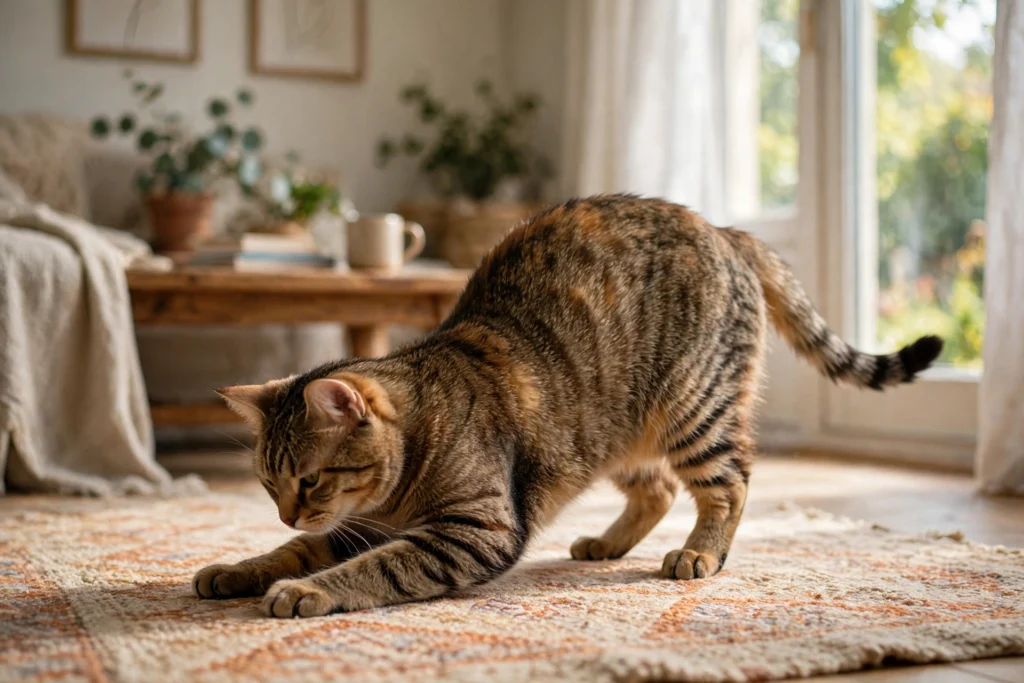
When you stroke her back, she crouches low with her front legs bent, pushes her rear into the air, holds her tail to one side, and treads with her back feet. This posture, called lordosis, is the clearest single sign of heat.
Restlessness and escape attempts
A cat in heat is focused on one thing: finding a mate. She may pace, sit by doors and windows, and dart out the moment a door opens. Keep doors, windows, and screens secure. A cat that gets out during heat will very likely come back pregnant.
Spraying and more trips to the litter box
Some females urinate more often, or spray small amounts on vertical surfaces. Her urine carries scent signals that tell males she is ready. This usually stops when the heat ends.
Less interest in food
Many cats eat less during a heat because mating takes over their attention. A day or two of smaller meals is common. If she stops eating fully, read our guide on why a cat won’t eat and call your vet if it lasts more than 24 to 48 hours.
What you should not see: bleeding. Cats do not normally bleed during heat. Any blood, discharge, or a bad smell is a reason to book a vet visit, as it can point to a urine infection or a womb infection rather than a heat.
How can you help a cat in heat at home?
You cannot switch a heat off, and no home remedy safely ends one early. What you can do is lower her stress and keep her safe until it passes:
- Keep her indoors. Close windows and be careful with doors. This is the single most important step if you do not want kittens.
- Play with her. Short, active play sessions burn off restless energy and can help her settle, especially in the evening when calling is often worst.
- Give her a calm corner. A quiet room with her bed, water, and litter tray helps. Some cats like a warm (not hot) blanket or a self-warming pad to lie on.
- Keep the litter tray extra clean. She is urinating more often, and a clean tray discourages spraying elsewhere in the house.
- Try catnip or silver vine. Some cats relax with it, others get more excited. Offer a little and see which way your cat goes.
- Be patient, and do not punish the noise. The yowling is hormonal, not bad behavior. Shouting or punishment only adds stress.
Avoid hormonal sprays, tablets, or injections sold online to “stop” heat unless your vet prescribes them. Some of these products carry serious side effects, including womb infection and tumors. If the heats are a real problem, spaying is safer than repeated hormone drugs.
Can you stop a cat from going into heat?
Yes. Spaying is the only permanent answer. It removes the ovaries (and usually the uterus), so the heat cycle ends for good. The ASPCA notes that spaying also prevents womb infections and lowers the risk of breast tumors, which are cancerous in about 90 percent of cats. Spaying before the first heat gives the strongest protection against those tumors.
Can a cat be spayed while she is in heat? Usually yes, but many vets prefer to wait until the heat finishes, because the tissues carry more blood during estrus and surgery can be a little more complex and costly. If your cat is mid-heat, call your vet and agree on the timing together.
Until she is spayed, every heat carries a real pregnancy risk. A short escape is all it takes, and a cat can have several litters in a single year.
When should you call the vet?
A normal heat needs no treatment. Book a visit if you notice any of the following:
- Heat signs that run non-stop for more than 2 to 3 weeks with no quiet break. This can point to an ovarian problem or a false cycle pattern that needs checking.
- Blood, discharge, or a foul smell. None of these belong to a normal heat.
- She stops eating or drinking, vomits, or becomes very quiet. Illness and heat can happen at the same time.
- She got outside while in heat. Your vet can explain your options, and the sooner you call, the more options you have.
- A spayed cat showing heat signs.
- She seems to be crying in pain rather than calling, strains to urinate, or cannot pass urine. Treat this as urgent.
If you are unsure whether the behavior is heat or sickness, a short video helps your vet a lot.
Conclusion
A typical cat stays in heat for about 7 days, comes out of it for roughly a week, then starts again, repeating every 2 to 3 weeks through the breeding season. The loud calling, rolling, and mating posture are normal signs, and home care is mostly about keeping her indoors, calm, and safe. If you are not breeding, spaying ends the cycle for good and protects her health. Heats that never seem to pause, any bleeding, or a cat that stops eating need a vet.
Frequently asked questions
How long does a cat’s full heat cycle last?
One full cycle, heat plus the break that follows, averages about 3 weeks. It can be as short as 1 week or as long as 6 weeks, and still be normal.
Do cats bleed when they are in heat?
No, not normally. Unlike dogs, cats do not have a bloody discharge during heat. A few drops of clear fluid can appear, but blood is not expected. If you see blood, book a vet visit to rule out a urine or womb infection.
Can you spay a cat in heat?
Yes, in most cases. The surgery is slightly more involved because blood flow to the area is higher, and some clinics charge a little more. Many vets prefer to wait a week or two until the heat ends. Ask your vet what they recommend for your cat.
How do you know when a cat is out of heat?
The signs fade over a day or two. The calling stops, she no longer crouches into the mating posture when stroked, her appetite returns, and she acts like herself again. Remember the break is often only about a week before the next heat begins.
Do male cats go into heat?
No. Only females have heat cycles. An unneutered male is ready to mate at any time once mature, and he will react strongly to a female in heat nearby, with calling, spraying, and attempts to reach her.
Can a cat get pregnant during her first heat?
Yes. Cats can conceive from their first heat, which can arrive as early as 4 to 5 months old. Keep young females indoors and away from unneutered males, and ask your vet about early spaying.