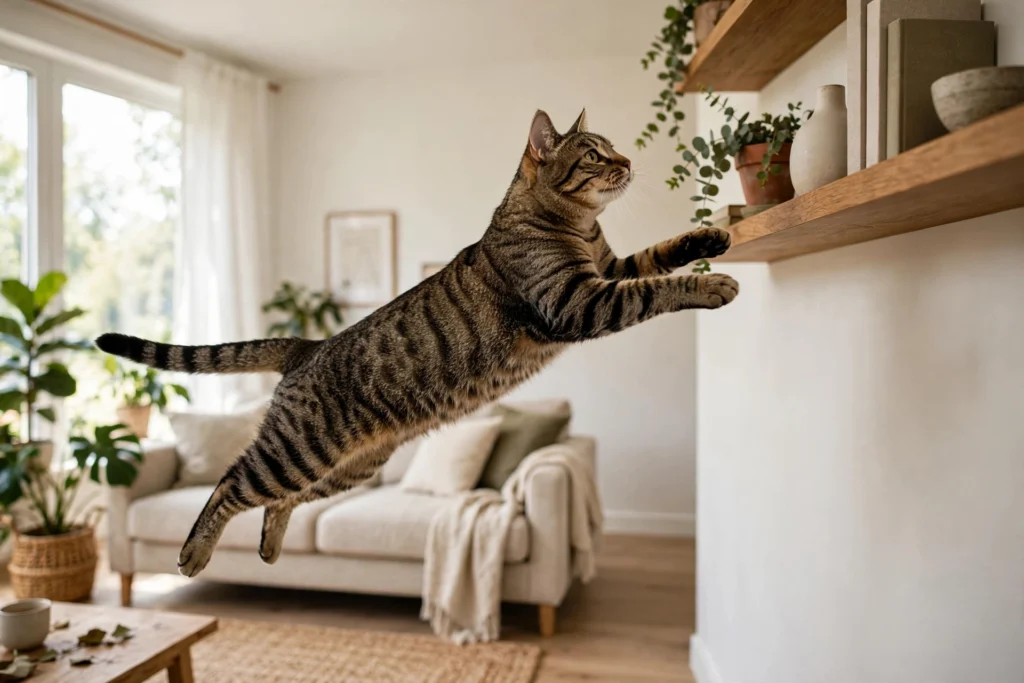

A healthy adult cat can jump about 5 to 6 feet straight up from a standstill — and athletic cats can do even better. Measured against their own bodies, that is roughly five to six times their body length in a single leap. If you could jump in the same proportion, you would clear a two-story house.
This guide explains where those numbers come from, the anatomy that powers such an outsized leap, and how jump height changes with age and breed. It also covers the horizontal jump, how to set up safe jumping routes at home, and the honest truth about cats and falls — because a great jumper is not an invincible one.
How high can cats jump, exactly?
You will see a few different numbers quoted, so here is the fair summary. Most healthy adult house cats manage around 5 feet vertically without much trouble, and 6 feet is well within reach for a fit, motivated cat. Cat care sources, including Chewy’s guide to cat jumping, put the vertical jump at about five to six times a cat’s body length and give top figures of 8 to 9 feet for the most athletic leaps.
Why the gap between 5 and 9 feet? The numbers measure different things. Five to six feet is the comfortable, everyday jump of an average pet cat. The higher figures come from the most athletic cats jumping at full effort, sometimes with a short run-up or a boost from a lower surface. What is consistent across sources is the ratio: a cat’s leap is extraordinary for its size, roughly five to six times its body length.
For everyday life, the practical takeaway is simple: if a surface in your home is under about 6 feet high, assume your cat can reach it. That includes kitchen counters, the top of wardrobes, and most garden fences.
Why can cats jump so high?
A cat’s jump is not one trick. It is several pieces of anatomy working together.
Powerful hind legs
A cat’s back legs are much longer and stronger than its front legs, relative to body size, and they act like loaded springs. When a cat crouches before a jump, it compresses those legs; when it launches, the legs extend explosively and do almost all the work of the leap. The front legs mainly reach, steer, and prepare for the landing.
A flexible spine
A cat’s spine is unusually flexible, with extra give between the vertebrae. During a jump the spine first curls, then extends fully, adding length and power to the launch like a bow uncurling. The same flexibility lets a cat stretch its body out in mid-air and reposition for the landing.
Fast, strong muscle
Cats carry a high proportion of fast-twitch muscle fiber, the type built for short bursts of explosive power rather than endurance. They cannot run for long distances, but for a single split-second effort — a pounce or a leap — few animals their size come close.
A tail for balance
The tail works as a counterweight. In mid-air a cat swings and angles its tail to fine-tune its position, correct small tilts, and line up the landing. Cats with short or missing tails can still jump well, but a full tail makes mid-air steering noticeably easier.
Built-in landing gear
The landing matters as much as the launch. Cushioned paw pads, flexible leg joints, and loose shoulder blades all absorb impact, and sensitive receptors in the paws give the cat instant feedback about the surface it is leaving and the one it is aiming for. This is how cats land so quietly and precisely on narrow edges.
How high can cats jump at different ages and breeds?
Not every cat is an athlete. Age, build, and breed change the numbers a lot:
| Cat | Typical vertical jump | Notes |
|---|---|---|
| Young kitten (under 6 months) | Low — hops and scrambles more than jumps | Legs and coordination are still developing; climbing often substitutes for jumping |
| Healthy young adult | About 5 to 6 feet | Peak jumping years; fit cats may exceed this |
| Athletic, slim breeds (Bengal, Abyssinian, Savannah, Oriental) | 6 feet and above | Long legs, lean muscle, and a strong drive to climb and leap |
| Heavy or stocky breeds (British Shorthair, Persian) | Lower — often 3 to 4 feet | More body weight for the same engine; many prefer shorter hops between levels |
| Senior cats (11+) | Drops off noticeably | Arthritis and muscle loss are the usual reasons; steps and ramps help |
Motivation matters too. A cat jumping for a high perch it loves, or away from a startling noise, will outperform a cat making a lazy hop. And a cat jumping from furniture part-way up starts with a head start, which is why cats chain smaller jumps — floor to chair, chair to counter, counter to the top of the fridge — to reach heights no single leap could manage.
How far can cats jump horizontally?
The long jump is as impressive as the high jump. A healthy adult cat can typically leap about 5 to 7 feet horizontally — again, around five to six times its body length. You can see this in action whenever a cat clears the gap between two pieces of furniture without hesitation.
The official record is remarkable. The Guinness World Record for the longest jump by a cat is 7 feet 6 inches (about 2.3 meters), set by a cat named Sputnik in Italy in 2024. Ordinary cats will not match a record holder, but a 5-foot gap — across a hallway, or from a fence to a shed roof — is comfortably within a normal cat’s ability, which is worth remembering if you are trying to keep a cat in (or out of) a garden.
Vertical and horizontal jumps use the same engine but different technique: the vertical jump is mostly raw hind-leg power, while the long jump adds body extension and a flatter trajectory. Cats judge both carefully before committing, which is why you will see a cat crouch, wiggle, and measure a gap with its eyes before it finally goes.
How can you make jumping safer at home?
Jumping is natural, healthy exercise, and trying to stop it entirely is a losing battle. The goal is to give your cat good places to jump, and to remove the risky ones.
- Make perches solid. Wall shelves, cat trees, and window perches must be fixed firmly enough to take a landing cat at speed. A shelf that wobbles or pulls loose mid-landing is how injuries happen.
- Clear the landing zone. Cats aim for a specific spot. Keep breakables, hot pans, and clutter off the surfaces your cat uses, and leave landing space around perches rather than crowding them.
- Build stairs out of furniture. Arrange stable intermediate levels — a sturdy box, an ottoman, a mid-height shelf — so young, old, or heavy cats can climb in stages instead of attempting one big leap or, worse, one big drop.
- Add steps or a ramp for seniors. A cat that once cleared 5 feet may quietly stop trying. Pet steps beside the bed or sofa let an older cat keep her favorite spots without painful jumps.
- Secure windows and balconies. Use proper window screens and balcony netting. Most serious falls happen when a cat slips or lunges at a bird, not when she deliberately jumps.
Can cats get hurt falling? The truth about high-rise syndrome
Cats are famous for landing on their feet, and the righting reflex behind that fame is real: a falling cat can twist in mid-air to land feet-first, then spread its body to slow the fall. But landing on your feet is not the same as landing safely.
Vets have a name for the pattern of injuries from falls from the second story or higher: high-rise syndrome, a term coined by New York City veterinarians in the 1980s. Typical injuries include broken limbs, jaw and facial fractures, chest trauma, and internal injuries. Studies of cats brought to vets after falls found that around 90 percent survived with treatment — an impressive figure, but one that still means falls regularly kill and maim cats, and about a third of survivors would not have made it without veterinary care.
One finding surprises people: very short falls can injure a cat badly too, because the cat may not have time to right itself before landing. And the old claim that cats are safe falling from any height is simply false. Any cat that has fallen from a window or balcony should see a vet the same day, even if she seems fine, because chest and internal injuries are not always obvious at first.
When is jumping less a warning sign?
A cat that suddenly jumps less, or stops jumping altogether, is often telling you something hurts. The most common cause in older cats is arthritis, which is very common in seniors and easy to miss because cats hide pain well. Watch for hesitation before a jump, failed attempts, using intermediate surfaces she used to skip, or new grumpiness about being picked up. Weight gain makes jumping harder too, and a cat that has put on pounds may quietly retire from her high perches.
Appetite is part of the picture as well: pain and stiffness often show up as a cat eating less, especially if her bowls require a jump or an awkward climb to reach. If your cat’s habits have changed, our guide on why a cat won’t eat will help you work through the possibilities, and a vet check is the right next step either way. Do not give a cat human painkillers — common ones like ibuprofen and paracetamol are poisonous to cats. Your vet can offer safe pain relief and joint support that genuinely improve an older cat’s mobility.
Conclusion
A healthy cat can jump around 5 to 6 feet straight up — five to six times its own body length — powered by spring-loaded hind legs, a flexible spine, fast-twitch muscle, and a tail that steers in mid-air. Athletic breeds clear even more, kittens and seniors less, and the official long jump record stands at an astonishing 7 feet 6 inches. Celebrate the athleticism, but respect its limits: fix perches firmly, give older cats steps, secure high windows, and remember that landing on their feet does not make cats fall-proof. And if a cat that used to leap suddenly stops, treat the change as information — it is one of the earliest signs of pain your vet can help with.
Frequently asked questions
Can cats jump over a 6-foot fence?
Many can. A fit adult cat can jump close to or above 6 feet, and cats also climb and use nearby objects as launch pads. If keeping your cat in the garden matters, add angled netting or rollers to the top of the fence and clear away furniture and bins near it.
How high can a kitten jump?
Much less than an adult. Young kittens mostly hop, climb, and scramble while their legs and coordination develop. Jumping power builds over the first year, and adult-level leaps usually arrive by about 12 months of age.
Can a cat jump from a height without getting hurt?
Sometimes, but never count on it. Cats right themselves in the air and land on their feet, yet falls still cause broken bones, jaw fractures, and chest injuries — the pattern vets call high-rise syndrome. Short falls can be dangerous too, because the cat may not have time to twist upright. Any significant fall deserves a same-day vet visit.
Why does my cat hesitate or wiggle before jumping?
The crouch and wiggle are measurement and loading. Your cat is judging the distance, testing the surface, and compressing her hind legs like springs before launch. Older or sore cats hesitate longer, and a cat that starts refusing jumps she used to make should be checked for arthritis or injury.
Which cat breeds jump the highest?
Lean, long-legged, athletic breeds are the standout jumpers: Bengals, Abyssinians, Savannahs, and Orientals are all known for clearing 6 feet and seeking out the highest spots in the house. Stockier breeds such as British Shorthairs and Persians usually jump lower and prefer staged climbs.
Do cats always land on their feet?
Almost always, given enough falling distance — the righting reflex is fast and reliable. But “on their feet” does not mean “unhurt.” Landing forces can still break legs and jaws and injure the chest, which is exactly why vets advise a checkup after any serious fall.



Pingback: Do Cats' Teeth Fall Out? Kittens Yes, Adults No