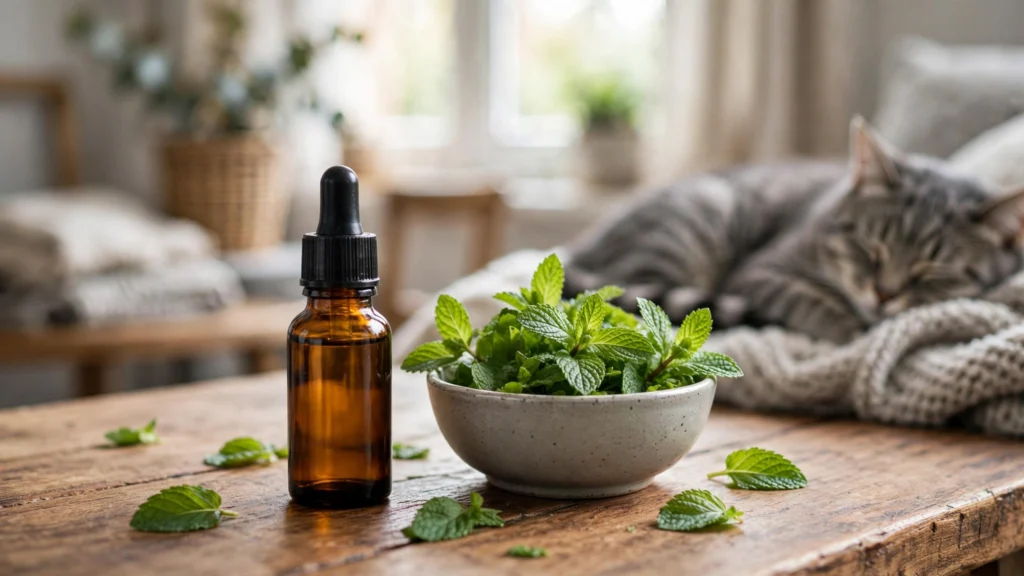

No. Peppermint oil is not safe for cats. It is one of the essential oils known to poison them, and it can harm your cat whether she licks it, gets it on her skin, or breathes it in from a diffuser.
That answer surprises a lot of people. Peppermint oil is natural, it smells clean, and for humans it is a mild, useful remedy. You may have bought it to freshen a room, ease a headache, repel mice, or treat fleas. None of that matters to a cat’s body. What is gentle for you can be genuinely dangerous for her, and this guide explains why, the warning signs to watch for, and what to use instead.
Why is peppermint oil so dangerous for cats?
The problem is in your cat’s liver. To break down many plant compounds, the body uses an enzyme called glucuronyl transferase. Cats have very little of it. Dogs and humans process these compounds far more easily, which is why a product can be safe around a dog and still poison a cat.
Peppermint oil is rich in compounds called phenols, plus ketones such as pulegone and menthol-related chemicals. Because your cat cannot clear them efficiently, they build up and start to damage the liver and the nervous system. The Pet Poison Helpline lists peppermint oil by name among the essential oils known to cause poisoning in cats, alongside wintergreen, tea tree, eucalyptus, clove, cinnamon, pine, and citrus oils.
Concentration makes it worse. An essential oil is the plant squeezed down to its strongest form. A cat sniffing a mint leaf in the garden is meeting a tiny trace of these compounds. A cat licking peppermint oil from her fur is meeting hundreds of times more, all at once. That is why “natural” and “diluted at home” do not make a bottle of oil safe.
Cats add one more risk of their own: grooming. Anything that lands on the coat ends up in the stomach. Oil mist from a diffuser, a splash from a knocked-over bottle, or oil rubbed on the skin for fleas all get licked off and swallowed during a normal wash.
How can a cat be exposed to peppermint oil?
Poisoning does not only happen when a cat drinks from the bottle. These are the routes vets see most often:
| How it happens | Where it usually comes from | What it can cause |
|---|---|---|
| Breathing it in | Ultrasonic diffusers, steam, sprays used in a closed room | Irritated airways, coughing, fast or labored breathing, pneumonia in bad cases |
| Skin contact | Oil applied for fleas, spills, walking through a puddle of oil | Skin irritation or burns, then poisoning when she grooms it off |
| Swallowing it | Licking oil off fur, lapping a spill, oil mixed into food or water | Drooling, vomiting, stomach ulcers, liver damage |
| Long, low-level exposure | A diffuser running for hours every day in the room where she sleeps | Slow build-up, vague illness, liver stress over time |
Notice how ordinary these situations are. Nobody has to feed a cat oil for this to go wrong. A diffuser on a shelf, a flea “remedy” shared in a social media video, or a bottle left open on a counter is enough.
Is diffusing peppermint oil around cats safe?
This is where most owners get caught, because diffusing feels harmless. The oil never touches the cat, so how can it hurt her?
There are two kinds of diffuser, and they are not equal. Passive diffusers, like reed diffusers and scented candles, mostly release fragrance. Their main risk is irritation from strong smells, plus real danger if the liquid spills or is licked. Active diffusers are the bigger problem. Ultrasonic and nebulizing diffusers push out tiny droplets of actual oil. Those droplets hang in the air, your cat breathes them in, and they settle on her coat, where she later licks them off.
The ASPCA takes a careful middle line: using a diffuser for a short time in a secured room your cat cannot enter is not likely to be a problem. But if your cat has any history of breathing trouble, it is best not to use one at all. The ASPCA also points out that a scent that seems light to you can overwhelm a cat, whose sense of smell is far stronger than yours.
With peppermint specifically, the sensible rule is stricter than the general one. Peppermint is on the known-toxic list, not the “probably fine” list. Keep it out of rooms your cat uses, never run any diffuser in a closed room with your cat inside, and always leave a door open so she can walk away from a smell she dislikes.
What are the symptoms of peppermint oil poisoning in cats?
Signs depend on how much oil your cat met and how, but the pattern is consistent. Watch for:
- Drooling and pawing at the mouth. Often the first sign after a lick or taste.
- Vomiting or diarrhea. The gut reacts fast to swallowed oil.
- Refusing food. A poisoned cat usually goes off her meals. If your cat stops eating completely, our guide on why a cat won’t eat explains when that becomes an emergency on its own.
- Breathing changes. Coughing, wheezing, panting, or breathing that looks fast or hard. Any breathing struggle is urgent — see our guide on why a cat is breathing fast for how to judge it.
- Wobbliness and weakness. Vets call the unsteady, “drunk” walk ataxia. Tremors can follow.
- Lethargy or depression. Hiding, unresponsiveness, and low body temperature appear in more serious cases.
- Red, irritated skin where oil touched it, and watery eyes or a runny nose after inhaling fumes.
- Seizures or collapse. These are the most severe signs and mean the poisoning is advanced.
Liver damage is the slow, hidden part. A cat can seem to recover from the drooling and vomiting while her liver is still struggling, which is why a vet check matters even when the obvious signs settle down.
What should you do if your cat is exposed to peppermint oil?
Act quickly and calmly. Speed makes a real difference with essential oils, because they absorb fast through skin, lungs, and gut.
- Get her into fresh air. If a diffuser is running, switch it off, open windows, and move your cat to a clean room.
- Wash oil off her coat. If oil is on her fur or skin, wash the area with a small amount of mild dish soap and lukewarm water, as the ASPCA advises for greasy substances. This stops her swallowing more as she grooms.
- Do not make her vomit. Never induce vomiting at home unless a vet tells you to. Oils can be breathed into the lungs on the way back up and cause pneumonia.
- Take the bottle with you. The label tells the vet exactly which oil and how concentrated it is. That changes treatment.
- Call for help straight away. Phone your vet or an emergency clinic. If you cannot reach one, the ASPCA Animal Poison Control Center is on (888) 426-4435, and the Pet Poison Helpline is on (800) 213-6680, day and night. A consultation fee may apply.
Do not wait to “see how she goes” if she is drooling heavily, breathing oddly, wobbling, or has swallowed oil directly. Those cats need to be seen, not watched.
Are some cats at higher risk than others?
Yes. Any cat can be poisoned, but these cats have less margin for error:
- Kittens. Small bodies, immature livers, and they explore everything with their mouths.
- Cats with liver disease. The organ that struggles with phenols is already compromised.
- Cats with asthma or other breathing problems. Inhaled oil irritates airways that are already reactive.
- Small or elderly cats. Less body weight means the same exposure is a bigger dose.
- Cats in small, closed homes. Nowhere for fumes to disperse, and nowhere for the cat to escape them.
If your cat is on that list, the honest advice is to keep essential oils out of the house entirely, not just peppermint.
What can you use instead of peppermint oil?
Most people reach for peppermint oil for one of three jobs: repelling pests, freshening a room, or treating fleas. Each has a safer answer.
For mice and spiders. Peppermint oil is a weak repellent even when it works. Sealing the gaps mice use to get in, storing food in hard containers, and using snap traps or humane traps placed where your cat cannot reach them all work better and poison nothing. If you need a deterrent sprayed at entry points, spray it outside the home, at the hole itself, never in your cat’s living space.
For fleas. Never use essential oils as flea treatment, peppermint included. This is one of the most common causes of essential oil poisoning, because owners apply the oil directly to the coat. Use a vet-approved flea preventative made for cats, and treat the home with regular vacuuming and hot washes of bedding.
For a fresh-smelling home. Open windows beat any bottle. Simmer-based scents and plug-ins carry the same fumes problem in weaker form, so ventilate well. Baking soda sprinkled on carpets and vacuumed up after a short sit neutralizes odor without adding anything to the air. If you love scent, use your diffuser in one room, for a short time, with the door closed to your cat — and choose your times for when she is happily elsewhere.
For your own headaches and congestion. Use your peppermint oil on yourself, away from your cat, and wash your hands before stroking her. Do not cuddle her with oil freshly applied to your skin or a scented balm on your chest. She will rub against it, then groom it off herself.
Conclusion
Peppermint oil is not safe for cats. Their livers lack the enzyme needed to process the phenols it contains, so it can poison them through the lungs, the skin, or the stomach, and it sits on the Pet Poison Helpline’s list of oils known to cause poisoning in cats. Diffusing it in a closed room, applying it for fleas, or leaving a bottle where a curious cat can reach it are all real risks, not technicalities. The good news is that nothing peppermint oil does is irreplaceable: traps, sealing, ventilation, and vet-approved flea control all do the same jobs without the danger. And if exposure has already happened, fresh air, a wash, and a fast call to your vet or poison control give your cat the best chance of a full recovery.
Frequently asked questions
Is peppermint oil safe for cats to smell?
A faint, brief smell from another room is unlikely to poison a healthy cat. The danger rises with strength and time: concentrated fumes in a closed space can irritate the airways, and oil droplets settle on the coat and get licked off. If your cat leaves the room, sneezes, or seems unsettled when a scent runs, trust her judgment and switch it off.
Is diluted peppermint oil safe for cats?
Dilution lowers the dose but does not make peppermint oil safe to put on a cat, in her food, or in her water. Home dilution is guesswork, and cats groom off whatever lands on them, concentrating the dose again in the stomach. There is no home-diluted strength that vets recommend applying to cats.
Are fresh peppermint plants safe for cats?
The plant is far weaker than the oil, and a cat who nibbles a leaf is meeting a trace of the compounds, not a concentrated dose. Even so, peppermint sits on the ASPCA’s toxic plant list for cats because its oils can cause stomach upset, so it is best kept out of reach and never offered as a treat. The concentrated oil is the real hazard.
Can I use peppermint oil to keep mice away if I have a cat?
It is a poor trade. Peppermint oil is an unreliable mouse repellent, and every cotton ball soaked in it is a poisoning risk sitting at floor level where your cat lives. Seal entry points and use traps placed inside cupboards, wall voids, or other spots your cat cannot access instead.
What essential oils are toxic to cats besides peppermint?
The Pet Poison Helpline’s list of oils known to poison cats includes wintergreen, sweet birch, citrus (limonene), pine, ylang ylang, cinnamon, pennyroyal, clove, eucalyptus, and tea tree (melaleuca) oils. As a rule, treat all concentrated essential oils as unsafe around cats unless your vet specifically approves one.


Pingback: Can Cats Have Coconut Oil? Benefits, Risks and Dosage