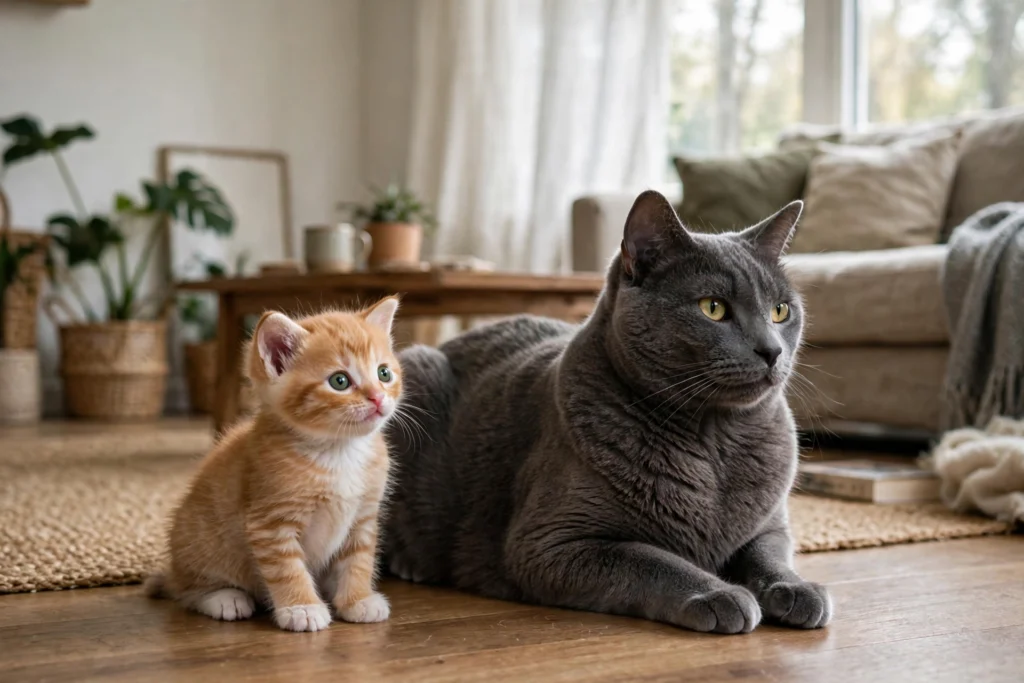

Most cats are fully grown by 12 to 18 months of age. They reach most of their adult height and length by their first birthday, then spend a few more months filling out with muscle and body condition. Large breeds are the exception: a Maine Coon can keep growing slowly until 3 to 5 years of age.
So “fully grown” depends on what you measure. This guide explains when growth in height and length stops, how the timeline changes with breed size, kitten growth month by month, the difference between true growth and simple weight gain, when to switch to adult food, and the signs that your cat has finished growing.
When are cats fully grown?
For a typical domestic cat, the answer is somewhere between 12 and 18 months. PetMD notes that cats are typically considered fully grown at about 1 year of age, when they have reached their mature size, which averages 8 to 10 pounds. Even so, many cats continue slow, subtle growth for several months after that, and 18 months is a safe point to call growth complete for an average-sized cat.
Two separate things have to finish before a cat is truly fully grown:
- Skeletal growth. The growth plates at the ends of the long bones stay open while a kitten is growing, then gradually close as maturity approaches. Once they have closed, the cat will not get any taller or longer.
- Filling out. After the frame reaches its final size, the cat adds muscle, a broader chest and head in males, and normal adult body condition. This is why a 12-month-old cat can look leggy and slim, then look noticeably more solid at 18 months without having grown upward at all.
Sex plays a part too. Males usually grow a little longer than females and end up larger, while females of many breeds reach their final size closer to 10 to 12 months. Neutering, nutrition, and general health can shift the timeline by a month or two in either direction.
How does breed size change the growth timeline?
Breed size is the biggest reason one cat finishes growing at a year and another is still going at three years. As a general pattern, the larger the breed, the longer it takes to mature.
| Breed size | Examples | Typical adult weight | Fully grown by |
|---|---|---|---|
| Small | Singapura, Cornish Rex, Devon Rex | About 5 to 8 pounds | Around 9 to 12 months |
| Medium (most cats) | Domestic shorthair, Siamese, Russian Blue, British Shorthair | About 8 to 12 pounds | Around 12 to 18 months |
| Large | Ragdoll, Norwegian Forest Cat | About 12 to 16 pounds | Around 2 to 3 years |
| Extra large | Maine Coon | Often 13 to 18 pounds for males | Around 3 to 5 years |
Mixed-breed cats, which make up most household cats, usually follow the medium timeline, with their adult size landing somewhere near their parents’ size. If you know what the mother and father looked like, that is the best clue to how big a kitten will get.
The Maine Coon deserves a special mention because it breaks these rules so clearly. Maine Coons grow slowly and steadily, often not reaching their full height, length, and heavy bone structure until somewhere between 3 and 5 years of age. Owners are often surprised when a “finished” 2-year-old Maine Coon adds more size during year three.
What are a cat’s growth stages by month?
Growth is fastest in the first six months and slows steadily after that. The weights below follow the rough rule of thumb that a young kitten gains about a pound a month, so a healthy kitten’s weight in pounds often matches its age in months early on. Kittens vary, so treat the table as a guide rather than a target.
| Age | Typical weight | What is happening |
|---|---|---|
| Birth to 2 weeks | A few ounces, roughly doubling birth weight in the first week or two | Born with eyes and ears closed; eyes open at about 8 to 12 days; eats and sleeps |
| 3 to 4 weeks | About 0.5 to 1 pound | Walking begins at 2 to 3 weeks; first baby teeth appear; play with littermates starts |
| 5 to 8 weeks | About 1 to 2 pounds | Weaning begins around 5 weeks and most kittens are fully weaned by about 7 weeks; first vaccinations are due |
| 2 to 3 months | About 2 to 3.5 pounds | Peak playfulness and social learning; ready for a new home from about 8 to 12 weeks |
| 4 to 6 months | About 4 to 6 pounds | Adult teeth come through between 3 and 4 months; sexual maturity can arrive from 4 months onward, so ask your vet about neutering |
| 6 to 9 months | About 6 to 8 pounds | The “teenage” stage; roughly 80 percent of adult size for an average cat; growth in height starts to slow |
| 9 to 12 months | About 7 to 10 pounds | Close to full height and length; behavior still kittenish; most cats can move to adult food at around 12 months |
| 12 to 18 months | Adult weight for the breed, about 8 to 10 pounds for an average cat | Growth plates close; the cat fills out with muscle and reaches full adult size |
| 18 months to 2 years | Stable for most cats | Average cats are done; large breeds are still slowly growing and filling out |
| 3 to 5 years | Full adult size for giant breeds | Maine Coons and similar extra-large breeds finally reach complete maturity |
A kitten that looks almost adult-sized at 6 months still has a lot of maturing to do inside, which is why kitten food and kitten care continue through the first year.
What is the difference between growing and gaining weight?
This distinction catches many owners out. A cat grows in two ways, and only one of them continues for long.
Growth means the skeleton is getting bigger: longer legs, a longer spine, a wider skull. This is controlled by growth plates, and it stops for good once those plates close, at around 12 to 18 months for most cats.
Weight gain means soft tissue is being added: muscle first, then fat if the calories keep coming. A cat that “keeps growing” at 3 years old — heavier and rounder — is almost always gaining fat, not height.
This matters for feeding. Kitten food is calorie-dense because kittens are building a body. Once growth has finished, an adult still eating like a kitten, especially after neutering when energy needs drop, will steadily gain fat. Weighing your cat every month or two and feeling for the ribs under a thin fat layer is a simple way to tell healthy filling out from creeping weight gain.
When should you switch from kitten food to adult food?
Most cats should move from kitten food to adult food at around 12 months of age, when growth slows to a stop for an average-sized cat. Adult formulas provide the right calories and nutrients for maintenance rather than building.
Adjust the timing to the cat in front of you:
- Small breeds that finish growing early may switch a little sooner, around 9 to 12 months, especially if they are starting to look round.
- Average cats switch at about 12 months.
- Large and extra-large breeds keep growing well past their first birthday, and many breeders and vets keep them on kitten or young-adult food until 18 to 24 months. Ask your vet what suits your cat.
Make the change gradually over about a week, mixing an increasing proportion of the new food into the old. A sudden swap is a common cause of an upset stomach. And if your cat flatly refuses meals during the transition or at any other time, do not let it drag on. Our guide on why a cat won’t eat explains when a skipped meal is harmless and when it needs a vet.
What are the signs your cat has finished growing?
You cannot see growth plates from the outside, but together these signs make a reliable picture:
- Weight is stable. Your cat’s weight stays within a few ounces for two to three months in a row, instead of climbing steadily as it did in kittenhood.
- Height and length stop changing. The cat no longer looks leggier or longer month by month, and last month’s collar still fits the same.
- The body looks filled out. The narrow, gangly teenage shape gives way to a smooth adult outline, with muscle over the shoulders and hips.
- All adult teeth are in. The full set of permanent teeth is usually complete by about 6 to 7 months, an early milestone that says the head and jaw are approaching adult size.
- Behavior settles (a little). The frantic kitten energy softens into adult patterns of play, rest, and routine, though plenty of adult cats stay playful for years.
- Your vet confirms it. At the 1-year check-up, your vet can judge body condition and, if it ever matters, an X-ray can show whether the growth plates have closed.
If your cat is an average mixed breed and is past 18 months with stable measurements, you can safely call them fully grown.
When should you call the vet about growth?
Steady growth is a sign of health, so changes in the pattern are worth a check. Book a visit if:
- A kitten stops gaining weight, or loses weight at any point
- Your kitten is dramatically smaller than its littermates and falling further behind
- A young cat seems stunted while its appetite is poor, or it has ongoing diarrhea, which can point to parasites or other problems stealing nutrition
- An adult cat keeps gaining weight quickly after growth should have finished, which suggests overfeeding or, less commonly, a medical issue
- You are unsure whether your cat’s size is normal for its breed and age
Slow growth caught early is usually much easier to fix than slow growth noticed months later, so it is always worth asking.
Conclusion
Most cats are fully grown between 12 and 18 months, reaching nearly all of their height and length by the first birthday and filling out afterward. Small breeds can finish as early as 9 to 12 months, while a Maine Coon may keep growing until 3 to 5 years old. Track weight month by month, switch to adult food at about 12 months (later for giant breeds), and remember that after the growth plates close, extra size means extra weight, not extra growth.
Frequently asked questions
Is a cat fully grown at 6 months?
No. A 6-month-old kitten may look like a small adult and be about 80 percent of its final size, but its growth plates are still open and it will keep growing in height, length, and muscle for months yet. Six months is closer to the teenage stage than to adulthood.
Do cats keep growing after 1 year?
Many do, just slowly. Between 12 and 18 months most cats add their last bit of skeletal growth and fill out with muscle. Large breeds continue for much longer, and giant breeds like the Maine Coon can grow until 3 to 5 years of age.
When do Maine Coons stop growing?
Maine Coons are the slowest-maturing common breed. Most reach close to full size by 3 years, and some keep adding size until 4 or 5 years of age.
Do male cats grow bigger than females?
Usually, yes. Males of most breeds end up somewhat heavier and larger-framed than females, and they often grow for a little longer too. The difference is modest in small breeds and much more obvious in large breeds like the Maine Coon.
Does neutering affect how big a cat grows?
Neutering changes the hormones involved in growth, and cats neutered young may grow very slightly taller because their growth plates can stay open a little longer. In practice the size difference is small. The bigger effect is on weight: neutered cats need fewer calories, so portion control matters once they are fully grown.
How can I tell how big my kitten will get?
Look at the parents if you can, since genetics is the strongest guide. Breed standards give a good range for purebred cats. Paw size is a popular clue, but it is not reliable on its own. A vet tracking your kitten’s growth curve over the first year can give you a sensible estimate.



Pingback: Do Cats Need Baths? How Often to Bathe a Cat Safely