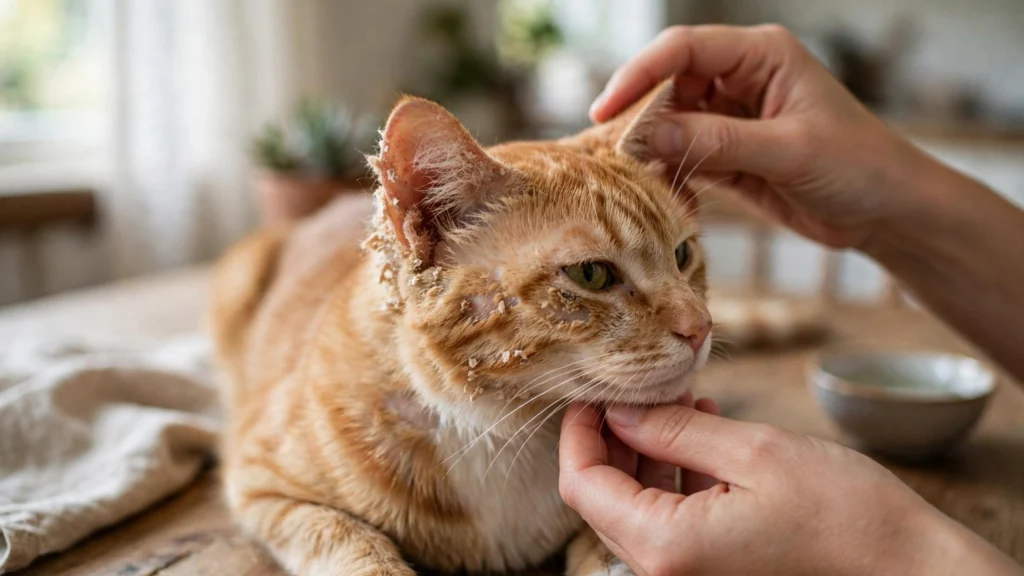

Mange on a cat usually looks like patchy hair loss with crusty, scaly, thickened skin and non-stop scratching. The most common form, feline scabies, almost always starts on the edges of the ears and the face, where you will see grey or yellow crusts and bare patches before it spreads. The mites themselves are microscopic, so what you actually see is the damage they cause and your cat’s reaction to it.
This guide shows you how each type of mange looks, where it tends to start, and how to tell it apart from look-alikes such as ringworm and ear mites. You will also learn how a vet confirms the diagnosis and what treatment actually gets rid of it.
What does mange look like on a cat?
Mange is not one single disease. It is the name for skin disease caused by several kinds of mites, and each leaves a slightly different pattern on the cat. Still, most cases share these warning signs:
- Intense itching. Usually the first and worst sign. A cat with mange scratches, bites, and licks far more than normal, sometimes until the skin bleeds.
- Hair loss (alopecia). Fur comes out in patches, either because the mites damage the skin or because the cat licks and scratches it off.
- Crusting and scabs. Thick grey, yellow, or brownish crusts build up, especially on the ears and face. The ear edges can look scaly or dirty.
- Scaly, flaky skin. Loose flakes sit on the coat, a bit like heavy dandruff in the affected areas.
- Thickened, wrinkled skin. Untreated, the skin on the face and ears can become thick, darkened, and leathery.
- Redness, sores, and infection. Self-trauma lets bacteria in, so you may see raw spots, pus, or a bad smell from the skin.
In severe, long-standing cases the constant itching can leave a cat tired, losing weight, and off its food. If your cat has stopped eating alongside skin problems, read our guide on why a cat won’t eat and book a vet visit rather than waiting it out.
You will not see the mites crawling in most cases; almost all mange mites are too small to see with the naked eye. Tiny white specks moving through the fur point to one specific type, Cheyletiella, covered below.
What are the different types of mange in cats?
Where the problem starts, and how itchy it is, depends on which mite is involved. This table sums up the main types and their look-alikes:
| Type | Mite | Where it usually starts | What it looks like |
|---|---|---|---|
| Notoedric mange (feline scabies) | Notoedres cati | Edges of the ears, then face, eyelids, neck, and paws | Intense itching, thick grey-yellow crusts, hair loss, wrinkled skin if untreated |
| Demodectic mange (localized) | Demodex cati | One or a few spots, often head, neck, and ears | Patchy hair loss and scaling, often with mild itching |
| Demodectic mange (generalized) | Demodex cati or Demodex gatoi | Large areas of the body, trunk and legs | Widespread hair loss; D. gatoi is very itchy and contagious between cats, D. cati often signals an underlying illness |
| Cheyletiellosis (“walking dandruff”) | Cheyletiella species | Along the back | Heavy white flakes that may seem to move, plus itching; the mites are just visible to the eye |
| Ear mites (for comparison) | Otodectes cynotis | Inside the ear canals | Dark, dry, coffee-ground-like debris in the ears, head shaking, scratching at the ears |
| Ringworm (a look-alike, not mange) | Fungus, not a mite | Anywhere; often face, ears, and paws | Round or patchy areas of hair loss with scaling; itching varies |
Notoedric mange (feline scabies)
This is the classic “cat mange” most people picture. The mite burrows into the skin and causes some of the most intense itching seen in cats. It nearly always begins at the edges of the ears with crusting and hair loss, then moves across the face and eyelids, down the neck, and onto the paws. Left alone, the crusts thicken and the skin wrinkles. It spreads easily between cats in close contact.
Demodectic mange
Demodex mites are different. Demodex cati is a normal resident of healthy cat skin and usually causes no trouble. Problems start when the mites multiply out of control. The localized form may be just one or a few bald, scaly patches, often on the head, neck, or ears, sometimes with surprisingly little itching. The generalized form covers large areas, and generalized Demodex cati often appears in cats whose immune system is weakened by another illness, such as feline leukemia virus or diabetes, so vets take it as a prompt to look deeper. A second species, Demodex gatoi, behaves differently: it lives on the skin surface, is very itchy, is contagious between cats, and often shows up as fur licked off the belly, trunk, and legs.
Cheyletiella (“walking dandruff”)
These pale mites live on the skin surface and feed along the back, producing heavy white scaling. Because the mites move among the flakes, the dandruff can appear to walk, which is how the condition got its name. It is one of the few mange types you might actually see. It is contagious to other pets and can cause an itchy rash in people.
Is mange contagious to other pets or to people?
It depends on the mite. Notoedric mange and Demodex gatoi spread readily between cats that live together or share bedding. Cheyletiella also passes between cats, dogs, and rabbits. Demodex cati, by contrast, is not really contagious; it is already on your cat’s skin and only causes disease when something else goes wrong.
People can get a temporary, itchy rash from close contact with some of these mites, especially Notoedres and Cheyletiella. Cat mites cannot complete their life cycle on human skin, though, so the rash clears once the cat is treated. If you develop a rash while your cat has suspected mange, mention it to your own doctor.
Until your vet tells you otherwise, assume a cat with suspected mange is contagious to other pets.
Can you diagnose mange just by looking at it?
No, and this matters. Ringworm, allergies, flea allergy, bacterial infection, and mange can all produce itching, crusts, and hair loss. Treating the wrong one wastes weeks while the cat keeps suffering.
A vet diagnoses mange mainly with a skin scraping. They gently scrape an affected area, place the sample on a slide, and look for mites or eggs under a microscope. Sometimes a tape test or plucked hairs are used instead. Mites can be hard to find, especially Demodex gatoi, so a negative scraping does not always rule mange out; if the signs fit, your vet may treat anyway and judge by the response. Ringworm is checked differently, with a fungal culture or microscopic exam of hairs, which is another reason a vet visit beats guessing at home.
How is mange in cats treated?
There is no reliable home remedy for mange. Treatment is prescribed by your vet and aimed at the exact mite involved, which is why the scraping comes first. In general terms, it may include:
- Modern parasiticides. Prescription spot-on products are the backbone of treatment for most feline mange. VCA Animal Hospitals notes that selamectin, a topical antiparasitic applied at the base of the neck, is used to treat notoedric mange in cats as well as ear mites. Vets also use other products in the same family; fluralaner, for example, is sometimes used to treat demodectic mange in cats.
- Lime sulfur dips. This older treatment is still used for several mite types, including some Demodex and Cheyletiella cases. It smells strongly and can yellow a light coat for a while, but it works, and it is often used when spot-ons are not suitable, for example in very young kittens.
- Treating every in-contact pet. For the contagious types, all cats in the home usually need treatment at the same time, even if only one is scratching. Treating one cat while its housemate quietly carries mites just restarts the cycle.
- Care for damaged skin. If the skin is infected, your vet may add treatment for the bacterial infection, and something to ease the itching while the skin heals.
Never use a dog mange product on a cat unless your vet specifically tells you to. Some insecticides that are safe for dogs, such as certain concentrated permethrin products and amitraz dips, can be dangerous or even fatal to cats. Follow your vet’s dose and schedule exactly, including repeat doses. Stopping early because the itching improved is one of the most common reasons mange comes back.
What can you do at home while your cat is treated?
Home care supports the medicine; it does not replace it:
- Isolate the affected cat from other pets as much as you reasonably can until your vet says the contagious period is over, and keep it indoors.
- Wash bedding and soft toys in hot water, and vacuum carpets and furniture. Most of these mites survive only a few days away from a host, so ordinary cleaning plus treating every pet is normally enough.
- Stop the scratching cycle. If your cat is tearing at its skin, ask your vet about a recovery collar (cone) until the itching settles.
- Do not apply home remedies to the skin. Oils, garlic, vinegar, and similar folk remedies do not kill these mites, can irritate damaged skin, and some are toxic if licked.
- Finish the full course and go back for the recheck your vet schedules, even if your cat looks completely better.
With the right treatment, most cats itch less within the first week or two, and the fur regrows over the following weeks.
When should you call the vet?
Book a vet visit for any cat with patchy hair loss, crusting skin, or itching that does not settle within a few days. Mange will not clear up on its own, and the contagious types keep spreading meanwhile. Call sooner if:
- The itching is so intense your cat cannot sleep or is wounding itself
- The skin looks raw, weepy, swollen, or smells bad, suggesting infection
- Crusts are spreading fast, or the eyelids are involved
- More than one pet in the home is scratching
- The cat is a kitten, elderly, pregnant, or has another illness such as diabetes or feline leukemia
- Your cat stops eating or becomes withdrawn alongside the skin signs
- You or family members develop an itchy rash after handling the cat
Conclusion
Mange on a cat most often looks like intense itching with patchy hair loss, crusts, and scaly or thickened skin, starting on the ear edges and face for feline scabies, along the back for walking dandruff, and in one or a few spots for localized Demodex. You cannot confirm it by looks alone, and ringworm is easy to mistake for it. A quick skin scraping lets your vet name the mite and prescribe the right treatment, and with all in-contact cats treated and bedding washed, most cases clear well.
Frequently asked questions
Can humans catch mange from a cat?
You can get a temporary itchy rash from some cat mites, especially the scabies mite and Cheyletiella, after close contact. These mites cannot breed on people, so the rash fades once the cat has been treated. If a rash persists, see your own doctor.
How long does it take for cat mange to go away?
Most cats feel noticeably less itchy within 1 to 2 weeks of starting the right medication. Skin and coat take longer to look normal, often several weeks, and many treatments need repeat doses. Your vet may repeat a skin scraping to confirm the mites are gone.
Can mange go away on its own without treatment?
Generally, no. A very mild, localized Demodex case in a healthy cat occasionally settles, but scabies, Demodex gatoi, and Cheyletiella persist and keep spreading to other animals. Waiting also lets scratching damage and skin infection build up.
What is the difference between mange and ringworm?
Mange is caused by mites; ringworm is a fungal infection and is not a worm at all. Both cause patchy hair loss and scaling, which is why they get confused. Ringworm patches are often rounder, and itching is usually milder than with scabies. Only testing can reliably tell them apart.
Is ear mite infestation the same as mange?
Ear mites are technically a type of mange mite, but they live in the ear canals rather than on the body. The giveaway is dark, dry debris like coffee grounds inside the ears, with head shaking and ear scratching, rather than crusts on the face. They still need proper treatment.
Can indoor cats get mange?
Yes. Indoor cats can pick up contagious mites from a new pet or from a boarding or grooming facility, and Demodex cati already lives on normal skin regardless. Indoor life lowers the risk but does not remove it.