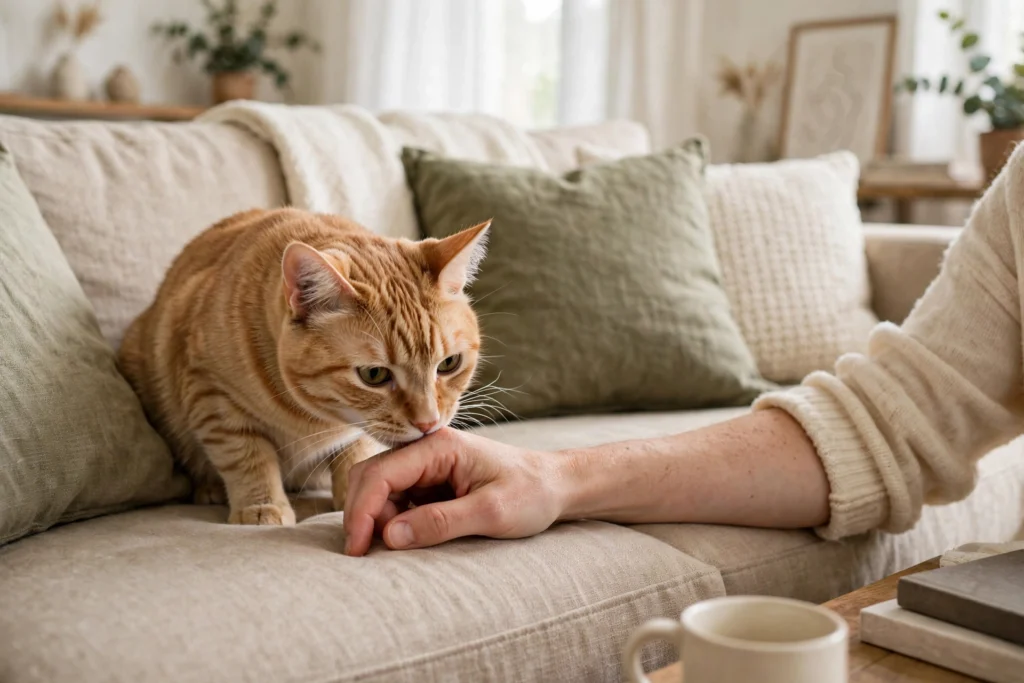

A gentle bite that seems to come out of nowhere is usually a “love bite.” Most of the time it is not aggression at all. Your cat is most likely showing affection, asking for attention, inviting play, or politely saying that petting time is over. The bite is soft, the skin is not broken, and the cat stays relaxed and close to you instead of running away.
That said, a gentle bite can be the first step on a ladder: miss the early warning signs and a soft nibble can turn into a real bite. This guide explains why cats bite gently, how to read the body language that comes first, how to respond, and when biting means a vet visit.
What is a love bite?
A love bite is a soft, controlled nibble a cat gives during a friendly interaction. The teeth touch your skin, sometimes with a little pressure, but they do not puncture it. Cats learn this control as kittens: bite a littermate too hard and the other kitten yelps and play stops. Kittens grow up knowing exactly how much pressure is “play” and how much is “too much.”
Cats also mouth each other during friendly grooming. Two cats licking each other’s fur peacefully often end the session with a small nip. Your cat does the same to you: grooms you, licks your hand, and finishes with a gentle bite. In cat language, you have been included in a social grooming session, and the little bite is part of the routine, not a complaint.
Why does my cat bite me gently?
There is rarely one single reason: the same cat may bite gently for affection in the morning, for play in the afternoon, and for “please stop” in the evening. These are the most common causes.
Affection and bonding
Cats that are strongly bonded to their owners often nibble during quiet, cuddly moments. The cat is relaxed, purring, and kneading, and the bite is slow and soft. Some cats do this while rubbing against you or settling onto your lap. Think of it as the cat version of a squeeze of the hand: a sign of trust, even if a slightly odd one.
Overstimulation while being petted
This is the most common cause of the bite that truly seems to come “out of nowhere.” Your cat is purring on your lap, enjoying being stroked, and then suddenly grabs your hand and bites. What happened? Repetitive stroking builds up sensation, and a spot that felt good thirty seconds ago can become irritating or even uncomfortable. The ASPCA explains that petting-induced biting happens when repeated physical contact quickly becomes unpleasant for the cat, usually after subtle warnings. The belly and the base of the tail trigger it most, because the hair follicles there are especially sensitive.
Play behavior
Hands that move, wiggle, or dart away look like prey to a cat. If your cat is in a playful mood, with wide eyes and a crouched, wiggly posture, a gentle bite on your fingers or toes is part of the hunt sequence: stalk, pounce, grab, bite. Young cats, and cats played with using hands as kittens, do this most. The bite usually comes with bunny kicks or wrapped paws, and the cat lets go quickly.
Asking for attention
Cats are quick learners. If a soft bite reliably makes you look at your cat, talk to her, feed her, or start a game, she will keep using it. A cat that bites your ankle as you walk past, then looks at her empty bowl, is not being naughty. She has found a doorbell that works.
Teething in kittens
Kittens get their full set of baby teeth by about 8 weeks, and between roughly 3 and 6 months those teeth fall out and are replaced by adult teeth. During teething, gums are sore and kittens have a strong urge to chew. Fingers are warm, soft, and always nearby, so they become a favorite teething toy unless you offer something better. Kitten bites are usually gentle, but this is the age to teach that hands are not chew toys.
How can you tell a love bite from a warning bite?
The bite itself is only part of the message; the rest of the body tells you whether your cat is content or close to her limit. Learn this table and the “out of nowhere” bites will look a lot less random.
| Body signal | Relaxed love bite | “Stop now” warning |
|---|---|---|
| Tail | Still, or slowly swaying | Twitching, flicking, or thumping against the floor |
| Ears | Facing forward, normal position | Flattening, or rotating forward and back |
| Skin and back | Loose and still | Rippling or twitching along the back |
| Eyes | Soft gaze, slow blinks | Dilated pupils, hard stare at your hand |
| Body | Loose, leaning into you | Tense, shifting away, or freezing suddenly |
| Sounds | Purring, quiet | Purring stops, low growl, or hissing |
| The bite | Soft mouthing, lets go at once | Quick grab, holds on, may bite harder if you keep going |
The most reliable early warnings are a flicking tail, rippling skin along the back, and your cat suddenly turning her head to watch your hand. The ASPCA lists the same signals for overstimulation, along with body tension, flattened or rotating ears, and dilating pupils. When you see any of them, stop petting before the bite happens, not after.
What should you do when your cat bites you gently?
Your reaction in the first few seconds teaches your cat what biting achieves.
- Freeze, do not yank your hand away. Pulling back triggers the grab-and-hold reflex, and a soft bite can turn into a hard one. Keep your hand still and she will usually let go on her own.
- Stop the interaction. If you were petting, stop. If she is on your lap, stand up slowly and let her slide off, or sit still until she hops down.
- Stay quiet and calm. Shouting, spraying water, or tapping the cat’s nose teaches her that you are unpredictable, which makes future biting worse. The ASPCA notes that physical punishment almost always makes biting problems worse, because the cat becomes fearful or finds contact with you even more unpleasant.
- Redirect to a toy. Once she lets go and settles, offer a wand toy or a kicker toy. The arousal gets a safe target, and she learns what teeth are actually for.
- Do not reward the bite with attention. If biting produces a game, a treat, or a meal, you are training it. Wait until she is calm, then give attention freely.
If a bite ever breaks the skin, wash the wound right away with soap and running water. Cat mouths carry bacteria, and bites that puncture, especially on the hand or a joint, can become infected quickly. Call your doctor the same day for any puncture, sooner if redness or swelling spreads.
How can you reduce gentle biting over time?
You do not need to stop the affection, just adjust the routine around it.
- Keep your hands out of playtime. Never wiggle your fingers for your cat to chase, and never wrestle with your hands. Always use toys. This one habit removes most play biting within a few weeks.
- Pet in shorter sessions. Learn your cat’s limit and stop before you reach it. If she usually gets twitchy after five minutes of stroking, stop at three and leave her wanting more. Most cats prefer the cheeks, chin, and sides of the face over long strokes down the back.
- Let the cat start the interaction. Hold out a finger and let her rub against it. Cats that choose the contact tolerate more of it.
- Give biting and chewing an outlet. Wand toys, kicker sticks, cardboard, and for kittens, soft teething toys all satisfy the urge to bite something.
- Burn off energy with scheduled play. Two or three short, active play sessions a day, especially one before bed, reduce the ambush bites aimed at ankles and feet.
- Reward calm behavior. A small treat or quiet praise when she sits with you without mouthing reinforces the behavior you want.
Be consistent: everyone in the house must follow the same rules, or the cat will learn which person still plays the hand game.
When is gentle biting a sign of pain or illness?
Biting that is new, sudden, or out of character deserves attention. A cat that has always been gentle but starts biting when touched in one spot may be protecting something sore. Arthritis, a hidden injury, a skin problem, or dental pain can all make a cat react to touch that used to be fine. The ASPCA advises ruling out medical causes first whenever petting-related aggression is a new behavior.
Book a vet visit if you notice any of the following:
- A cat that suddenly starts biting, or biting much harder than before
- Biting or flinching when you touch one particular area of the body
- Biting paired with hiding, reduced grooming, or sleeping more than usual
- Appetite changes. A cat in pain often eats less, and if yours has gone off food, read our guide on why a cat won’t eat and call your vet if it lasts more than a day
- Drooling, pawing at the mouth, or bad breath, which can point to dental pain
- Any bite that breaks your skin repeatedly, or biting in an older cat that has never done it before
Your vet will check for pain and illness first, and if she is healthy, may suggest a behavior plan or a referral to a behavior specialist. Do not assume a sudden change is “just attitude”: in cats, behavior is often the first symptom.
Conclusion
A cat that bites you gently out of nowhere is almost always communicating, not misbehaving. The bite may mean “I love you,” “play with me,” “feed me,” or “that is enough petting now.” Read the whole body, especially the tail, ears, and skin, and you will usually see the message coming. Freeze instead of pulling away, stop petting at the first warning signs, keep hands out of playtime, and redirect the energy to toys. If the biting is new, sudden, or paired with other changes, treat it as a possible sign of pain and book a vet visit.
Frequently asked questions
Do love bites mean my cat loves me?
Often, yes. A soft nibble during a relaxed, affectionate moment is a bonding behavior borrowed from social grooming between cats. As long as the body is loose, the ears are forward, and the cat stays with you afterward, it is friendly. The same mouthing paired with a flicking tail or flattened ears means something different: she wants the petting to stop.
Why does my cat bite me gently and then lick me?
Licking and then nibbling is the classic grooming sequence. Cats do it to each other during friendly grooming, and the small nip often comes at the end, almost like punctuation. With you, it means your cat treats you as part of her social group. If the licking becomes intense and the nibble harder, she may be getting overstimulated, so that is a good moment to pause.
Why does my cat bite me when I touch her belly?
Most cats protect their bellies, because in the wild that area is vulnerable. A cat rolling onto her back is showing trust, but it is rarely an invitation to rub her stomach. Touching the belly triggers a grab, bite, and kick reaction in many cats, even affectionate ones. Stick to the head, cheeks, and shoulders unless your cat clearly enjoys belly rubs.
Why does my kitten bite my hands all the time?
Kittens explore the world with their mouths, and teething makes the urge to chew even stronger. Hand biting at this age is play and teething, not aggression, but it sets a lifelong habit if you let it continue. Keep toys within reach, swap your fingers for a teething toy every time, and end the game calmly if she gets too excited. An adult cat that learned hands are toys is much harder to retrain.
Should I punish my cat for biting me?
No. Punishment, including shouting, spraying with water, or tapping the nose, does not teach a cat what you want. It teaches her that you are scary, or that contact with you ends badly, and both lessons make biting more likely, not less. Stopping the interaction, giving space, and redirecting to toys works far better.
Can a gentle cat bite be dangerous?
A bite that does not break the skin is harmless. The risk starts when teeth puncture skin, because cat bites can push bacteria deep into tissue, especially in hands and joints. Wash any puncture thoroughly with soap and water, and contact your doctor the same day, even if it looks minor. Do the same sooner if the area becomes red, swollen, stiff, or painful.